Bitcoin Hashrate Regains 1 ZH/s Despite Miners’ Shift to AI
Bitcoin’s computing power is recovering even as major public miners redirect infrastructure toward artificial intelligence, keeping competitive pressure on operators that remain focused on mining.
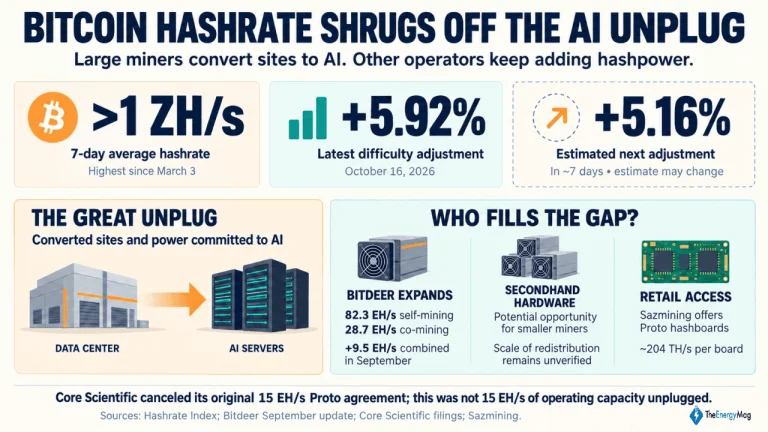
Bitcoin’s seven-day average hashrate has recovered to 1 zettahash per second despite major public mining companies redirecting infrastructure toward artificial intelligence, according to BlocksBridge Consulting’s Miner Weekly. The rebound suggests those corporate departures have not delivered an enduring reduction in competition for miners that remain.
The average, equivalent to 1,000 exahashes per second, reached its highest level since March 3, the newsletter reported. Hashrate measures the computational power directed at mining Bitcoin, rather than the number of companies operating on the network. A retreat by prominent operators therefore does not necessarily translate into a smaller network.
Mining difficulty is also rising. Miner Weekly reported a 5.92% increase on October 16 and projected another increase of approximately 5.16% at the following adjustment, based on block production at the time. That second figure remains an estimate, not a confirmed outcome.
The distinction matters for operators expecting relief from competitors’ AI conversions. Difficulty adjusts how demanding it is to mine blocks, so an increase intensifies competition for a given amount of computing power. A corporate shift away from mining offers limited relief if other operators replace the departing capacity.
Earlier reporting from the newsletter estimated that public miners had shed 75 EH/s of realized hashrate while directly reported AI and high-performance computing revenue increased 52% quarter over quarter. It valued the displaced computing capacity at roughly $1.5 billion in equivalent hardware investment, using an assumed acquisition cost of $20 per terahash. That calculation was not a resale valuation.
Bitdeer provides one example of continued expansion. Its September figures, cited by Miner Weekly, showed self-mining capacity rising to 82.3 EH/s from 79.9 EH/s in August. Its co-mining capacity, involving company-owned machines at third-party facilities, increased to 28.7 EH/s from 21.6 EH/s.
Equipment resale offers another possible route for capacity to return. The newsletter identified Sazmining listings for used Antminer S21 XP machines hosted in Paraguay and Texas. Those listings demonstrate an available resale channel, but do not establish the machines’ previous owners or the scale of purchases by smaller operators.
The economics of a mining facility and its equipment can diverge. Converting a site for AI can remove that location from Bitcoin production, while its mining machines remain usable elsewhere. Whether redeployment makes commercial sense depends on electricity costs, equipment prices and available hosting space.
The evidence therefore supports a narrower conclusion than a wholesale reversal of the AI migration. Network computing power is recovering, but the newsletter does not provide a complete accounting of which operators supplied every increment. Used-equipment availability is a plausible contributor, not a quantified explanation.
The next difficulty adjustment will help show whether the recent pace of block production persists. Miner Weekly’s outlook points to renewed competitive pressure rather than automatic relief for remaining miners, while acknowledging that its projected increase will change as more blocks arrive.
Primary source: Bitcoin.com News. Newzly rewrites and structures source reporting for clarity; verify critical details at the original.