Elon Musk Is a 'Real Genius', Putin Says After Satellite Talks With SpaceX Boss
Russian President Vladimir Putin heaped praise on the SpaceX founder, calling him a 'real genius', and confirmed the two are in 'close contact' over orbital coordination as Russia races to build its own Starlink rival.
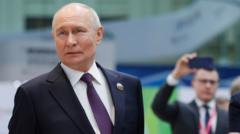
Russian President Vladimir Putin publicly described Elon Musk as a "real genius" on Tuesday, October 28, while delivering remarks at the Russia-Africa summit, adding that Moscow maintains close contact with the SpaceX founder to avoid conflicts in orbit. The comments represent one of the most direct and effusive endorsements Putin has offered any Western business figure since Russia's full-scale invasion of Ukraine in 2022.
The praise came as Putin received a briefing from Russia's Digital Development and Communications Minister Maksut Shadayev on the country's efforts to build its own satellite internet system, known as Rassvet. Russia has launched more than 30 satellites under the programme — a figure that underscores how far Moscow lags behind SpaceX's Starlink network, which operates approximately 10,000 low-orbit satellites according to Orbital Radar tracking data.
Putin acknowledged the gap openly. "We are only taking our first steps," he said, while framing Musk's achievement in expansive terms and comparing his ambition to that of Sergei Korolev, the celebrated Soviet rocket engineer who led the USSR's early space programme. The comparison was notable given the Cold War symbolism attached to Korolev's legacy inside Russia.
The Russian president indicated that coordination with Musk covers practical orbital traffic management — preventing satellites from different operators interfering with one another as congestion in low-Earth orbit grows. "Both we and our American partners value this mutual respect," Putin said, according to reports citing the summit remarks.
The relationship between Musk and Russia carries acute geopolitical weight. Starlink has been a cornerstone of Ukraine's wartime communications infrastructure, providing battlefield connectivity for troops and enabling the drone operations that have repeatedly struck deep inside Russian territory. Ukraine's military, along with its intelligence services, has relied on both the civilian Starlink service and its military variant, Starshield, throughout the conflict.
Tensions over that reliance surfaced sharply in recent weeks after SpaceX throttled Starlink connection speeds available to Ukraine, a move that Ukrainian officials said hampered their ability to intercept Russian drones. Musk stated publicly that Ukrainian forces had been using the civilian commercial service for offensive drone strikes in violation of SpaceX's terms of service. Service was subsequently reported to have been partially restored following intervention by US President Donald Trump.
The episode illustrated how Musk's control of a critical wartime communications network has placed him at the centre of the conflict's diplomatic and military dynamics — a position that gives his contacts with the Kremlin added sensitivity. Putin's warm characterisation of those contacts is likely to intensify scrutiny in Kyiv and among European allies already concerned about Washington's shifting posture toward Russia.
In a separate but related security incident, Bulgarian authorities arrested two 19-year-old German nationals suspected of setting fire to Starlink antennas near Sofia. Bulgaria's Interior Minister Ivan Demerdzhiev confirmed the arrests; investigators are examining possible links to foreign influence operations, though no formal charges had been announced at the time of reporting.
Russia's Rassvet programme faces considerable technical and financial hurdles before it could serve as a meaningful alternative to Starlink, analysts have noted. Western sanctions have restricted Moscow's access to advanced semiconductor components essential for satellite manufacturing, and the 30 satellites currently in orbit represent a fraction of the minimum constellation size needed to provide continuous broadband coverage across Russian territory.
For now, Putin's public admiration for Musk signals that Moscow views the entrepreneur as a pragmatic interlocutor — one whose commercial decisions can directly shape the battlefield. Whether that framing reflects genuine coordination or a strategic attempt to drive a wedge between Musk and Ukraine's supporters remains, for the moment, an open question.
Primary source: BBC Technology. Newzly rewrites and structures source reporting for clarity; verify critical details at the original.