European Space Agency Probe Returns to Asteroid Site of NASA Planetary Defense Test
A European Space Agency probe is journeying to inspect the asteroid site where NASA previously tested planetary defense technologies, seeking vital data on how space rocks respond to deliberate deflection efforts.
In this piece
Years after NASA tested systems to deter hazardous space rocks, a European Space Agency probe is returning to examine the target asteroid system. The follow-up…
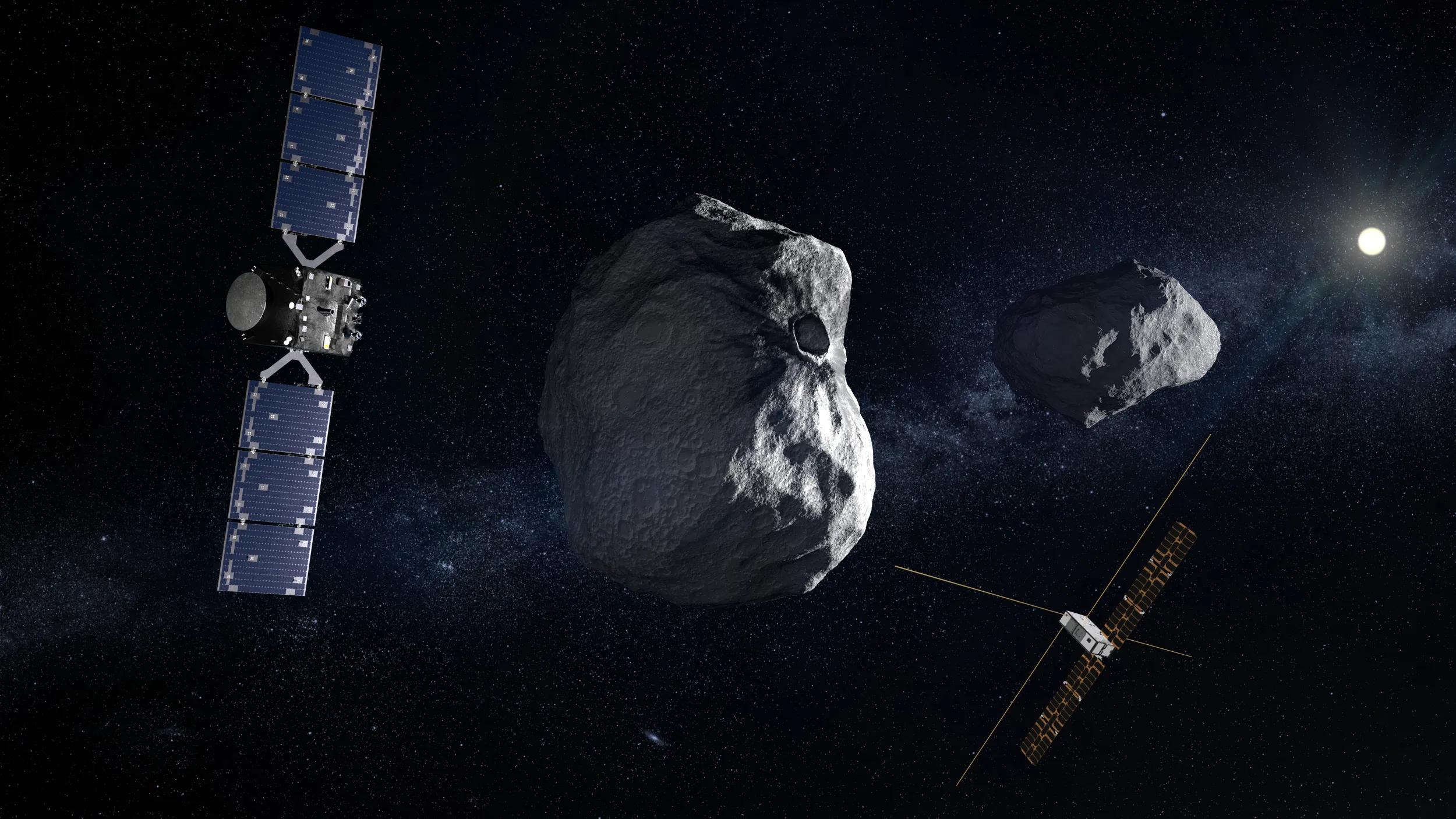
A spacecraft developed by the European Space Agency is traveling back to the distant asteroid system where NASA previously tested planetary defense technologies designed to protect Earth from hazardous space rocks. The follow-up mission marks an important scientific step in evaluating how celestial bodies respond when deliberately targeted by deflection hardware. By revisiting the impact zone, researchers hope to gather detailed observations that were impossible to collect during the initial demonstration.
Several years ago, NASA conducted a landmark planetary defense test aimed at determining whether human technology could alter the trajectory of a potentially dangerous asteroid. The American space agency directed a spacecraft to collide with a target space rock to test the concept of kinetic deflection. While initial tracking confirmed that the collision influenced the asteroid, many precise details regarding the physical consequences of the impact could not be fully analyzed from afar.
Following the original test, ground-based observatories and space telescopes monitored the asteroid system from great distances to measure changes in its movement. Although those remote observations provided critical preliminary data showing that the asteroid shifted, distant instruments faced natural limitations in resolving fine surface features. Scientists acknowledged that fully understanding the structural alterations would require sending an instrumented probe directly back to the site.
Now, the European Space Agency has dispatched its own probe to conduct that comprehensive investigation. The spacecraft is tasked with surveying the target asteroids up close, mapping the environment, and documenting the aftermath of NASA's collision. By examining the site directly, the mission aims to transform an experimental demonstration into a thoroughly documented scientific case study.
During its close-up inspection, the European probe will focus on analyzing the physical damage caused by the earlier deflection experiment. Investigators are particularly keen to examine the size, depth, and structure of any crater left behind on the asteroid's surface. In addition, the mission seeks to assess how the impact affected the internal composition, mass distribution, and structural integrity of the target rock.
Understanding these physical properties is essential for validating planetary defense as a viable safeguard for Earth. Planetary defense models depend heavily on knowing whether a kinetic impact simply moves an asteroid or fractures it into multiple hazardous fragments. Direct data from the European Space Agency probe will provide empirical evidence needed to calibrate computer simulations and improve predictions for future deflection attempts.
The mission also underscores the growing importance of international cooperation in space exploration and global planetary security. While NASA led the initial deflection test, the European Space Agency is providing the critical follow-up analysis needed to evaluate the broader implications. Space agencies worldwide recognize that defending the planet from potential cosmic threats requires coordinated efforts and shared scientific expertise across international borders.
Researchers caution that operating around an asteroid system carries substantial technical uncertainties. Navigation near small, irregular bodies with weak gravitational fields presents significant operational hurdles for any spacecraft. The probe must carefully maneuver through the debris and dust that may still linger around the system while maintaining stable orbital positioning to capture high-resolution imagery and scientific measurements.
As the European Space Agency probe completes its approach and begins its survey, scientists anticipate a steady flow of detailed imagery and telemetry from the asteroid system. The resulting data will be analyzed over the coming years to determine the full extent of the momentum transferred during NASA's test. If successful, the combined findings from both agencies will help establish a proven framework for deflecting dangerous space rocks should an Earth-threatening object ever be detected.
Primary source: Wired. Newzly rewrites and structures source reporting for clarity; verify critical details at the original.