NASA’s Voyager 1 Is Now So Distant That Light Takes 24 Hours to Reach Earth
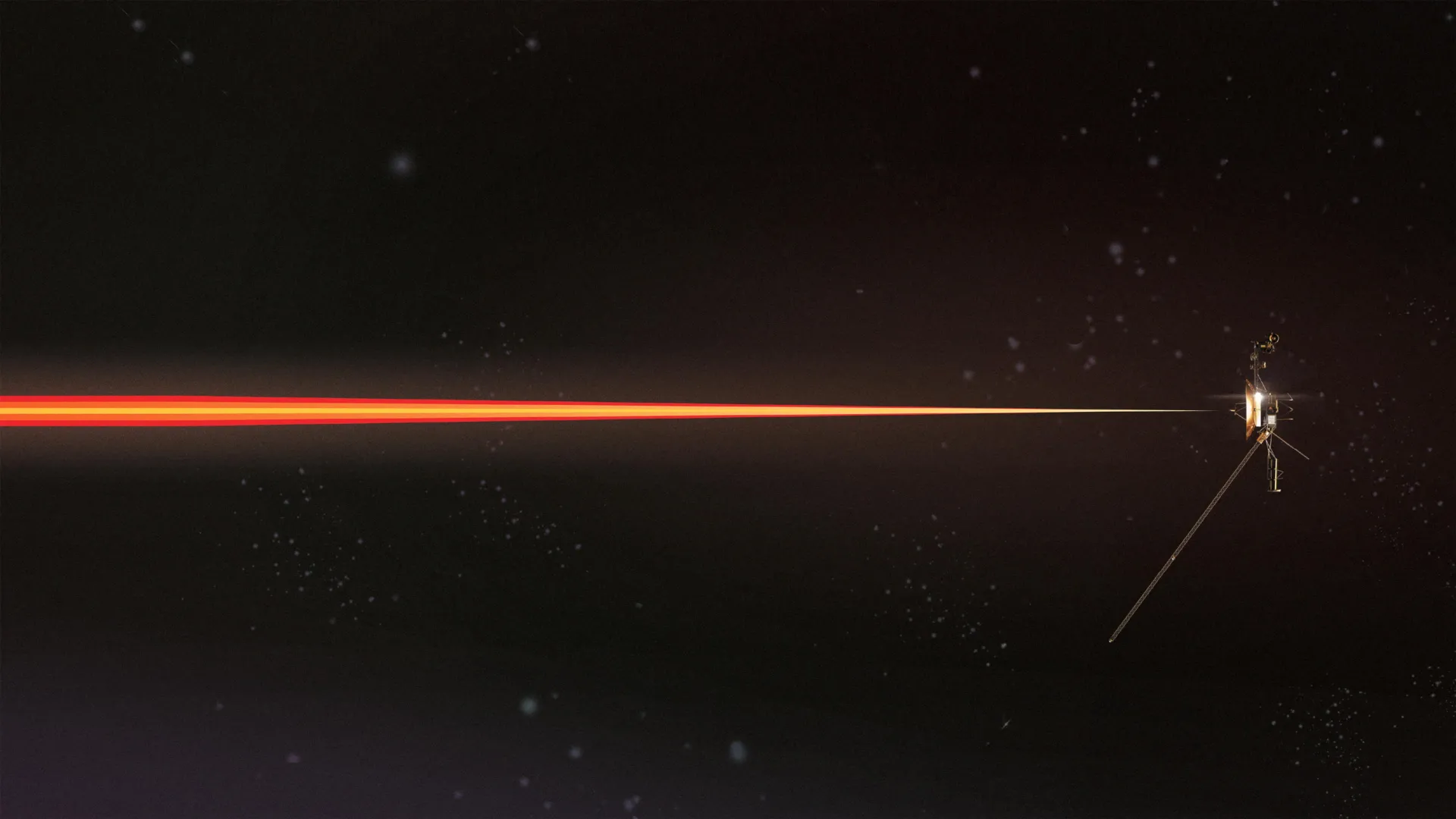
NASA’s Voyager 1 spacecraft has crossed an unprecedented milestone in deep space, reaching 16.1 billion miles from Earth—a distance so immense that signals now require a full day to complete a one-way trip.
In this piece
NASA’s Voyager 1 has reached a historic distance of 16.1 billion miles from Earth, marking the first time radio signals take an entire day to bridge the gap.…
NASA’s Voyager 1 spacecraft has crossed another unprecedented threshold in cosmic exploration, reaching a distance of 16.1 billion miles from Earth. At this monumental range, radio signals traveling at the speed of light now take a full 24 hours to complete a one-way transit between the probe and mission controllers.
The achievement marks the first time any human-made object has ventured so far that an entire day is required for a signal to arrive. Consequently, any operational command sent to the spacecraft now demands a 48-hour round-trip interval before engineers can observe the outcome on Earth.
Launched nearly 50 years ago, Voyager 1 was originally designed for a four-year primary mission focused on conducting close-up studies of Jupiter and Saturn. After completing those planetary flybys and revealing unexpected atmospheric and geological details, the probe continued outward toward the edge of the solar system, eventually crossing into interstellar space.
The spacecraft has spent more than a decade traversing this uncharted cosmic medium, gathering unique measurements of the particles, magnetic fields, and cosmic rays that lie beyond the sun's heliosphere. Its instruments have provided astrophysicists with direct empirical observations of an environment that had previously only been studied through theoretical models.
Maintaining communication across 16.1 billion miles requires the specialized infrastructure of NASA’s Deep Space Network, which uses massive ground-based radio antenna dishes positioned around the globe. Even with these powerful receiving facilities, the signals captured from the probe are extraordinarily faint, having attenuated drastically across billions of miles of vacuum.
Operating a robotic explorer five decades into its journey has presented escalating engineering hurdles. Voyager 1 relies on a radioisotope thermoelectric generator, a power system that produces steadily less electricity each year as its plutonium fuel naturally decays. This gradual power loss forces flight teams to make difficult trade-offs regarding which components can stay energized.
To conserve the remaining electrical output, flight engineers have systematically turned off non-essential heaters and secondary systems over the years. These power-saving measures are designed to preserve energy for the scientific instruments that remain operational and capable of returning usable interstellar data.
The mission has also confronted occasional technical setbacks, including computer memory corruptions and propellant line issues that have tested ground teams. Each anomaly requires meticulous troubleshooting under the extended transmission delay, turning routine diagnostic checks into complex multi-day operations. Specialists must carefully verify every instruction before uplink to prevent unintended disruptions to the aging craft.
Despite these compounding obstacles, the probe remains one of humanity's most durable and historic scientific endeavors. Every additional day of operation provides fresh insights into the outer boundary of our solar neighborhood and tests the absolute limits of deep-space engineering and communication.
As Voyager 1 travels deeper into the interstellar void, mission managers anticipate that dwindling power reserves will eventually drop below the threshold needed to run scientific hardware. Until that final operational sunset arrives, the venerable spacecraft continues to pioneer the frontier of human exploration a full light-day away from home.
Primary source: ScienceDaily. Newzly rewrites and structures source reporting for clarity; verify critical details at the original.