NASA Highlights Voyager 2’s Iconic Crescent View of Neptune
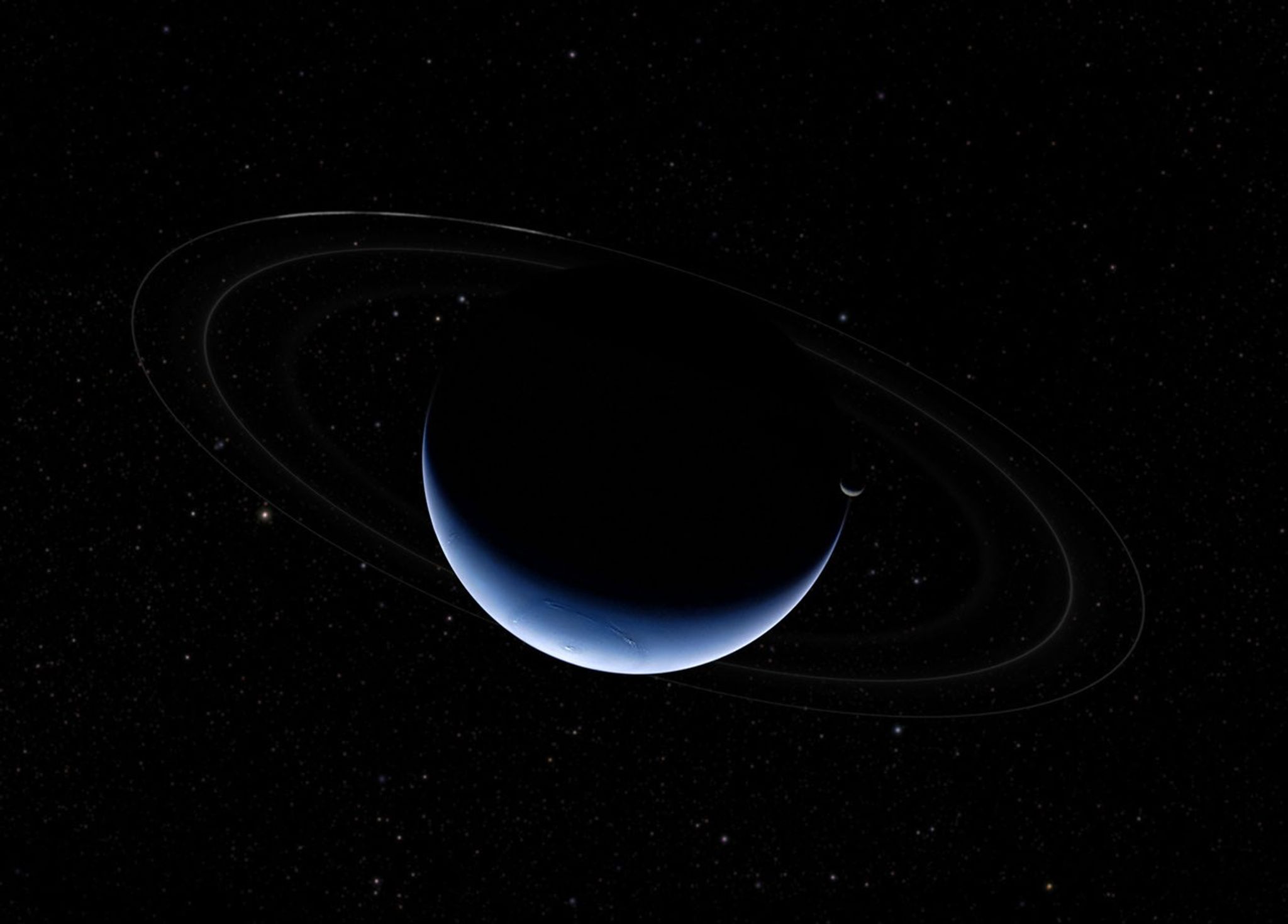
NASA’s Astronomy Picture of the Day revisited Voyager 2’s historic 1989 flyby of Neptune, featuring an outbound composite showing the crescent ice giant, its moon Triton, and faint rings.
In this piece
NASA highlighted a composite image from Voyager 2's historic 1989 flyby of Neptune as its Astronomy Picture of the Day. The portrait captures Neptune and its…
NASA's Astronomy Picture of the Day spotlighted a remarkable vista of Neptune on November 21, showcasing a composite view captured by the Voyager 2 spacecraft during its historic encounter with the distant world. The featured presentation highlights the ice giant alongside its primary moon, Triton, seen from an outbound vantage point looking back toward the inner solar system.
Recorded around the time of the robotic probe's closest approach on August 25, 1989, and over the days that followed, the scene presents both Neptune and Triton as slender sunlit crescents against the blackness of deep space. Because the perspective looks back toward the Sun, the illuminated planetary limbs reveal delicate atmospheric layers that are invisible from standard Earth-facing telescopic orientations.
Voyager 2’s imagery documented intricate dynamic phenomena across the planet’s atmosphere, including bright cirrus clouds floating high above the deeper azure cloud deck. A dark atmospheric band circles Neptune’s south polar region, accompanied by a prominent cloudy vortex situated directly over the pole itself.
The composite also incorporates Neptune’s tenuous ring system, depicting the faint ring tracks and distinct bright ring arcs that Voyager discovered during its flyby. In the background, a starfield spanning roughly 7.5 degrees was compiled from astronomical sky survey data centered on the constellation Camelopardalis, accurately matching the probe's outbound line of sight.
Voyager 2 launched from Cape Canaveral in 1977 as part of a grand tour of the outer planets, utilizing rare planetary alignments to swing past Jupiter, Saturn, Uranus, and ultimately Neptune. Its rendezvous with Neptune in late August 1989 marked the climax of the primary planetary mission, providing humanity with its first close-up measurements, photographs, and magnetic surveys of the eighth planet.
More than three decades later, Voyager 2 remains the only spacecraft ever to visit the outermost major planet in the solar system. The flyby radically reshaped scientific understanding of Neptune, uncovering active atmospheric storms such as the Great Dark Spot, discovering new moons, and identifying geyser activity on Triton.
The enduring significance of the Voyager encounter stems partly from the lingering scarcity of in situ data from the ice giants. Planetary scientists still rely heavily on modern re-analyses and reprocessing of Voyager 2’s archival observations to calibrate observations made by contemporary space observatories and terrestrial telescopes.
The lack of a follow-up orbiter has left many questions about Neptune's magnetosphere, deep interior, dynamic atmosphere, and unique satellite system unresolved. Space agencies including NASA have considered dedicated flagship missions to the ice giants, but any such venture would require decades of development and transit across billions of miles.
Meanwhile, Voyager 2 itself has long since departed the planetary frontier, crossing the heliopause into interstellar space where it continues transmitting telemetry back to Earth. The newly highlighted portrait serves as a poignant reminder of an epochal planetary encounter that remains humanity’s singular close inspection of the solar system’s outermost giant.
Primary source: NASA Breaking News. Newzly rewrites and structures source reporting for clarity; verify critical details at the original.