First Green Star Discovered as Dead White Dwarf Absorbs Warm Light
NASA has highlighted WD J1330+6435, a dead white dwarf star whose destruction of surrounding rocky planets created an exotic chemical atmosphere that emits the universe's first confirmed green stellar glow.
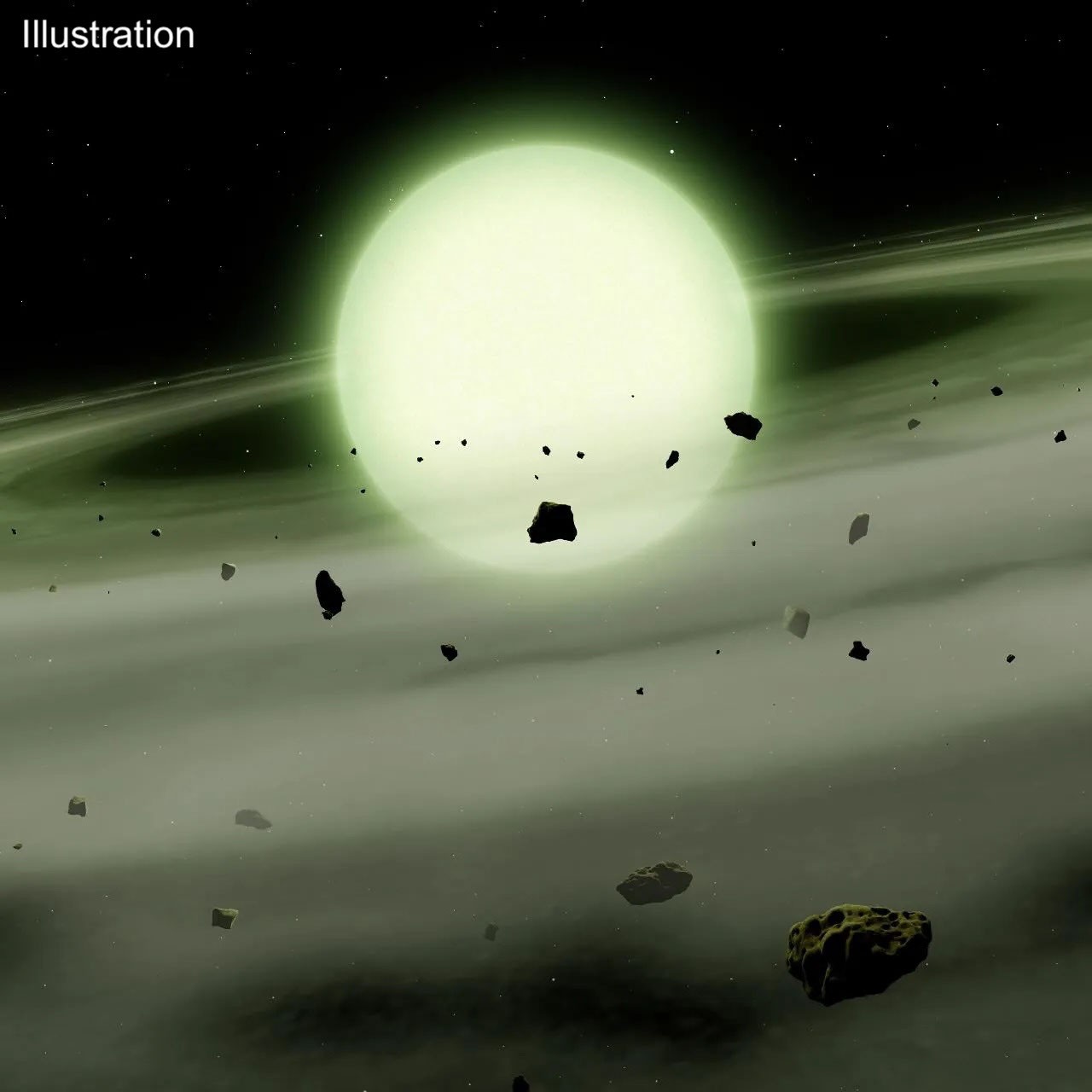
Astronomers have identified the first known green-appearing star in the cosmos, a dying stellar core designated WD J1330+6435 located approximately 280 light-years from Earth. Featured on NASA's Astronomy Picture of the Day, the remarkable white dwarf in the northern constellation Draco challenges long-standing astronomical assumptions about the visible colors of stars.
For centuries, stargazers and astrophysicists have noted that stars span shades of blue, white, yellow, orange, and red, but never green. Because ordinary stars radiate light as blackbody emitters, an object hot enough to radiate peak green light also emits substantial amounts of blue and red wavelengths, blending into white light to human vision.
WD J1330+6435 is a cool white dwarf with an effective surface temperature of roughly 4,300 Kelvin, or about 4,000 degrees Celsius. Unlike living main-sequence stars fueled by nuclear fusion, white dwarfs are dense remnants left behind after medium-mass stars exhaust their core fuel and shed their outer envelopes.
The unique hue of this particular stellar ember is driven by heavy atmospheric pollution caused by the gravitational destruction of its own planetary system. Over eons, rocky debris including pulverized asteroids and exoplanetary crusts plunged into the white dwarf's outer envelope, infusing it with heavy elements such as lithium, calcium, and sodium.
Under the crushing surface gravity and high atmospheric pressures of the helium-dominated white dwarf, these trace elements behave in unexpected ways. Collisions between dense helium and sodium atoms dramatically broaden the sodium absorption lines, carving out massive swaths of the yellow, orange, and red spectrum.
By stripping away the warmer wavelengths that would normally dominate a cool star's emission, the altered spectrum leaves behind a distinct chartreuse-green glow. Human eyes observing the star directly through a telescope would register an unmistakably green point of light rather than the typical reddish-orange glow of a cool stellar remnant.
The discovery stems from research led by Dr. Mark Hollands and his team at the University of Warwick, published in the journal RAS Techniques and Instruments. By modeling the perceived visual colors of more than 150 nearby white dwarfs, the team revealed that chemical contamination can produce a startling palette of unconventional stellar shades, including magenta and cyan.
Beyond its visual novelty, the discovery provides an invaluable probe into the chemical composition of alien solar systems that have met their demise. Because the heavy elements in the white dwarf's atmosphere sink toward the interior over time, their presence indicates recent or ongoing accretion of shattered rocky worlds.
Astronomers plan to deploy ground-based observatories and space telescopes to conduct deeper spectroscopic surveys of polluted white dwarfs across the Milky Way. Researchers anticipate that cataloging these chemically altered dead stars will yield further insights into the geophysics of destroyed planetary systems and the ultimate fate of our own planetary neighborhood.
Primary source: NASA Breaking News. Newzly rewrites and structures source reporting for clarity; verify critical details at the original.