NASA's Hubble Charts Path for Roman Space Telescope Using Gravitational Lenses
The Hubble Space Telescope has captured a series of gravitational lensing observations to establish target baselines and observational frameworks ahead of the Nancy Grace Roman Space Telescope's upcoming wide-field cosmic surveys.
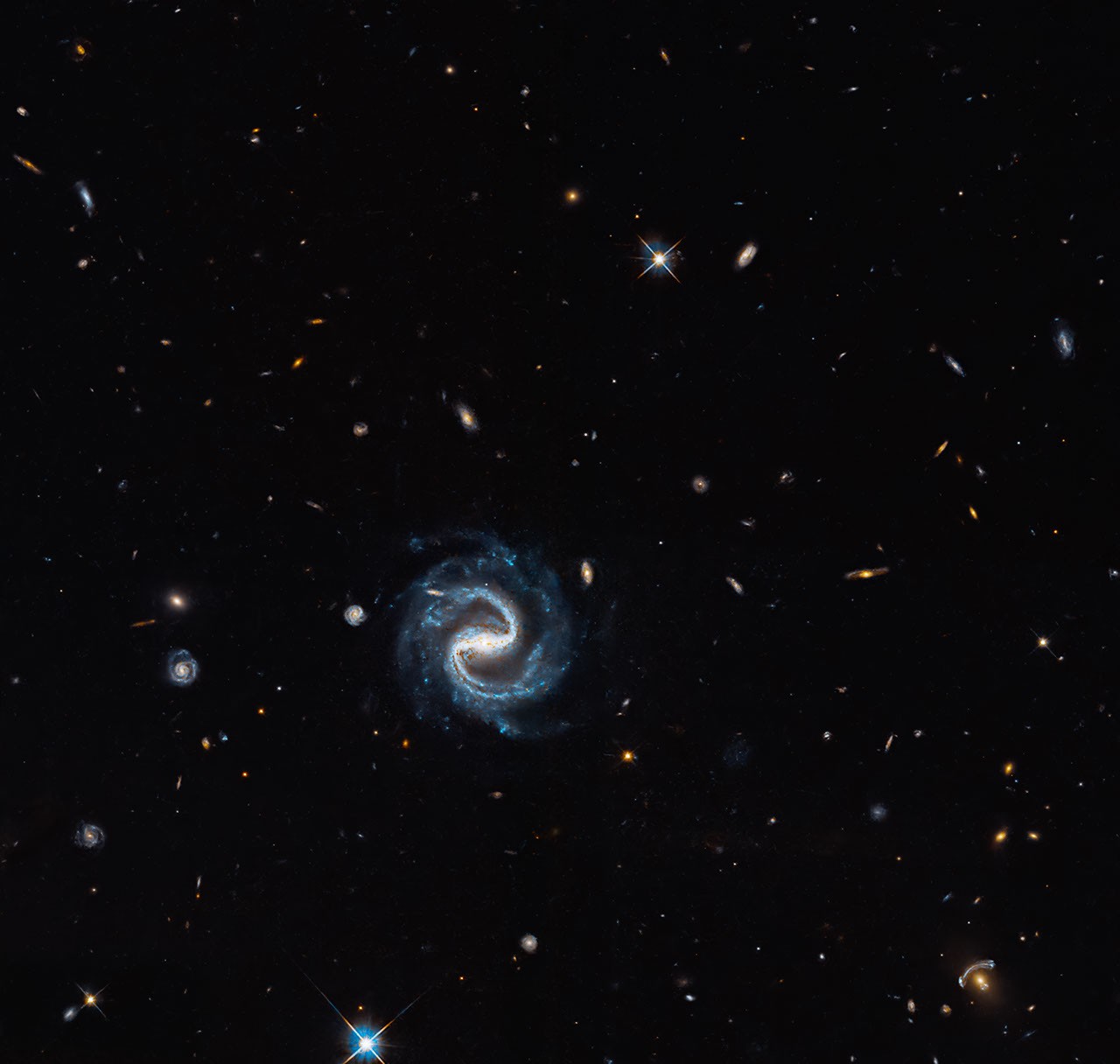
The Hubble Space Telescope has completed a series of gravitational lensing observations designed to lay the scientific groundwork for NASA's next-generation observatory, the Nancy Grace Roman Space Telescope. The latest imagery highlights how massive foreground galaxies bend and magnify the light of more distant objects, creating natural cosmic magnifying glasses. These targeted observations serve as initial benchmarks for evaluating complex lensing systems before Roman begins its own wide-angle observations.
Gravitational lensing occurs when an immense concentration of mass, such as a massive galaxy or an entire galaxy cluster, warps the fabric of spacetime around it. As light from a background galaxy travels past this warped region, its path bends, stretching the distant object into luminous arcs, rings, or multiple distinct images. Hubble has spent decades documenting these intricate optical illusions, providing astronomers with unique glimpses into deep space that would otherwise remain far too faint to detect.
In the newly featured observation, Hubble resolved a foreground elliptical galaxy acting as the gravitational lens, curving the light of an aligned background system into vivid blue arcs. The wide exposure also captured a nearby barred spiral galaxy sharing the field of view, presenting a diverse snapshot of galactic morphology. Such observations demonstrate how fine structural details within lensed arcs can be isolated and measured with high-resolution space instruments.
NASA is using these targeted Hubble studies to prepare scientific pipelines and analysis models for the Nancy Grace Roman Space Telescope. Scheduled to join NASA's fleet of astrophysics missions, Roman will build upon Hubble's long legacy of spaceborne astronomy. While Hubble targets relatively narrow patches of the sky with extraordinary precision, Roman is engineered to capture expansive panoramic surveys of the universe in infrared light.
The primary technological advantage of the Roman Space Telescope lies in its wide-field infrared camera, which boasts a field of view roughly one hundred times larger than Hubble's infrared instrument. While Hubble requires hundreds of individual pointings to mosaic large cosmic structures, Roman can capture equivalent areas of the sky in single snapshots. This dramatic expansion in coverage is expected to transform gravitational lensing from a painstaking, object-by-object specialty into a statistical powerhouse.
Over its more than three decades of operations, Hubble has discovered and analyzed hundreds of gravitational lenses across various sky surveys. By contrast, Roman's broad infrared surveys across high galactic latitudes are projected to uncover tens of thousands of lensed galaxies and quasars. Establishing rigorous observational baselines with Hubble ensures that researchers can calibrate automated detection algorithms to identify and catalog these rare systems across Roman's enormous datasets.
The science enabled by these lensing systems addresses fundamental questions about the composition and evolution of the universe. Because the degree of light bending depends directly on total mass, gravitational lenses allow astrophysicists to map invisible dark matter distributions within lensing galaxies and clusters. Combining these mass measurements with Roman's wide-field surveys will also yield critical constraints on dark energy, the mysterious force accelerating the cosmic expansion rate.
Hubble's high-resolution capabilities across ultraviolet and optical wavelengths complement Roman's optimized near-infrared sensitivity. By cross-referencing Hubble's existing multi-wavelength archive with Roman's future broad surveys, astronomers can reconstruct the physical properties of distant, magnified galaxies in unprecedented detail. This multi-observatory approach enables researchers to verify complex lens modeling techniques and refine magnification estimates across diverse cosmic epochs.
As NASA continues preparations for Roman's launch, Hubble will maintain its role in identifying and characterizing key lensing candidates to refine upcoming survey strategies. Teams at the Space Telescope Science Institute and partner institutions are continuing to develop analysis frameworks tailored to Roman's forthcoming data deluge. These foundational observations ensure that when Roman begins operational surveys, astronomers will be fully equipped to unlock the structural secrets of the distant universe.
Primary source: NASA Breaking News. Newzly rewrites and structures source reporting for clarity; verify critical details at the original.