Hubble Captures Edge-On View of Spiral Galaxy NGC 1827
A newly released Hubble Space Telescope image reveals the edge-on spiral galaxy NGC 1827 in vivid detail, offering researchers an essential cross-sectional look at galactic dust, star formation, and satellite systems.
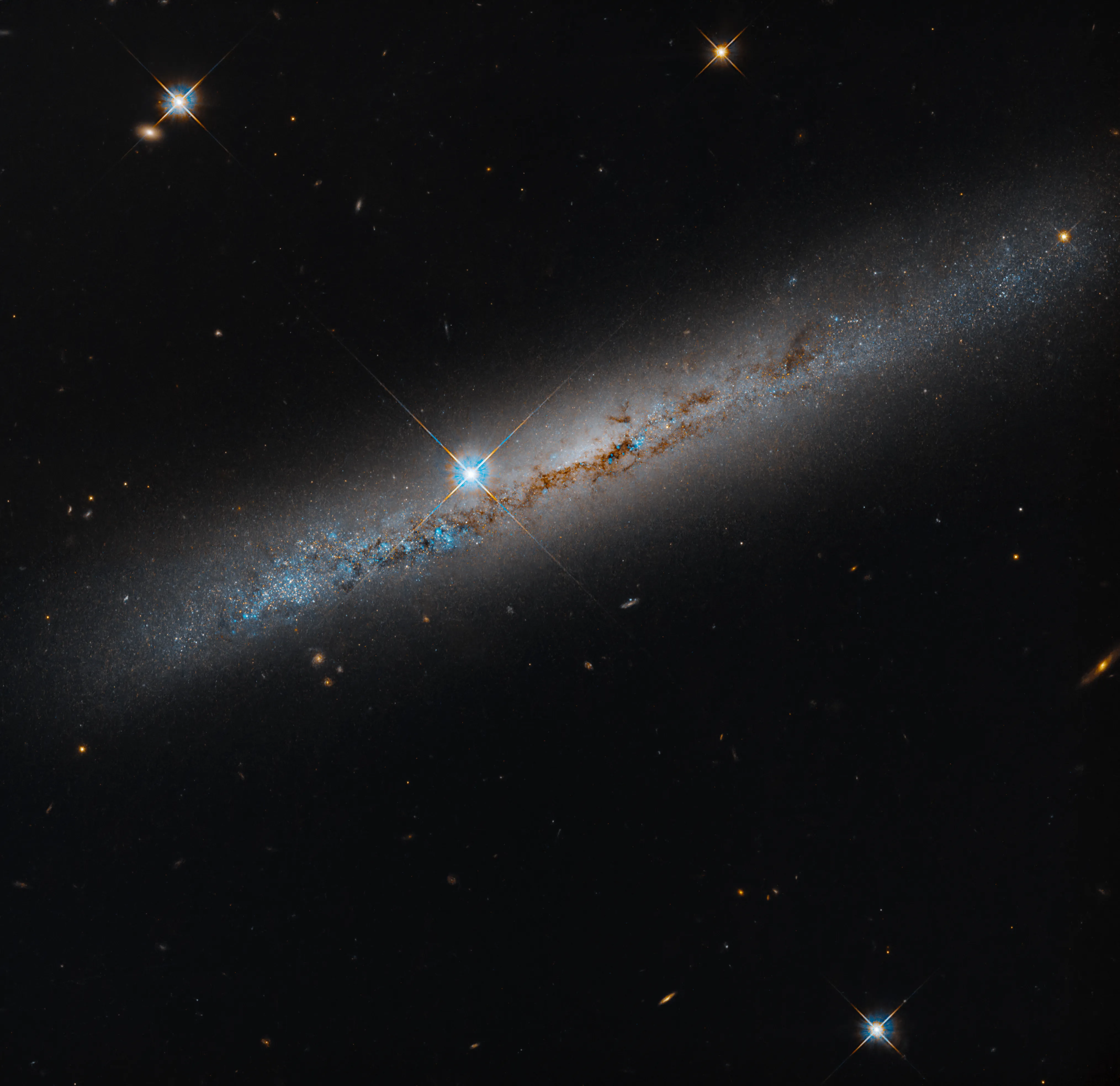
The NASA/ESA Hubble Space Telescope has captured a detailed edge-on portrait of NGC 1827, an intermediate spiral galaxy located roughly 37 million light-years from Earth in the constellation Columba, the Dove. The newly released image offers astronomers a direct cross-sectional look at the stellar system, which appears as a slender ribbon of light tilted side-on to Earth's perspective. Prominent dust lanes and vibrant pockets of star formation are visible along the full length of the galactic plane.
Because the galaxy is oriented nearly edge-on relative to Earth, its spiral arms are obscured from direct overhead view, blending into a flattened disk bisected by dense ribbons of interstellar dust. A brilliant foreground star belonging to our own Milky Way galaxy shines brightly near the frame, distinguished by the sharp four-pointed diffraction spikes characteristic of Hubble's optical design. The glowing central bulge of NGC 1827 radiates warmly behind the silhouetted dust clouds, highlighting the structural layers of an intermediate spiral system.
Hubble gathered the data using its Advanced Camera for Surveys as part of an ambitious observational campaign dedicated to studying low-mass satellite galaxies. The wider survey targets 260 satellite galaxies distributed around 22 Milky Way-like host galaxies located within approximately 32 million light-years of Earth. By compiling uniform observations across these neighboring systems, researchers are assembling an extensive inventory of dwarf and satellite structures in the local universe.
The newly published view of NGC 1827 represents one installment in this broader multi-target initiative. Mission records indicate that Hubble has already documented 111 of the 260 planned satellite candidates within the survey sample. The remaining targets are scheduled to be observed during subsequent orbital windows as telescope time and pointing constraints allow.
Satellite galaxies play an essential role in testing prevailing cosmological theories, particularly models that describe how dark matter governs the assembly of cosmic structures. On large cosmic scales, standard cold dark matter models reliably reproduce the distribution of massive galaxy clusters and cosmic filaments. However, these models encounter persistent discrepancies on smaller scales, where simulations often predict substantially more satellite companions than astronomers detect around isolated spiral galaxies.
Investigating systems like NGC 1827 in high resolution helps astrophysicists address these small-scale cosmological puzzles. Detailed images enable scientists to measure stellar populations, trace ongoing star-forming activity, and evaluate how tidal interactions with nearby host galaxies alter satellite morphologies. Reconciling the observed properties of satellite systems with theoretical simulations is critical for understanding whether the missing satellites are genuinely absent or merely too faint and diffuse to detect easily.
The edge-on orientation of NGC 1827 provides specific diagnostic advantages for galactic dynamics researchers. Viewing a galaxy from the side makes it possible to determine the vertical scale height of its stellar disk and trace how gas and dust are distributed above and below the midplane. These profiles deliver crucial constraints on galactic evolution, demonstrating how stellar winds and supernova feedback circulate enriched materials throughout the circumgalactic medium.
More than three decades into its operational life, the Hubble Space Telescope continues to execute precision surveys that complement data from newer facilities such as the James Webb Space Telescope. Hubble's ultraviolet and optical imaging capabilities remain uniquely suited for discerning blue stellar clusters and intricate dust structures in nearby galaxies. Observations from the satellite survey demonstrate the observatory's enduring capacity to supply high-value data for foundational astrophysical research.
As the survey continues through upcoming orbits, astronomers will integrate the Hubble imaging of NGC 1827 and its sister satellite targets into broader statistical analyses. These data will be combined with ground-based spectroscopy and multi-wavelength surveys to refine models of galactic halo dynamics. The completed census will offer researchers a clearer benchmark for evaluating how satellite galaxies evolve within the gravitational influence of Milky Way analogs across cosmic time.
Primary source: NASA Breaking News. Newzly rewrites and structures source reporting for clarity; verify critical details at the original.