Fossil Footprints in Brazil Reveal Cougar-Sized Mammal Coexisted With Dinosaurs
Fossilized footprints found in Brazil show a cougar-sized mammal walked alongside dinosaurs, challenging the long-held belief that early mammals were exclusively tiny creatures hiding in the shadows.
In this piece
Fossilized tracks preserved in Brazil's Botucatu Formation indicate a cougar-sized mammal lived alongside dinosaurs during the Mesozoic Era. The discovery…
Fossilized footprints preserved in ancient Brazilian sandstone indicate that a mammal roughly the size of a modern cougar roamed alongside dinosaurs during the Mesozoic Era. The tracks, documented from the Botucatu Formation in southeastern Brazil, reveal an animal far larger than the tiny, shrew-like beasts long thought to have comprised nearly all early mammalian life.
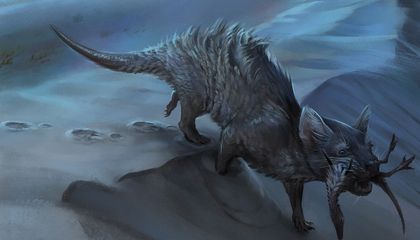
The fossil trackway displays the distinctive paw prints of a quadrupedal mammal, estimated to have stretched around five feet long. Paleontologists analyzing the impressions determined that the creature was comparable in mass and build to a mountain lion, an unprecedented scale for mammals known from that specific geological setting.
The impressions were set into what was once an expansive desert dune system during the transition between the Late Jurassic and Early Cretaceous periods. Windblown sands buried and gradually fossilized the footprints, preserving anatomical details of the pads and claws millions of years before the sand consolidated into red sandstone.
For decades, classical paleontology depicted Mesozoic mammals as meek, nocturnal insectivores confined to the ecological fringes to avoid predatory dinosaurs. Popular understanding suggested that mammals remained tiny and unspecialized throughout the age of reptiles, only diversifying into larger ecological roles following the end-Cretaceous mass extinction.
The Brazilian tracks provide fresh geographic proof that early mammals occasionally attained notable body sizes much earlier than previously assumed. Discoveries across China and elsewhere, such as Repenomamus—a badger-sized predator famously found with dinosaur bones in its stomach—have already challenged the notion that early mammals were strictly diminutive prey.
At cougar size, a mammal living in an arid dune ecosystem would have occupied a meaningful predator or omnivore niche. Rather than cowering from all reptilian neighbors, an animal of that stature could have competed directly with smaller theropod dinosaurs or hunted their juveniles and hatchlings across the prehistoric sands.
Because the discovery consists entirely of trackways without associated skeletal remains, researchers cannot yet assign the prints to a definitive mammalian genus or species. Paleontologists classify such trace fossils within specialized ichnotaxonomic frameworks, noting clear mammalian gait and foot morphology while acknowledging that a definitive skeleton is required to reveal the animal's exact lineage.
Field researchers are continuing expeditions across the Botucatu Formation and comparable South American strata to locate corresponding dental or skeletal fossils. Unearthing fossilized teeth or bones remains the critical next step to resolve whether the trackmaker belonged to a known branch of ancient mammaliaforms or represents an entirely unsuspected predatory group.
Until skeletal evidence emerges, the Brazilian footprints stand as compelling physical proof of an ecological landscape far more intricate than traditional textbooks suggest. They illustrate that the mammalian evolutionary tree was already experimenting with substantial body plans and apex roles while dinosaurs still reigned supreme.
Primary source: Smithsonian Magazine. Newzly rewrites and structures source reporting for clarity; verify critical details at the original.