NASA Highlights Webb Telescope View of Star Formation and Energetic Jets in NGC 7129
NASA has highlighted a James Webb Space Telescope observation of reflection nebula NGC 7129, revealing how newborn stars carve surrounding dust clouds and unleash supersonic jets into deep space.
In this piece
A newly featured image from the James Webb Space Telescope reveals detailed star-forming activity in nebula NGC 7129, located 3,000 light-years away in Cepheus.…
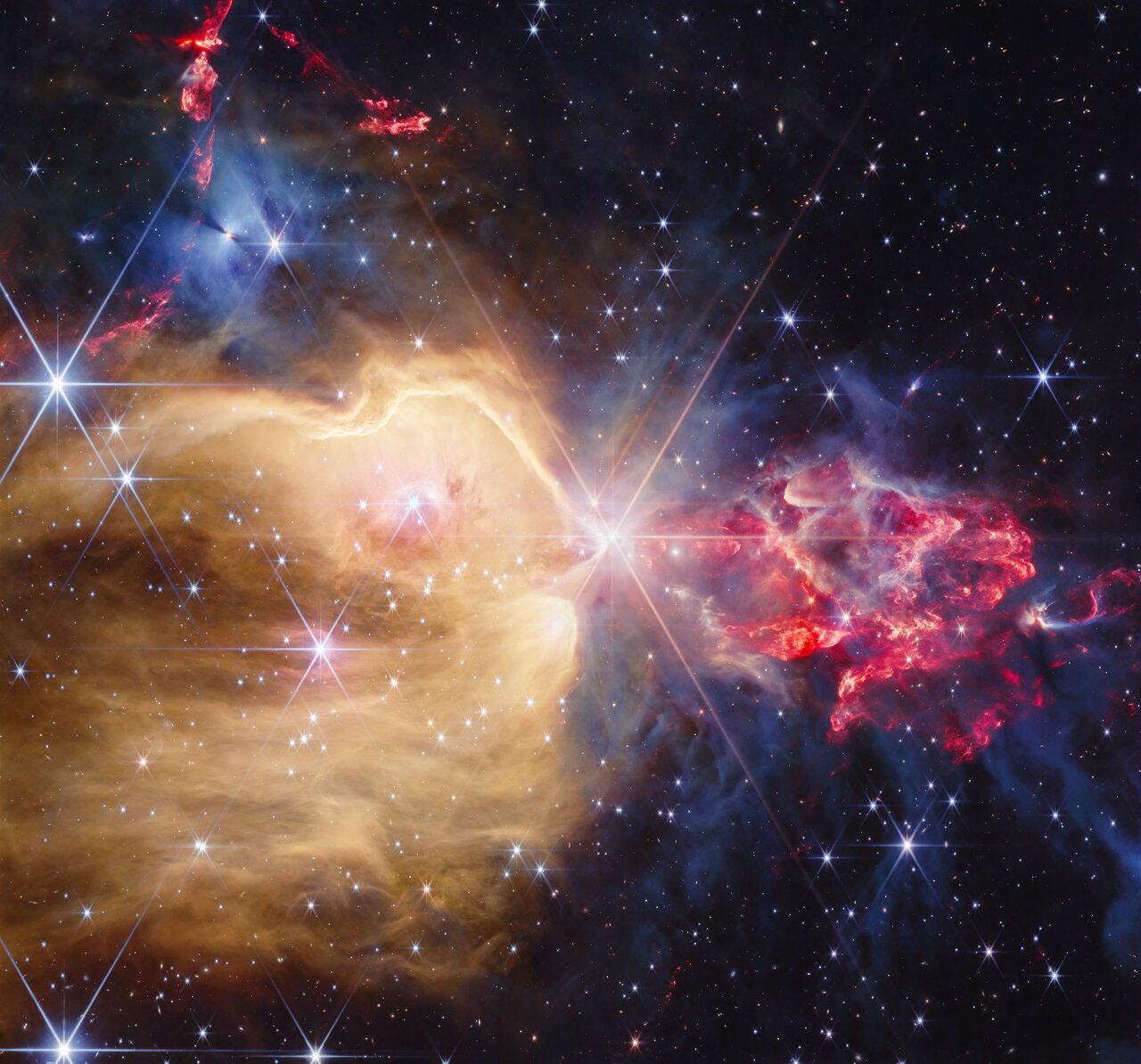
NASA has featured a striking new view of the star-forming region NGC 7129 as its Astronomy Picture of the Day, highlighting high-resolution observations captured by the James Webb Space Telescope. The vivid image provides an intimate look at newborn stars emerging from dense molecular gas clouds while driving powerful, high-velocity jets into the surrounding cosmos. Astronomers selected the portrait to showcase how cutting-edge infrared imaging uncovers structural dynamics that were once concealed behind opaque cosmic dust.
Located roughly 3,000 light-years away in the constellation Cepheus, NGC 7129 is widely recognized by astronomers as an active stellar nursery. The region functions primarily as a reflection nebula, where illumination from energetic infant stars scatters across sweeping curtains of interstellar dust. Within this compact astronomical laboratory, several dozen young stars are undergoing early evolutionary phases, offering scientists a detailed window into the mechanisms of stellar birth.
The James Webb Space Telescope's infrared vision proves uniquely suited for studying regions like NGC 7129 because longer wavelengths can penetrate thick dust columns that scatter visible light. By peering deep into the nebula's core, the space observatory reveals faint structures, warm dust filaments, and hidden protostellar embryos that optical instruments cannot detect. These crisp details allow researchers to trace the distribution of gas and dust with unprecedented clarity.
Among the most prominent features highlighted in the Webb portrait are dynamic stellar jets launched by protostars during their growth process. As newly forming stars pull in surrounding matter from their circumstellar disks, powerful magnetic forces channel portions of that material into focused, supersonic beams traveling in opposite directions. When these fast-moving streams collide with the cooler surrounding cloud, they generate glowing shock fronts known to astronomers as Herbig-Haro objects.
These outflow phenomena play an essential role in regulating the birth and eventual mass of infant stars. By carving out wide cavities in their parental cloud, the energetic jets relieve internal pressure and help clear away the surrounding envelopes of gas. Without such feedback processes, collapsing cores might continue accreting unchecked, fundamentally altering the distribution of stellar masses across the entire cluster.
In addition to clearing birth cocoons, the energetic outflows and intense ultraviolet radiation from the young stars influence the potential formation of planetary systems. The surrounding dusty disks provide the raw ingredients for future planets, asteroids, and comets, though the harsh environment poses challenges for their long-term survival. Studying the interactions between stellar winds and surrounding disks helps researchers determine whether infant worlds can successfully coalesce under such turbulent conditions.
Astrophysicists consider clusters like NGC 7129 to be valuable natural analogs for the early environment in which our own sun and solar system formed more than 4.5 billion years ago. Our solar system is believed to have originated within a similarly crowded and dynamic stellar nursery where neighboring stars exerted strong gravitational and radiative influences. Deciphering the physics of NGC 7129 provides vital benchmarks for verifying evolutionary models of early solar systems.
The image was presented through NASA's Astronomy Picture of the Day service, a long-running public outreach initiative that pairs daily astronomical images with explanations written by professional scientists. The platform frequently highlights groundbreaking data from flagship missions, helping to translate complex scientific discoveries into accessible formats for a global audience. The feature underscores how public space science missions continue to bridge the gap between academic research and general curiosity.
Looking ahead, scientists anticipate combining Webb’s detailed infrared observations with archival data from ground-based radio observatories and space-based X-ray telescopes. Multi-wavelength investigations will enable astronomers to map the chemical composition of gas in the region, measure magnetic field strengths, and track the velocity of expanding outflows over time. As data processing continues, researchers expect NGC 7129 to yield further insights into the delicate balance governing star birth throughout the Milky Way.
Primary source: NASA Breaking News. Newzly rewrites and structures source reporting for clarity; verify critical details at the original.