How Jonty Rhodes Overcame Epilepsy to Transform Cricket Fielding
Before revolutionizing modern cricket fielding with his airborne acrobatics, South Africa icon Jonty Rhodes overcame a childhood epilepsy diagnosis, forging a trailblazing athletic career defined by resilience.
In this piece
A retrospective traces how South African cricket legend Jonty Rhodes surmounted a childhood epilepsy diagnosis to become one of the sport's greatest fielders.…
South African cricket icon Jonty Rhodes redefined modern athletic standards on the cricket pitch, yet his rise unfolded against the backdrop of a lifelong battle with epilepsy. A retrospective feature published in Divya Bhaskar highlights how Rhodes overcame severe neurological challenges in his youth to emerge as the sport's greatest fielding pioneer. His journey remains one of international sports' most celebrated testaments to physical discipline and perseverance.
The condition first manifested when Rhodes was six years old, experiencing sudden fainting spells and unexpected collapses during daily activities. Subsequent medical evaluations confirmed that he was living with a mild form of epilepsy, an intimidating diagnosis at a time when awareness surrounding the disorder was limited. Despite the medical uncertainties, his family resolved not to let the diagnosis constrain his development or passion for athletics.
Physicians advised against participating in high-impact collision sports such as rugby, warning that head trauma could exacerbate seizure activity. Accepting the medical guidance, Rhodes redirected his competitive focus toward non-contact pursuits that demanded speed, agility, and sharp reflexes. The decision preserved his safety while unlocking an innate aptitude for ball-tracking and rapid footwork.
Before making his mark on international cricket, Rhodes distinguished himself as a premier talent in field hockey. His agility made him a standout prospect, putting him on the cusp of selection for South Africa's national squad ahead of the 1992 Summer Olympics in Barcelona. Although the team ultimately missed out on Olympic competition, the multisport conditioning provided the physical foundation for his cricket career.
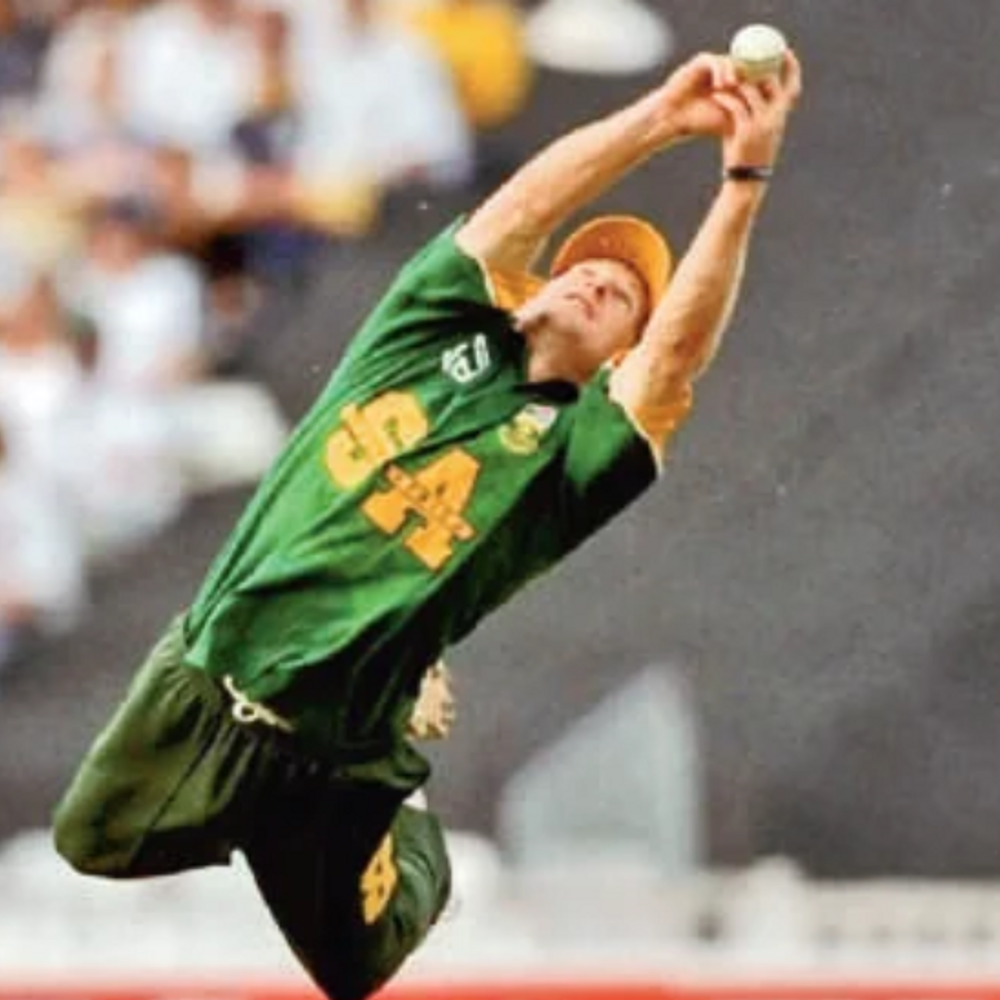
Rhodes attained worldwide recognition during the 1992 Cricket World Cup, producing a defining moment that altered the perception of fielding forever. Patrolling the backward point boundary against Pakistan, he launched his entire body through the air horizontally to shatter the stumps and run out Inzamam-ul-Haq. The spectacular dismissal was broadcast across the globe, instantly establishing Rhodes as an athletic sensation.
Throughout the following decade, Rhodes turned backward point into an attacking tactical position that saved dozens of runs per match. Opposing batters grew hesitant to take singles into his zone, as his lightning pick-up and throw routinely manufactured dismissals from half-chances. His acrobatic catches and fearless diving set a new benchmark that every major cricketing nation rushed to emulate.
Beyond his defensive brilliance, Rhodes was an invaluable contributor with the bat in the South African middle order. His aggressive running between the wickets, situational awareness, and boundary-hitting helped anchor the Proteas through their return to the international arena following readmission. Over hundreds of matches, he proved to be one of the most dependable competitors of his generation.
Rather than concealing his medical condition after achieving international stardom, Rhodes chose to speak openly about living with epilepsy. He aligned with Epilepsy South Africa, using his platform to dismantle persistent social stigmas and encourage young people dealing with chronic ailments. His advocacy demonstrated that a neurological diagnosis need not disqualify an individual from reaching the apex of professional sport.
Following his retirement from competitive play, Rhodes carried his expertise into coaching, mentoring elite fielders across franchise tournaments and national squads. His innovative training drills revolutionized fielding culture across leagues such as the Indian Premier League. Modern training setups worldwide continue to integrate the spatial awareness and diving mechanics that Rhodes first perfected.
Decades after his international debut, Rhodes remains a towering figure whose impact stretches far beyond scorecards and highlight reels. His story illustrates how strategic adaptation and relentless work ethic can triumph over physiological limitations. For athletes and individuals navigating medical adversity, his legacy endures as a blueprint for turning vulnerability into generational excellence.
Primary source: Divya Bhaskar Magazine. Newzly rewrites and structures source reporting for clarity; verify critical details at the original.