Keplr Suspends Social Logins After Web3Auth Vulnerability Sparks $6 Million in Transfers
Keplr disabled Google and Apple sign-ins after a Web3Auth vulnerability exposed private keys, prompting more than $6 million in Cosmos transfers amid ongoing recovery efforts.
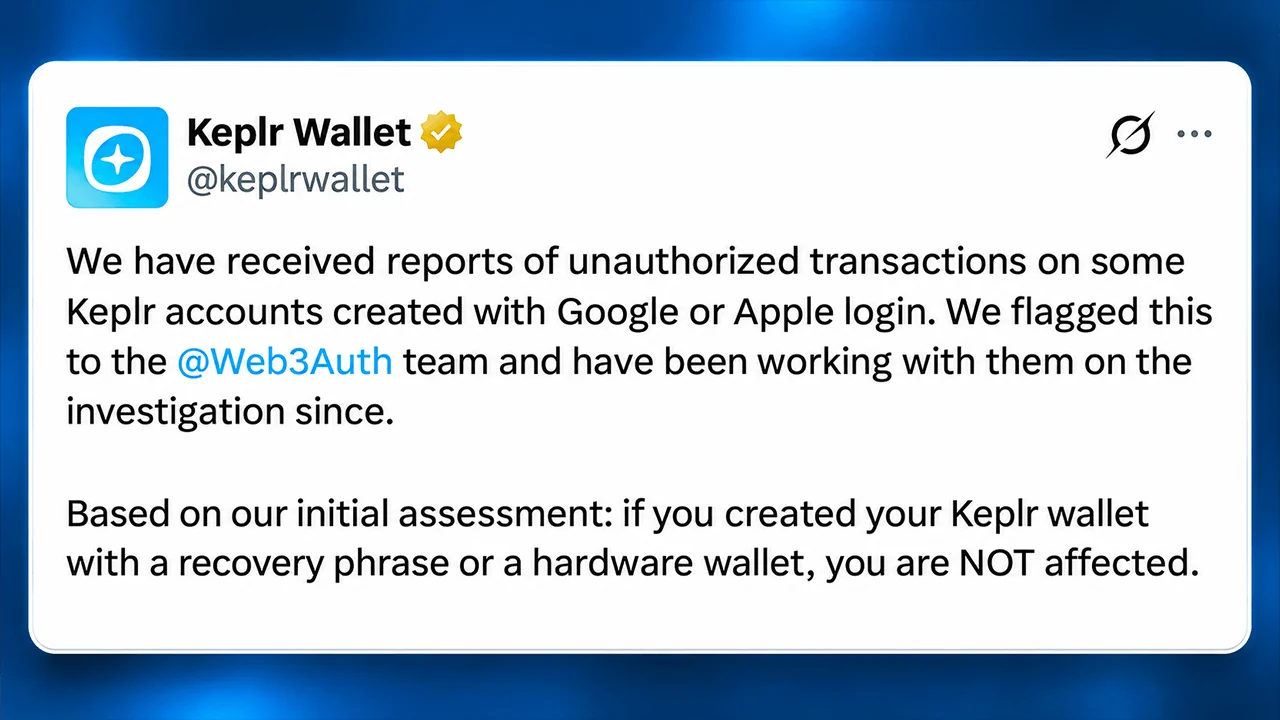
Cosmos ecosystem wallet provider Keplr has temporarily suspended social login functionality following a critical security incident tied to its third-party authentication architecture. The vulnerability exposed private keys for accounts authenticated through mainstream providers, triggering a rapid wave of unauthorized transactions across connected networks. The emergency shutdown began on Friday as engineering teams moved swiftly to limit further unauthorized activity.
The security breakdown stemmed from a vulnerability in Web3Auth, an infrastructure provider that enables decentralized applications to offer seamless social onboarding. Following the disclosure that private keys were exposed, Keplr disabled both Google and Apple login mechanisms across its interface. The suspension was implemented as a protective measure to block attackers from accessing compromised accounts while investigation teams examined the scope of the incident.
Blockchain intelligence analysts tracking the fallout reported more than 6 million dollars in unauthorized asset transfers moving across Cosmos-based networks. The illicit transactions occurred rapidly across multiple decentralized ledgers as perpetrators took advantage of the exposed cryptographic material. Observers noted that the multi-chain nature of the Cosmos ecosystem allowed funds to disperse across diverse connected applications within hours.
Establishing the final financial toll remains complicated due to ongoing intervention and fund recovery operations. Alongside illicit transfers, coordinated rescue efforts were initiated to sweep vulnerable assets into secure storage before malicious actors could drain them. Because these protective transfers run in parallel with unauthorized transactions, forensic analysts continue working to separate rescued capital from actual network losses.
Social login mechanisms have become a popular feature for Web3 interfaces aiming to ease onboarding hurdles for everyday cryptocurrency users. By allowing individuals to manage decentralized wallets through familiar corporate credentials, platforms seek to eliminate the steep learning curve associated with manual private key handling. However, the convenience introduces structural tradeoffs when centralized or distributed key-management middleware suffers an operational breach.
The vulnerability underscores the delicate balance decentralized platforms navigate when integrating multi-party computation and third-party credential brokers. While non-custodial architectures are designed to preserve individual sovereignty, relying on external identity layers introduces shared attack surfaces. When an underlying infrastructure partner experiences an exposure, the blast radius often extends across thousands of retail accounts simultaneously.
Within the Cosmos ecosystem, the incident highlights the ongoing challenges of securing interconnected cross-chain environments. The Cosmos network relies on modular application-specific blockchains communicating through decentralized protocols, meaning a compromised account key can impact liquidity across numerous decentralized exchanges and staking contracts. Coordinating forensic analysis and containment therefore requires collective vigilance from node operators and protocol developers.
Users who created their Keplr wallets using traditional cryptographic seed phrases or hardware devices appear unaffected by the Web3Auth flaw. The issue remains isolated to accounts that relied on social login credentials to manage their private keys. Keplr has advised affected account holders to remain alert and monitor their blockchain addresses as security specialists deploy targeted patches.
Looking ahead, recovery efforts and technical post-mortems will determine when social authentication features can be safely restored to the platform. Developers at both Keplr and Web3Auth are conducting exhaustive code reviews to guarantee that all security loopholes are eliminated prior to relaunching services. The broader community now awaits formal audit reports that will detail the incident's mechanics and finalize the verified loss figures.
Primary source: Bitcoin.com News. Newzly rewrites and structures source reporting for clarity; verify critical details at the original.