NASA APOD Features Andromeda Galaxy Rising Over Australian Hills
A newly featured NASA image highlights the Andromeda Galaxy skimming the northern horizon above New South Wales, showcasing the unique challenges and beauty of southern hemisphere astrophotography.
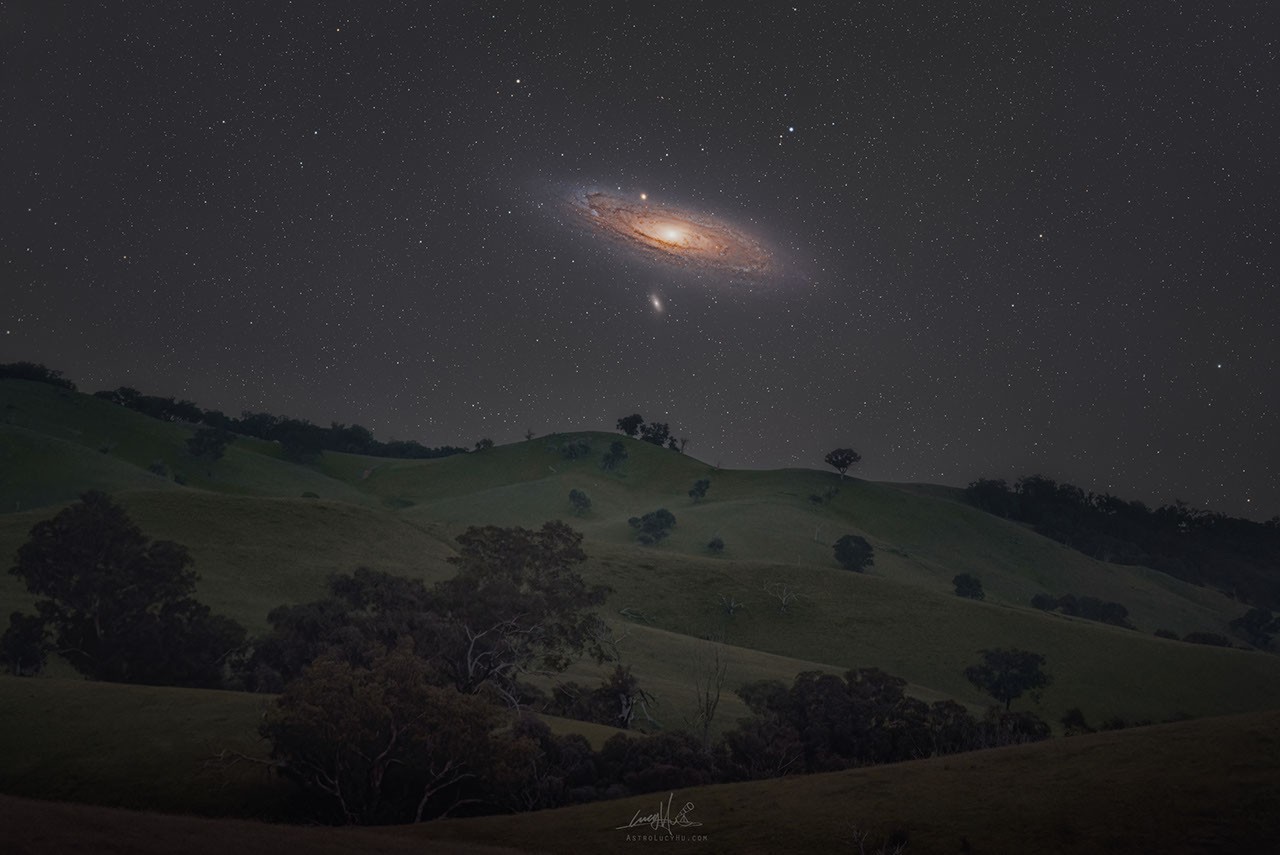
NASA’s Astronomy Picture of the Day on October 23 highlighted a rare and striking view of the Andromeda Galaxy hovering just above the Australian horizon. The photograph, captured by astrophotographer Lucy Yunxi Hu from Mullion in New South Wales, showcases our closest large galactic neighbor rising above rolling rural hills during the southern hemisphere's spring season. The composite image illustrates how celestial landmarks familiar to northern observers take on an entirely different character when seen from the other side of the planet.
For observers stationed in the southern hemisphere, spotting the Andromeda Galaxy, formally cataloged as Messier 31, requires patience and clear northern vistas. From mid-southern latitudes, the immense spiral galaxy never climbs high into the heavens, remaining pinned within just a few degrees of the horizon throughout the night. This low altitude forces observers to look through thicker layers of Earth's atmosphere, which scatter incoming light and make clear detection challenging.
The southern spring months provide the optimal, albeit brief, viewing window for southern astronomers tracking the target. During this time of year, Andromeda climbs to its highest point in the northern sky around midnight. Astrophotographers must capitalize on these late-night hours to frame the galaxy before orbital mechanics and daylight wash out its delicate spiral arms.
Hu assembled the final picture using a telephoto lens and sophisticated astrophotography techniques designed to draw out faint cosmic light. The image blends multiple tracked and stacked exposures of the deep sky with an aligned foreground shot of the terrestrial landscape. This method preserves crisp structural details in the galaxy's dust lanes without blurring the dark contours of the Australian countryside.
Although Andromeda is distant, its true angular footprint across the sky is enormous when captured through long-exposure photography. In dark-sky conditions, the spiral system spans an apparent width equivalent to nearly six full moons placed side by side. To the unassisted human eye, only the dense galactic core is typically visible as a hazy patch of light.
Located approximately 2.5 million light-years from Earth, Andromeda is the most massive member of the Local Group, a gravitationally bound cluster that also includes the Milky Way and Triangulum galaxies. Scientists actively study the spiral system to understand galactic evolution, stellar populations, and interstellar dust distributions. Because of its structural kinship with the Milky Way, Andromeda serves as an invaluable analog for researchers examining our home galaxy from the outside.
Ground-based imaging near the horizon demands meticulous planning to counter atmospheric distortion and local light interference. Stacking software combines dozens of individual frames, averaging out sensor noise and sharpening the faint light emitted by distant stellar clusters. Hu's result demonstrates how modern tracking mounts and digital sensors allow amateur astrophotographers to capture clean astronomical data even under demanding geometric conditions.
The featured capture is part of NASA’s long-standing Astronomy Picture of the Day initiative, which delivers daily celestial photography accompanied by brief explanations written by professional astronomers. The service highlights both premier imagery from major space observatories and exceptional field photography created by independent stargazers worldwide. By showcasing diverse perspectives, the archive offers the public an accessible window into cosmic phenomena.
As the southern spring continues, stargazers across Australia and neighboring southern latitudes will continue monitoring clear northern horizons for midnight appearances of Andromeda. Astrophotographers anticipate that continued improvements in camera sensitivity and mobile tracking mounts will encourage more observers to document low-altitude deep-sky targets. For now, Hu's panoramic portrait stands as a vivid reminder of how Earth's vantage points reshape humanity's view of the wider cosmos.
Primary source: NASA Breaking News. Newzly rewrites and structures source reporting for clarity; verify critical details at the original.