NASA Astronomy Picture of the Day Highlights Vibrant Swirls and Storms on Jupiter from Juno
NASA’s Astronomy Picture of the Day has showcased a striking perspective of Jupiter’s vibrant cloud swirls and storms, drawing on atmospheric imagery captured by the orbiting Juno spacecraft.
In this piece
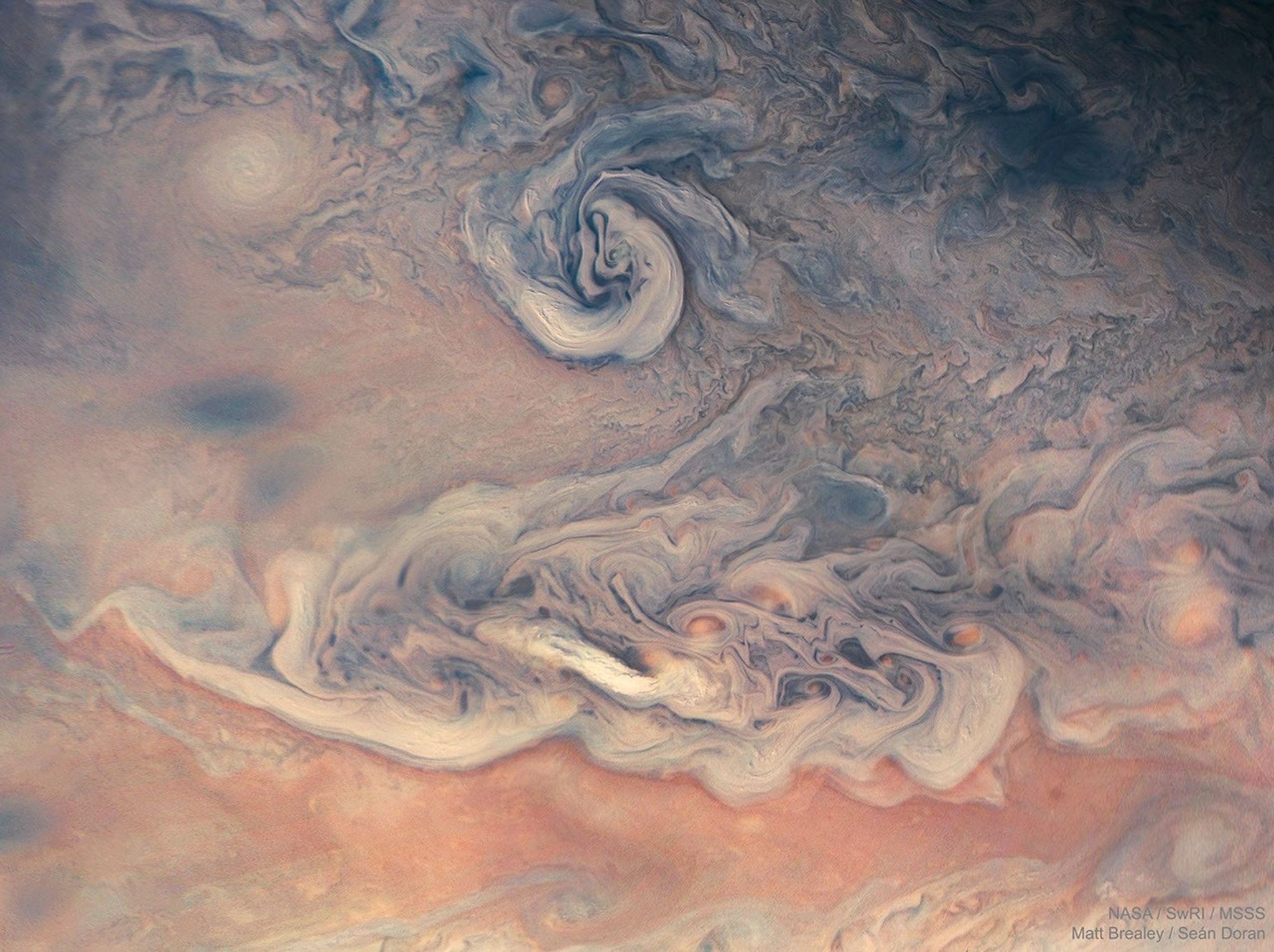
NASA has featured a detailed view of Jupiter’s colorful, swirling atmosphere as its Astronomy Picture of the Day for November 22. The image, captured by the…
NASA’s Astronomy Picture of the Day for November 22 has highlighted a remarkable view of Jupiter, focusing on vibrant swirls and dynamic atmospheric colors captured by the Juno spacecraft. The featured visual showcases the gas giant’s turbulent cloud patterns and intricate storm systems in exceptional detail. Planetary scientists and stargazers regularly turn to the daily feature to observe unique perspectives of major planetary bodies across the solar system.
The selection forms part of NASA’s Astronomy Picture of the Day archive, an educational program that shares a different view of the universe each day alongside explanations authored by professional astronomers. Through this ongoing series, researchers highlight both ground-based telescopic discoveries and close-up views collected by active interplanetary probes. The latest entry underscores how robotic explorers continue to reveal the complex aesthetic and scientific nature of neighboring worlds.
The visual data behind the feature was gathered by NASA’s Juno orbiter, a mission designed to study Jupiter’s atmosphere, gravitational field, and magnetosphere from close range. Flying along an elliptical polar orbit, the spacecraft periodically sweeps close to the cloud tops during specialized perijove passes. During these maneuvers, the probe’s onboard camera system captures high-resolution perspectives of the planet’s shifting storm systems and delicate fluid boundaries.
Jupiter’s upper atmosphere is renowned for its swirling ribbons, oval storm clusters, and contrasting color gradations. The features displayed in the newly highlighted image reflect complex chemical reactions and atmospheric upwelling across varying altitudes and temperatures. Traces of sulfur, phosphorus, and hydrocarbon compounds interact with sunlight in the dense upper clouds, generating the vivid hues and sharp transitions visible between neighboring jet streams.
Detailed atmospheric imagery of this caliber plays an essential role in planetary research, allowing scientists to track how weather systems operate in an environment devoid of a solid surface. Observations of Jovian vortices help researchers evaluate atmospheric turbulence, thermal circulation, and the sheer scale of storms that can span thousands of kilometers. Each new set of observations offers fresh reference points for understanding the planet’s deep-seated atmospheric engine.
Public engagement and citizen science have also become central to the presentation of Juno’s photographic legacy. Raw data captured by the JunoCam instrument are made publicly accessible shortly after downlinking, enabling digital image processors and volunteer analysts to calibrate colors, reduce noise, and produce striking representations. This collaborative approach has yielded some of the most widely shared and scientifically illustrative depictions of Jupiter’s swirling bands.
Beyond advancing knowledge of the solar system’s largest planet, insights gained from Jupiter’s cloud structures inform the broader study of exoplanets throughout the cosmos. As astronomers discover thousands of giant worlds orbiting distant stars, Jupiter serves as a primary benchmark for modeling extreme atmospheric circulation and cloud composition. High-resolution imagery from missions like Juno provides critical baseline observations that theoretical models rely upon to interpret distant planetary data.
The Juno spacecraft is continuing its extended orbital journey, carrying out further scientific measurements of Jupiter, its rings, and its major moons. Future data releases and planned image sequences will offer researchers additional opportunities to track the evolution of these swirling storms over time. As telemetry and processed frames continue to arrive, scientists anticipate further revelations regarding the atmospheric forces shaping the gas giant’s vibrant visage.
Primary source: NASA Breaking News. Newzly rewrites and structures source reporting for clarity; verify critical details at the original.