NASA Highlights Morse Code Tribute as Voyager 1 Reaches One Light-Day Distance
NASA's Astronomy Picture of the Day highlighted a global Morse code tribute to Voyager 1, celebrating the historic probe as it officially crossed one light-day of distance from Earth.
In this piece
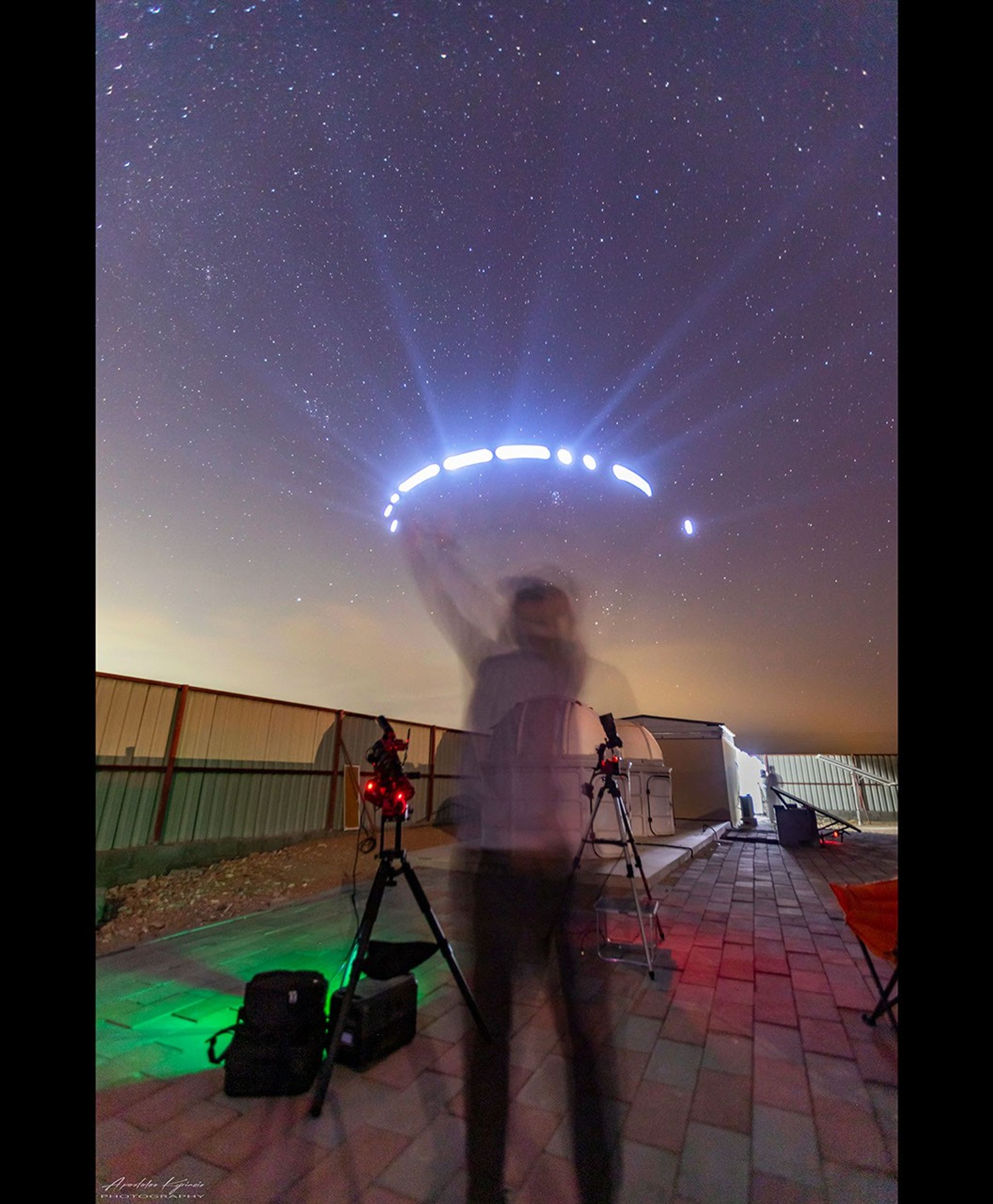
NASA's Astronomy Picture of the Day featured a long-exposure photograph capturing Morse code flashes directed at Voyager 1. The symbolic tribute coincided with…
NASA’s Astronomy Picture of the Day has showcased a striking visual tribute to humanity’s most distant traveler, capturing Morse code light signals beamed toward the Voyager 1 spacecraft. The image, published by the space agency on November 20, highlights a coordinated skywatching effort in which observers flashed signals into the night sky to honor the probe’s latest interstellar milestone.
The featured photograph was captured as a time exposure from the Emirates Astronomical Observatory, recording a sequence of light pulses switched on and off against the dark backdrop. When decoded, the alternating dashes and dots formed the letters V-G-R, serving as an astronomical call sign for the venerable spacecraft.
The initiative coincided with a significant cosmic benchmark for Voyager 1, which officially reached a distance of one light-day from Earth. NASA confirmed that the milestone occurred on November 18 at 10:16:07 UTC, establishing a new operational range for human technology beyond the solar system.
At that threshold, radio signals and light beams emitted from Earth require a full twenty-four hours of travel time to reach the robotic explorer. The probe currently travels through interstellar space at an immense distance of approximately 26 billion kilometers, navigating the sparse medium beyond the heliosphere.
Voyager 1 began its epic voyage nearly five decades ago following its launch from Earth in 1977. Originally designed to conduct flybys of Jupiter and Saturn, the spacecraft completed its primary planetary surveys before extending its trajectory outward toward the edge of the sun's magnetic domain.
After decades of operational extensions, the spacecraft crossed the heliopause into interstellar space in 2012, becoming the first human-made object to venture into the space between the stars. Despite dwindling power reserves and aging onboard instrumentation, the probe continues to transmit scientific measurements back to tracking stations on Earth.
The one light-day achievement offers a tangible measure of the vast scale of interstellar space. At its current speed, having required roughly fifty years to cross a single light-day, mathematicians and astronomers note that it will take the spacecraft approximately 18,250 years to traverse a single light-year.
The November 17 skywatching call invited astronomy enthusiasts around the globe to participate in pointing handheld light sources toward Voyager's position in the sky. By translating the collective gesture into photographic art, the observatory emphasized the enduring cultural and scientific legacy of deep space exploration.
Voyager 1 remains an unprecedented benchmark in robotic exploration as flight engineers carefully manage its remaining systems to prolong data collection. While its power will eventually diminish, the spacecraft will continue coasting through the galaxy as an enduring testament to early interstellar exploration.
Primary source: NASA Breaking News. Newzly rewrites and structures source reporting for clarity; verify critical details at the original.