NASA’s Dragonfly Rotorcraft Receives DragonCam Imaging Suite for Titan Mission
Engineers at the Johns Hopkins Applied Physics Laboratory have begun integrating the seven-camera DragonCam suite onto NASA’s Dragonfly rotorcraft, equipping the car-sized vehicle for its upcoming exploration of Saturn’s moon Titan.
In this piece
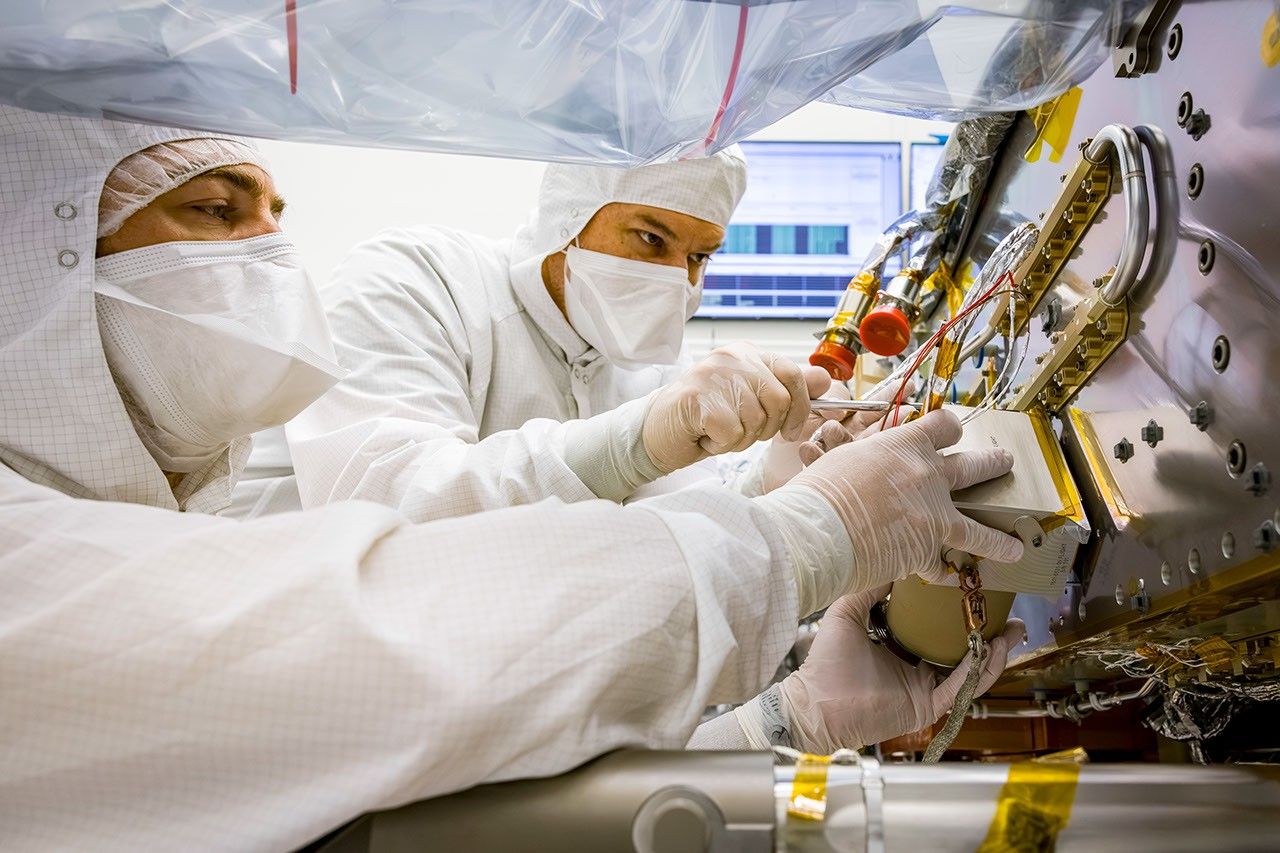
NASA has installed the DragonCam imaging system onto the Dragonfly rotorcraft at the Johns Hopkins Applied Physics Laboratory in Maryland. The seven-camera…
NASA’s Dragonfly mission has reached a key assembly milestone with the arrival and integration of its primary imaging system at the Johns Hopkins Applied Physics Laboratory in Laurel, Maryland. The suite, named DragonCam, consists of seven dedicated cameras designed to serve as the visual eyes for the car-sized rotorcraft. Engineers and technicians have begun mounting the instruments as the spacecraft takes shape for its historic journey to Saturn’s largest moon, Titan.
Built by Malin Space Science Systems, DragonCam is the first scientific hardware suite to be integrated onto the Dragonfly chassis at the Maryland facility. Teams completed the installation and functional testing of all seven cameras by mid-November, securing them into specialized housings. The successful installation marks the formal transition from individual component fabrication to vehicle-level payload assembly.
The imaging suite is designed to characterize Titan’s alien surface across multiple operational scales. While Dragonfly is airborne, the cameras will photograph regional topography, scouting potential landing zones and tracking geological formations such as dunes and craters. Once on the surface, the system will switch to close-up imaging to examine granular soil textures and candidate sample sites in minute detail.
Operating in Titan’s brutal environment requires specialized thermal engineering, as ambient temperatures plunge to approximately minus 290 degrees Fahrenheit. To survive these cryogenic conditions, each camera looks out through a dedicated optical window embedded in a protective foam enclosure. This insulating barrier safeguards delicate electronics and prevents heat from leaking out of the rotorcraft's interior.
Because Titan’s day-night cycle lasts nearly 16 Earth days, Dragonfly will spend long stretches operating in complete darkness during the eight-day lunar night. To overcome this challenge, engineers at the Applied Physics Laboratory developed a configurable LED lighting array that mounts alongside the cameras. The illumination unit spans light wavelengths from the ultraviolet to the infrared, ensuring the vehicle can observe its surroundings at any hour.
The onboard lighting system is tailored specifically to assist in scientific discovery rather than merely illuminating the terrain. By casting ultraviolet light on surface deposits, the cameras can detect fluorescence in organic compounds that would otherwise go unnoticed. This capability provides planetary scientists with true-color imagery and immediate data regarding the chemical makeup of Titan's organic sands.
Titan represents one of the most compelling astrobiology targets in the solar system due to its thick nitrogen atmosphere and complex carbon chemistry. Although frigid, the moon hosts liquid methane lakes and weather patterns that mirror Earth's hydrological cycle, offering a natural laboratory for studying how organic molecules evolve. Dragonfly aims to determine the extent of prebiotic chemical progression and search for signs of potential habitability.
With DragonCam firmly in place, the engineering team at the Applied Physics Laboratory is preparing to receive additional mission instruments over the coming months. Forthcoming hardware deliveries will include mass spectrometers, seismometers, and atmospheric sensors designed by international and domestic partner institutions. Each system will undergo rigorous standalone checks before integration onto the shared rotorcraft platform.
As more components arrive, the mission team will begin comprehensive system-level evaluations to verify how the instruments interact. The completed rotorcraft will ultimately enter environmental test chambers to simulate the violent acoustic vibrations of launch and the vacuum of space transit. These stress tests will confirm that Dragonfly's mechanical and scientific systems can endure years of space travel before touching down on Titan.
Dragonfly is scheduled to launch toward the Saturnian system later this decade, kicking off an ambitious multi-year trek across the outer solar system. Upon arrival, the rotorcraft will perform a sequence of controlled flights across Titan's surface, hopping from one scientific target to the next. The mission will mark humanity’s first mobile aerial exploration of an ocean world, opening a new chapter in planetary science.
Primary source: NASA Breaking News. Newzly rewrites and structures source reporting for clarity; verify critical details at the original.