NASA's Webb Telescope Unveils Intricate Details of Hot Dust in Cassiopeia A
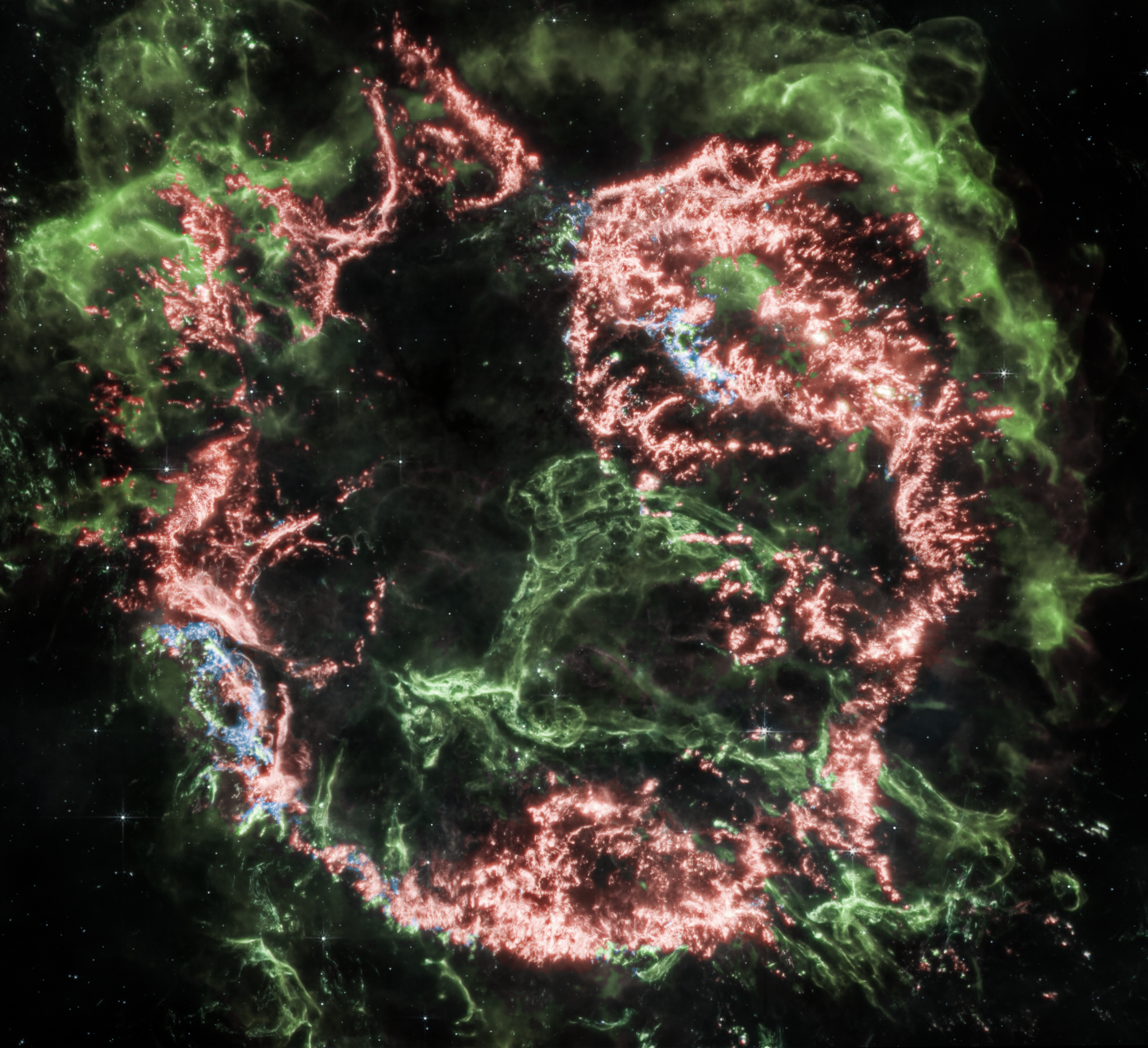
A new high-resolution mid-infrared image from NASA's James Webb Space Telescope reveals detailed structures of hot dust inside the Cassiopeia A supernova remnant, offering fresh insight into how stellar explosions seed future stars and planets.
In this piece
NASA has released a high-resolution mid-infrared view of the Cassiopeia A supernova remnant captured by the James Webb Space Telescope. The detailed image…
A newly released high-resolution observation from NASA's James Webb Space Telescope has unveiled intricate structures of hot cosmic dust within the famed supernova remnant Cassiopeia A. The mid-infrared view, released by the space agency on November 23, 2026, provides astronomers with an unprecedented look into the lingering wreckage of an exploded massive star.
Cassiopeia A, commonly referred to as Cas A, represents one of the most thoroughly scrutinized stellar remnants in the sky. When a massive star reaches the catastrophic conclusion of its life cycle, the resulting violent blast hurls stellar debris across surrounding interstellar space at extraordinary velocities.
The newly published imagery highlights the hot dust that constitutes substantial portions of the expanding remnant. Rather than dispersing into complete obscurity, these expansive clouds of gas and particulate matter endure for centuries, preserving a structural record of the core-collapse explosion.
Infrared instrumentation aboard the Webb telescope is uniquely suited to cut through cosmic veils and resolve fine thermal emissions from dust clouds. Mid-infrared observations allow researchers to distinguish temperature variations and composition gradients that remain invisible at shorter optical wavelengths.
Such supernova remnants hold fundamental significance for astrophysical models governing cosmic chemical evolution. The dust and heavy elements dispersed in these catastrophic stellar deaths do not simply vanish; they enrich surrounding gas reserves across the host galaxy.
Over extended cosmic timescales, these dispersed clouds of interstellar gas and dust coalesce under gravity to form new generations of stars and planetary systems. In this manner, remnants like Cas A serve as cosmic nurseries, recycling material forged deep within ancient stellar cores.
Studying the structural distribution of dust in Cas A also aids scientists in reconstructing the specific physical mechanisms of the initial blast. Discrepancies in dust concentration and geometry offer clues into stellar asymmetric shocks and turbulent mixing during core collapse.
While previous space- and ground-based observatories have mapped Cas A across multiple wavelengths, Webb's enhanced resolving power reveals previously hidden structural details. The fine clumps, filamentary knots, and diffuse sheets seen in the mid-infrared data showcase the dynamic complexity of the remnant's interior.
The newly cataloged details are expected to guide ongoing research into how dust grains survive the destructive shockwaves created after a supernova explosion. Understanding whether these fragile silicate and carbon grains endure or are obliterated in the violent aftermath remains an active topic of astronomical inquiry.
NASA indicated that the newly released imagery will support ongoing and future analytical investigations targeting stellar lifecycles and cosmic dust propagation. As observational data from Webb continues to be processed, researchers anticipate further insights into the profound physical processes that shape our universe.
Primary source: NASA Breaking News. Newzly rewrites and structures source reporting for clarity; verify critical details at the original.