Netanyahu bloc leads Israel election count but falls short of majority
Benjamin Netanyahu’s Likud party and its allies are projected to win 53 of parliament’s 120 seats, leaving them short of a governing majority with about 85% of ballots counted.
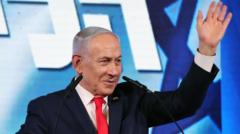
Benjamin Netanyahu’s Likud party and its allies are projected to win 53 seats in Israel’s 120-member Knesset with about 85% of ballots counted, according to partial results reported by BBC World. The tally puts his bloc ahead of its main rival but eight seats below the 61 needed for a parliamentary majority.
The opposition bloc led by Gadi Eisenkot has 48 projected seats, while Arab parties account for the remaining 19, according to the Times of Israel, citing the Central Elections Committee. Those figures leave neither of the two main blocs able to assemble a majority using only its existing partners. The results remain provisional as counting continues.
Likud itself is projected to take 26 seats, ahead of Eisenkot’s Yashar party on 21, according to reporting by the Times of Israel and the Irish Times. That would make Netanyahu’s party the largest individual force in parliament. But finishing first does not by itself resolve who can secure enough parliamentary support to form the next government.
The partial count also differs from the picture presented by exit polls from Israel’s three main television stations, which had placed the opposition bloc ahead, the Irish Times reported. Netanyahu’s allies have instead moved into the lead as ballots have been counted. That reversal has changed the relative positions of the competing blocs without giving either a clear route to a majority.
The Arab parties’ projected 19 seats put them in a potentially important position in any effort to build an alternative governing arrangement. However, the Times of Israel reported that opposition leaders had made campaign pledges against partnering with Arab parties. Their combined parliamentary strength therefore cannot be treated as evidence that a governing agreement is already within reach.
The immediate uncertainty concerns the ballots still outstanding and whether they will alter the distribution of seats. The Central Elections Committee said additional checks were needed for some ordinary ballots and that separately processed, double-envelope votes remained to be counted, according to the Times of Israel. Its report said those votes were expected to enter the tally over the following days.
Beyond the count, the political challenge is to turn parliamentary numbers into an agreement among parties with differing positions and commitments. Possible outcomes discussed in the Times of Israel include cooperation involving Arab parties, a broader unity arrangement or another election if negotiations fail. None of those possibilities is an established outcome of the partial results.
Attention now turns to the remaining count and the subsequent government-formation process. President Isaac Herzog must decide who receives the first opportunity to assemble a government, the Times of Israel reported, while the outgoing administration remains in office. For Netanyahu, the provisional lead preserves a path to negotiations, but it does not yet establish that he can command a majority.
Primary source: BBC World. Newzly rewrites and structures source reporting for clarity; verify critical details at the original.