Record Number of Purges Confirmed as Xi Stresses Party Discipline at Beijing Gathering
A major political gathering in Beijing confirmed a record wave of official expulsions, underscoring President Xi Jinping’s deepening drive to enforce political discipline and consolidate control over the military and party apparatus.
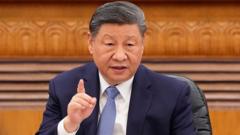
A closed-door plenary session of the Chinese Communist Party’s Central Committee in Beijing has concluded with the formal confirmation of a record number of high-level expulsions. The political gathering ratified the removal of dozens of senior officials, marking one of the most sweeping purges at a single plenum in modern Chinese political history. The move underscored Chinese President Xi Jinping’s continued determination to enforce uncompromising ideological and organizational discipline across the ruling establishment.
Official notices released after the gathering confirmed that 33 senior figures were formally expelled from the party’s central leadership ranks. Notably, nearly half of those purged—at least 16 officials—hailed from the People's Liberation Army and China's broader defense and security infrastructure. The heavy concentration of military figures reflects intense ongoing scrutiny within the armed forces, where loyalty checks and anti-graft investigations have accelerated significantly over recent months.
The latest removals bring the total number of Central Committee members ousted during Xi’s third leadership term to more than 50. The scale of the ongoing disciplinary sweep was physically apparent inside the hall in Beijing, which recorded the lowest attendance rate for a Central Committee plenum in the post-Mao era. Dozens of vacant seats served as a stark visual testament to the breadth of ongoing inquiries conducted by the party’s internal discipline watchdogs.
Unlike previous plenary gatherings that traditionally focused heavily on broad economic policy roadmaps, industrial targets, or fiscal restructuring, this gathering placed political hygiene and ideological adherence front and center. Official statements emerging from the plenum heavily reiterated party slogans around self-revolution and strict governance. The proceedings made clear that ideological rectification and internal compliance remain paramount priorities for the leadership in Beijing.
Political observers and regional analysts noted that the high-profile purge demonstrates how the anti-corruption drive has evolved over the past decade. While originally framed as an effort to eliminate graft and improve bureaucratic efficiency, analysts argue the campaign has increasingly functioned as an essential instrument to consolidate and maintain personal authority. By rooting out political nonconformity and suspected disloyalty, the leadership continues to systematically neutralize potential internal resistance.
Party communiques have repeatedly warned against what internal watchdogs describe as two-faced officials—cadres who publicly pledge fealty to central leadership while quietly pursuing personal factions or resisting policy directives. The targeted removal of senior military brass and party elites signals that even high-ranking figures are not immune from sudden administrative or criminal scrutiny. The atmosphere has reinforced a pervasive climate of caution across provincial administrations and ministerial headquarters alike.
The specific targeting of defense officials comes at a critical juncture for Beijing as it seeks to modernize the military and project power across the Indo-Pacific region. Analysts have suggested that corruption inquiries within the military, particularly involving procurement bodies and strategic missile units, may have disrupted operational timelines. Nonetheless, central authorities have signaled that political reliability and strict obedience take precedence over technical continuity or individual seniority.
The widening purges also carry significant implications for everyday governance and decision-making within the Chinese state. Observers point out that aggressive discipline campaigns often generate risk-averse behavior among mid-level and senior bureaucrats who hesitate to take initiative or implement bold economic policies for fear of triggering investigations. This dynamic has emerged at a sensitive time, as the world’s second-largest economy navigates structural slowdowns and real estate sector strains.
Looking ahead, the plenum’s outcomes set a firm operational tone for the remainder of Xi’s current term and the run-up to future party leadership milestones. With the Central Committee now reshuffled and purged of scrutinized figures, the party leadership is expected to fill vacant posts with thoroughly vetted loyalists. The enduring message delivered to the political establishment is unequivocal: unbending discipline and total alignment with central authority will remain non-negotiable pillars of governance in Beijing.
Primary source: BBC World. Newzly rewrites and structures source reporting for clarity; verify critical details at the original.