Johannesburg's Illegal Gold Rush Exposes Decades of Environmental Neglect
High gold prices are accelerating illegal mining around Johannesburg, but experts warn that blaming informal diggers obscures a century of industrial mining damage and deep economic hardship.
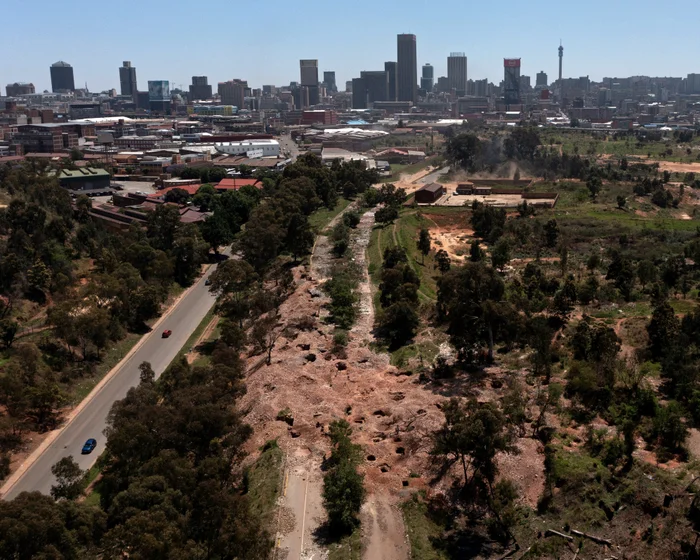
A surging global gold price is driving an aggressive resurgence of informal and illegal mining across the Witwatersrand basin, leaving the fringes of Johannesburg pitted with dangerous shafts and destabilized terrain. Communities near historical mining zones are witnessing an influx of unregulated diggers seeking residual ore in abandoned industrial workings. The proliferation of makeshift operations has renewed intense public debate over public safety, policing, and environmental decay.
In Roodepoort, west of Johannesburg, the escalation is unfolding directly on the doorsteps of local residents and community organizations. Cora Bailey, founder of Community Led Animal Welfare, observed that dozens of informal miners arrived in late September to dig trenches directly across from the charity's shelter on the grounds of the defunct Durban Deep mine. Bailey, who has worked in the township area since 1991, noted that while informal extraction is not new, its intensity has grown significantly alongside rising gold valuations.
Known locally as zama zamas, meaning "to take a chance" in Zulu, the diggers operate under extreme hazard inside derelict shafts once abandoned by commercial mining companies. Chronic unemployment, widespread poverty across Southern Africa, and high bullion prices continue to channel vulnerable laborers into the illicit trade. Without protective equipment or structural reinforcements, miners descend hundreds of meters underground to extract small quantities of precious metal.
The informal excavations have increasingly threatened civil infrastructure and residential neighborhoods situated along Johannesburg's historic gold reef. Roads, pipelines, and public land south and west of the city center have experienced ground fissures, structural damage, and localized collapses. These hazards have fueled alarm among suburban residents and municipal authorities who fear further ground destabilization.
South African law enforcement authorities have responded with armed sweeps, localized arrests, and operations designed to seal accessible mine openings. However, local observers and welfare groups describe these measures as largely ineffective over the long term. Once police teams withdraw from an area, informal miners routinely reopen portals or shift extraction efforts to neighboring unguarded land.
While politicians and municipal leaders frequently attribute the proliferation of sinkholes entirely to illegal diggers, researchers point out that the geological damage predates the current wave of informal mining. Independent analysts warn that scapegoating informal miners obscures the massive environmental legacy left behind by commercial mining houses. Decades of heavy corporate extraction altered subterranean rock strata across Gauteng province long before informal networks took root.
Columbia University anthropologist Rosalind Morris has underscored that formal industrial mining systematically pumped vast quantities of water out of the region's porous dolomitic ground formations. The removal of hundreds of millions of gallons of underground water daily destabilized the subterranean geography, making sinkholes an inevitable long-term consequence. While surface digging by zama zamas damages local topsoil, it is this historic dewatering that primarily triggers severe sinkhole formation.
The issue is further complicated by how closely informal mining has integrated into surrounding township economies. In many impoverished settlements, the money generated by informal miners sustains rental rooms, grocery shops, and informal transport operators. Removing the trade without viable economic alternatives threatens to deepen local destitution across already marginalized urban enclaves.
With global gold prices holding near historic highs and broader economic prospects remaining bleak, analysts anticipate that unregulated mining will continue to test municipal governance. Ending the cycle will require addressing deep-seated regional unemployment alongside historical industrial environmental liabilities. For now, communities along the Witwatersrand remain caught between immediate infrastructural peril and the relentless economics of poverty.
Primary source: The Guardian World. Newzly rewrites and structures source reporting for clarity; verify critical details at the original.