Spacecraft reaches Mercury after eight-year voyage, promising the closest look yet
A spacecraft has completed an eight-year journey to Mercury, the planet closest to the Sun. The mission is expected to deliver the most detailed view yet of a world that remains poorly understood.
In this piece
After an eight-year voyage, a spacecraft is visiting Mercury, the closest planet to the Sun. The mission is set to provide the best view yet of a planet long…
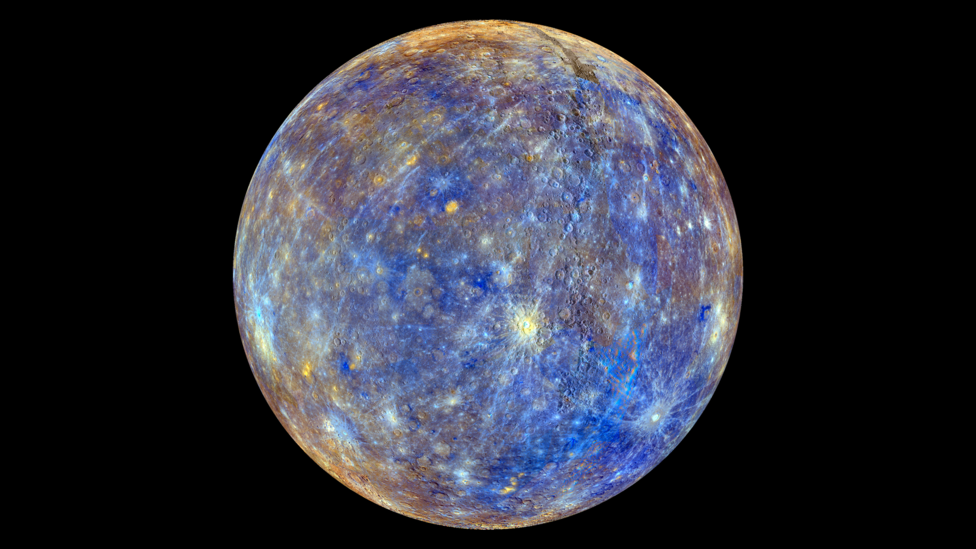
A spacecraft has arrived as a visitor to Mercury after an eight-year voyage, according to a BBC Science report. The mission is set to give the best view yet of Mercury, the closest planet to the Sun.
The report frames the encounter as the end of an epic trip to a world long described as mysterious. Mercury sits deep in the inner solar system, where the Sun’s glare and the planet’s small apparent size have limited what telescopes on and near Earth can resolve.
Because the source account is brief, it does not name the spacecraft, list its instruments, or set out a detailed timeline beyond the eight-year length of the voyage. What it does establish is the scientific aim: a closer, clearer look at Mercury than any previous effort has achieved.
Mercury is the innermost planet, orbiting nearer the Sun than Venus, Earth, or Mars. That location makes it both a natural laboratory for extreme conditions and a difficult target. Spacecraft must shed enormous orbital energy to match the planet’s path, which is why a journey measured in years is a familiar feature of Mercury missions rather than a sign of a short hop across space.
Earlier flybys and one dedicated orbiter transformed Mercury from a poorly mapped disk into a world with a global picture, a surprisingly large iron-rich interior, and a surface scarred by impacts and volcanic plains. Even so, many questions about how the planet formed, how its interior cooled, and how it interacts with the solar wind remain open. A mission billed as the best view yet is aimed at those gaps.
High-resolution imaging and sustained measurements from close range can show surface features, composition, and the magnetic and particle environment in more detail than distant observations allow. Scientists use that kind of record to test ideas about why Mercury is so dense, why it still has a magnetic field, and how intense sunlight and heat shape its surface and thin exosphere.
The practical stakes extend past one planet. Understanding the innermost world helps researchers compare rocky planets across the solar system and interpret similar planets found around other stars. Mercury is an end-member case: small, close to its star, and exposed to radiation and heat that Earth does not experience in the same way.
The BBC account does not describe what the spacecraft will do in the hours or days after arrival, whether it will enter orbit immediately, or when the first images and measurements will be released. Those steps, and any early findings, will depend on the mission plan and on how the spacecraft performs in Mercury’s harsh environment.
What the report does make clear is the expectation that this visit will surpass previous views of the planet. For a body that has been studied far less than Mars or the Moon, that prospect is the central news.
In the near term, attention will turn to whether the spacecraft can carry out the observations it was sent to make and how quickly those results reach scientists and the public. The eight-year voyage is complete; the scientific return is what the mission is now set to deliver.
Primary source: BBC Science. Newzly rewrites and structures source reporting for clarity; verify critical details at the original.