Spix’s Macaw, the Blue Bird of ‘Rio,’ Caught in a Collapsed Comeback
The Spix’s macaw vanished from South American skies more than 30 years ago. Smithsonian Magazine reports that a bid to bring the species back unraveled in controversy and confusion.
In this piece
Brazil’s Spix’s macaw, the blue parrot made famous by the animated film Rio, disappeared from the wild more than three decades ago. Smithsonian Magazine says an…
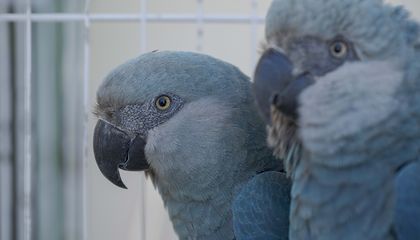
The Spix’s macaw, the brilliant blue parrot that became the face of the animated hit Rio, has been pulled into a real-world conservation crisis. Smithsonian Magazine reports that an effort to bring the species back from the brink collapsed in controversy and confusion.
The bird disappeared from South American skies more than 30 years ago. For a species already reduced to a singular, tightly watched population in human care, that absence turned every later recovery plan into a high-stakes experiment rather than a routine wildlife project.
In popular culture the macaw is inseparable from Rio, the film that cast a blue Brazilian parrot as its star and introduced millions of viewers to a bird most had never seen in the wild. That fame raised the species’ profile, but it did not, by itself, settle the harder questions of habitat, captive breeding, and who controls a recovery once a bird is gone from its native range.
Smithsonian’s account frames the comeback not as a completed rescue but as a drama. The magazine describes an effort to resurrect the species that broke down amid dispute and muddled decision-making. The reporting does not, in the material available here, spell out a single official verdict on what comes next for birds still held in captivity or for any attempted return to Brazil.
The stakes are unusually sharp because the Spix’s macaw is not one threatened bird among many in a still-functioning wild population. Once a species has vanished from the landscape, restoring it depends on birds that exist only because people kept them alive, and on agreements about where those birds belong.
That dependence is where conservation stories often turn political. Breeding programs, international transfers, and release sites all require trust among governments, private holders, and scientists. When that trust fails, the animals sit at the center of an argument they cannot influence, and the public narrative of a “saved” species can outrun the facts on the ground.
Brazil remains the geographic heart of the story: the bird is identified with the country, and the film that made it famous is set there. The loss itself is described more broadly, as a disappearance from South American skies. The available account does not pin the collapse of the recovery effort to a named locality, agency, or date beyond that long absence of more than 30 years.
Why the episode matters goes past one parrot. Iconic species attract money, attention, and impatience. They also show how quickly a rescue can stall when partners disagree about methods, ownership, or what counts as success. A collapse “in controversy and confusion,” as Smithsonian puts it, is a warning that visibility is not the same as a workable plan.
Readers should treat finer claims—population counts, the fate of particular release attempts, or quotations from participants—as outside what this brief account establishes. Those details belong to the full magazine report and to primary conservation records, not to extrapolation.
What happens next is unresolved in the material at hand. The species is still defined by a vanished wild presence and by a restoration effort that Smithsonian says fell apart. Any renewed attempt would have to rebuild both the biological program and the trust that the last one lost, with the blue bird of Rio still caught between celebrity and survival.
Primary source: Smithsonian Magazine. Newzly rewrites and structures source reporting for clarity; verify critical details at the original.