Tri-Screen Portable Monitors Offer Expansive Workspaces at the Cost of Added Bulk
Portable multi-display accessories promise mobile professionals desktop-grade productivity on the go, but emerging hardware designs show that carrying triple the screen real estate demands substantial trade-offs in weight, cable management, and power consumption.
In this piece
Triple-screen portable monitors are drawing interest from remote workers seeking expansive digital workspaces away from traditional desks. While the hardware…
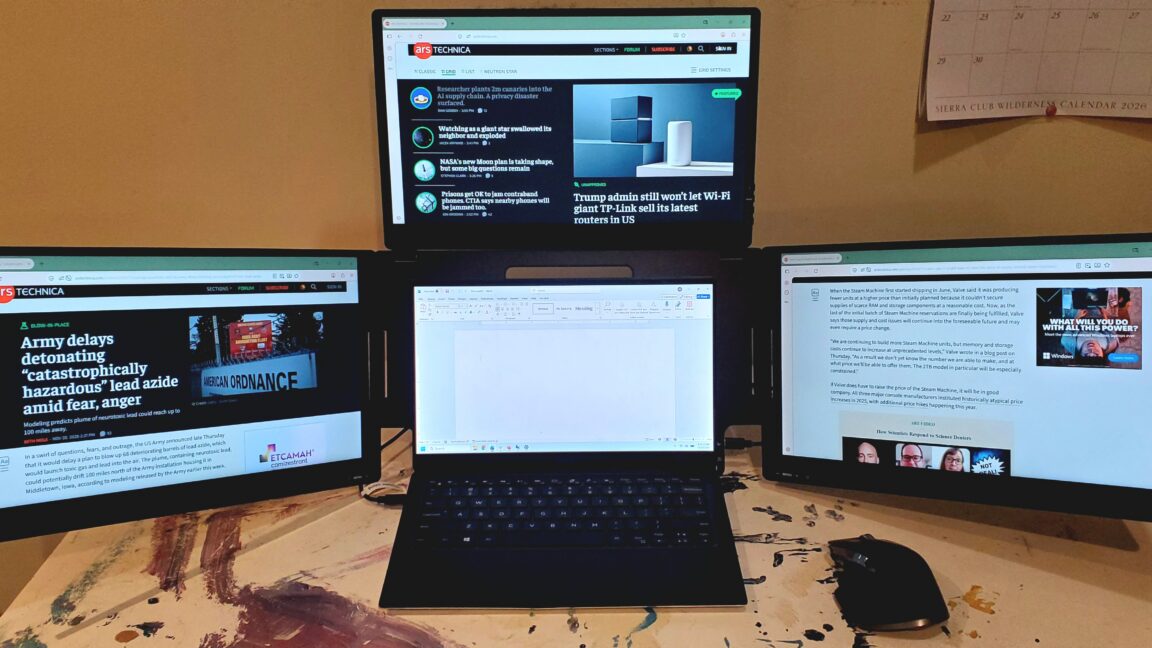
The rise of mobile workstations has spurred a wave of specialized accessories, but triple-screen portable monitors are proving to be a demanding solution for everyday travelers. As tech publication Ars Technica highlighted in its assessment of multi-display portable setups, expanding a laptop into a three-screen array introduces notable physical and operational burdens. While the hardware delivers unprecedented visual real estate outside the office, the practical experience often challenges conventional notions of portable computing.
Multi-screen extenders typically feature dual auxiliary displays that either clamp to the back of a laptop lid or unfold from an independent kickstand enclosure. Designed to flank a central laptop display, the units aim to recreate the multi-window productivity commonly found in dedicated desktop environments. For professionals managing sprawling spreadsheets, code repositories, or simultaneous communication feeds, having three active panels on the road offers an appealing workspace upgrade.
However, the physical toll of these accessories quickly becomes apparent once they are packed into a commuter bag. Incorporating two distinct display panels, structural hinges, protective outer frames, and mounting brackets inevitably adds substantial weight and thickness to mobile gear. Carrying an entire tri-screen apparatus alongside a laptop often doubles the heft of a traveler's bag, transforming an otherwise lightweight device into a dense load.
Beyond transit, the mechanical footprint of triple-screen monitors presents significant ergonomic and structural concerns during active use. Clamping dual auxiliary displays onto a laptop lid places continuous mechanical strain on delicate internal display hinges. Unless supported by sturdy secondary kickstands or deployed on spacious tables, the sheer width and shifting center of gravity can cause laptops to wobble or tip backward.
Connectivity and power delivery introduce another major layer of friction for prospective users. Powering two supplementary screens while transmitting independent video signals typically requires multiple full-featured USB-C cables, proprietary splitters, or external power bricks. Mobile workers often find themselves untangling an elaborate web of cords, negating the simplicity that typically defines modern laptop operation.
The energy footprint of two extra display panels also exacts a heavy toll on host machine performance and endurance. Running twin displays directly from a laptop battery can drain charge at an accelerated rate, leaving workers tethered to wall outlets. Furthermore, older or less capable laptops can experience thermal throttling or graphical stutter when tasked with driving multiple high-resolution video streams concurrently.
Because of these operational hurdles, industry observers note that tri-screen monitors remain a niche proposition rather than a universal travel necessity. While power users and specialized analysts who remain parked at temporary desks for weeks at a time might justify the bulk, casual coffee-shop workers and frequent fliers often find them impractical. Single-panel portable monitors have conversely found wider appeal by balancing secondary display utility with modest dimensions.
Hardware manufacturers are continuing to refine hinge mechanisms, lightweight composite materials, and single-cable data transmission in hopes of slimming down future iterations. As display panels become thinner and low-power display controllers mature, the footprint of multi-screen attachments may gradually decrease. Until those engineering breakthroughs become widespread, prospective buyers must weigh the luxury of extra pixels against the undeniable reality of extra bulk.
Primary source: Ars Technica. Newzly rewrites and structures source reporting for clarity; verify critical details at the original.