Unclaimed Bitcoin Bounty Raises Questions About PHP Hacking Challenge
Steal My Bitcoin is offering roughly $2,000 to anyone who retrieves a hidden private key, but an unverified analysis questions whether its server exposes the vulnerabilities participants are meant to exploit.
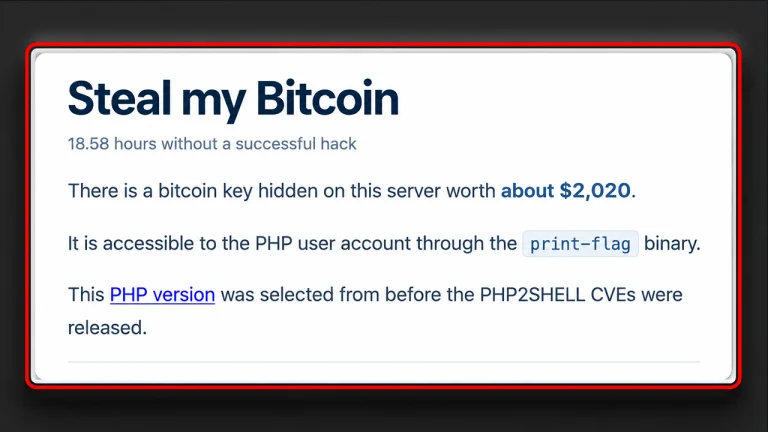
A website offering roughly $2,000 in bitcoin to anyone who retrieves a hidden private key has prompted questions about whether its hacking challenge is technically achievable. Bitcoin.com News reported on Oct. 25 that the prize remained unclaimed after more than 17 hours, while an independent examination questioned the server’s configuration.
The site, Steal My Bitcoin, challenges participants to compromise a deliberately unpatched PHP environment and use the concealed key to take the funds. According to TokenPost’s reporting, its creator, posting as cloudlandsdev, described the experiment as a test of whether recently disclosed PHP vulnerabilities could be exploited in practice.
The creator said the PHP container used default settings without special hardening, TokenPost reported. A version endpoint added after questions from commenters identified PHP 8.4.26, which predates the security update addressing the flaws. Those details describe the advertised environment, but do not independently establish a workable route to the key.
The uncertainty centers on how incoming requests are processed. According to Bitcoin.com News, an individual examining the challenge compared its responses with local test environments and suggested nginx might be forwarding requests to PHP’s built-in web server, rather than the initially suspected alternatives.
The same examination suggested the entry point could be serving a static HTML file instead of executing a PHP script. If correct, that configuration might prevent participants from reaching the conditions needed for the intended exploit. The interpretation remains a hypothesis, not a confirmed description of the server.
Response comparisons alone cannot prove that every permitted attack path is inaccessible. The individual behind the examination acknowledged that the findings could be wrong, Bitcoin.com News reported. An unclaimed prize therefore does not establish that the competition is impossible or deliberately misleading.
The underlying security concerns are separately documented by the PHP project. Its Oct. 21 advisory confirmed two critical vulnerabilities, CVE-2026-109618 and CVE-2026-109619, that can permit remote code execution without authentication. The project released fixes in PHP 8.5.12, 8.4.27, 8.3.36 and 8.2.35.
PHP’s advisory describes problems involving interrupted initialization during memory exhaustion and internal state remaining after its backing memory has been freed. It identifies installations serving web requests as at risk and says the highest risk is associated with Apache’s mod_php, where exploitation has been demonstrated before application code runs.
That broader warning limits what can be inferred from this particular contest. Failure to retrieve one server’s hidden key is not evidence that other affected installations are secure. The PHP project strongly urges users to update and says interim measures reduce specific exposures rather than provide a complete solution.
For the challenge, the unresolved issue is whether its actual request-processing environment makes the advertised vulnerabilities reachable. A demonstrated exploit or verified configuration analysis would provide stronger evidence than the elapsed time alone. Until then, the bounty remains an inconclusive practical test, not a verdict on the vulnerabilities’ severity.
Primary source: Bitcoin.com News. Newzly rewrites and structures source reporting for clarity; verify critical details at the original.