Voyager 1 nears one light-day from Earth
Nearly 50 years after launch, NASA’s Voyager 1 is approaching a distance of one light-day from Earth, adding another milestone to a mission that has already taken it beyond the heliosphere.
In this piece
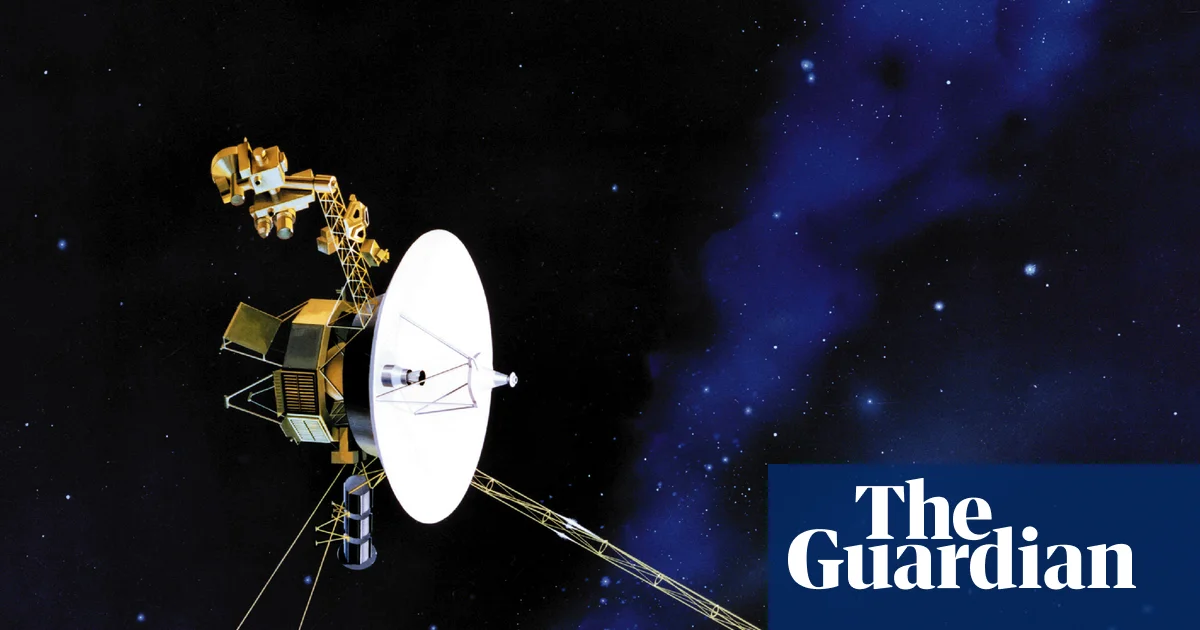
Voyager 1, the farthest human-made object from Earth, is nearing a distance that light takes a full day to cross. A Guardian Science video examines the…
NASA’s Voyager 1 is approaching a distance of one light-day from Earth, a milestone for the farthest human-made object from our planet. Nearly 50 years after the Voyager probes were sent into space, the spacecraft’s journey continues to stretch the scale of human exploration.
The approaching milestone is the subject of a Guardian Science video featuring planetary scientist Jim Bell, a professor at Arizona State University’s School of Earth and Space Exploration. Speaking with Madeleine Finlay, Bell discusses the mission’s impact on understanding the solar system and considers where Voyager 1 could be heading next.
A light-day is a measure of distance: the span that light travels in a full day. Describing Voyager 1’s separation from Earth in those terms makes an otherwise difficult-to-picture distance more understandable, while underscoring how far the spacecraft has travelled since the mission began.
NASA sent Voyager 1 and Voyager 2 into space almost five decades ago to explore the outer reaches of the solar system. The two probes form the background to a story that now extends beyond their original exploration of that region, with Voyager 1 holding the distinction of being farther from Earth than any other human-made object.
Voyager 1 has already left the heliosphere, the region of space dominated by the Sun’s influence through its outward-flowing solar wind. That boundary crossing and the approaching light-day distance describe different aspects of its journey: one concerns the spacecraft’s surrounding environment, while the other measures its separation from Earth.
The distinction matters because reaching one light-day does not, by itself, mark a new physical boundary in space. Instead, it offers a way to take stock of a mission whose significance includes both the distances travelled and the changes it has brought to scientific understanding. The Guardian’s discussion with Bell places that scientific legacy alongside the spacecraft’s continuing outward journey.
The supplied account describes Voyager 1 as about to reach the distance, rather than confirming that it has already done so. It does not provide an exact crossing time or further details about the spacecraft’s current operations, so the milestone is best understood here as approaching rather than completed.
What comes next is framed in the video as a question about Voyager 1’s onward path beyond the heliosphere. The account does not identify a specific destination or timetable for that journey. For now, the approaching one-light-day mark provides another opportunity to assess how a mission launched almost half a century ago has expanded humanity’s view of the solar system.
Primary source: The Guardian Science. Newzly rewrites and structures source reporting for clarity; verify critical details at the original.