Voyager 1’s one-light-day milestone prompts a fresh look at the Golden Record
An Ars Technica headline links Voyager 1’s one-light-day milestone with a historian’s reexamination of the Golden Record, bringing the spacecraft’s cultural message back into focus alongside its distance from Earth.
In this piece
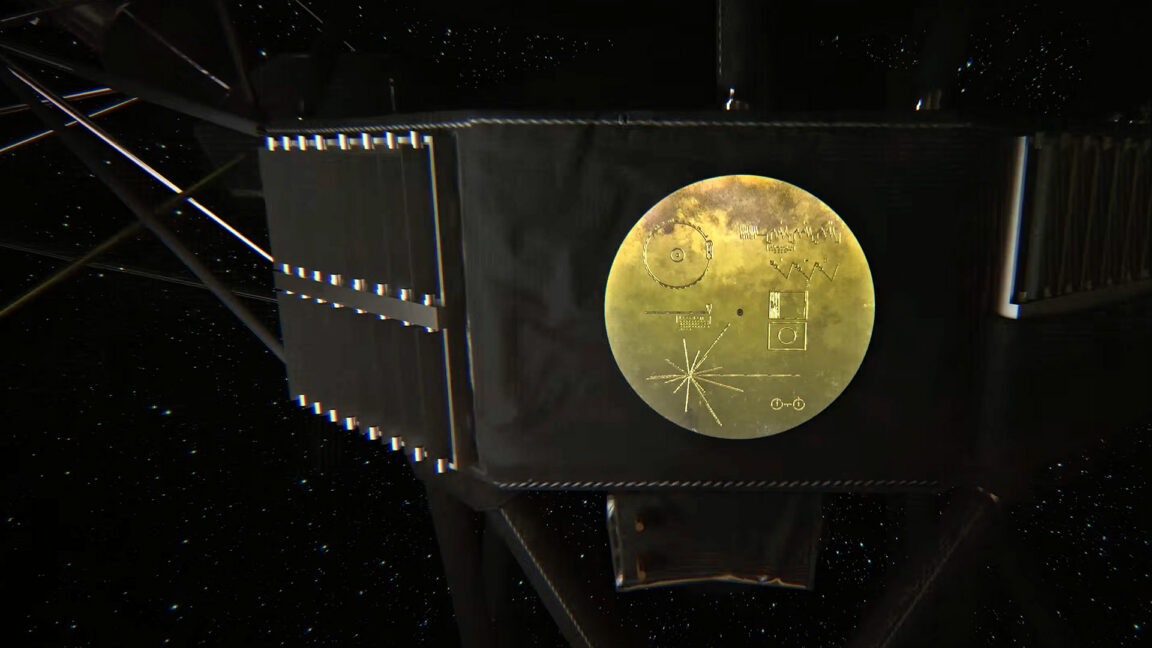
Ars Technica frames Voyager 1’s one-light-day milestone around a historian’s return to overlooked details of the Golden Record. The supplied material contains…
Voyager 1’s one-light-day milestone provides the setting for a historian’s reconsideration of the Golden Record, according to a headline published by Ars Technica. The framing brings together two aspects of the spacecraft’s significance: its extraordinary distance and the human message associated with its journey.
The supplied headline describes the historian as revisiting the record’s “forgotten details,” suggesting an account focused on aspects that have received less attention. However, no article text accompanies the link, so the particular details, the historian’s identity and the evidence behind that assessment cannot be established from the available material.
A light-day is a measure of distance: the distance light travels in one day. Applied to a spacecraft’s separation from Earth, it also conveys the scale of the communications delay, because a signal traveling at light speed would need a day to cover that distance in one direction.
That distinction matters when interpreting the milestone. The phrase describes distance through travel time rather than indicating how long Voyager 1 has been in flight, and the supplied headline alone does not establish the measurement date, reference point or whether the article treats the threshold as reached or forthcoming.
The Golden Record gives the story a different frame from a report concerned only with distance. By pairing the milestone with historical examination, the headline directs attention toward the meaning of the message accompanying the spacecraft, rather than presenting the journey solely as a numerical achievement.
The reference to forgotten details also calls for a distinction between historical recovery and a new discovery. Revisiting an overlooked account does not necessarily mean previously unknown evidence has emerged, and without the article it would be premature to characterize the historian’s work as overturning an established understanding of the record.
For readers, the central interest is the connection between a spacecraft moving farther away and a cultural artifact being examined again. That juxtaposition offers a way to consider the mission through both distance and historical interpretation, although the headline does not disclose what conclusions the historian draws or how those conclusions are supported.
The full report would be needed to establish the specific historical findings and the precise basis for the distance milestone. Until those details are available, the supported account remains narrow: Ars Technica has framed Voyager 1 at one light-day as an occasion to revisit the Golden Record, but the substance of that reassessment cannot be independently described from the supplied headline alone.
Primary source: Ars Technica. Newzly rewrites and structures source reporting for clarity; verify critical details at the original.