Wizz Air Flight From Luton Makes Emergency Landing in Budapest Following Bomb Threat
A Wizz Air passenger flight from London Luton Airport made an emergency landing in Budapest after a mid-air bomb threat prompted a Hungarian fighter jet to escort the aircraft.
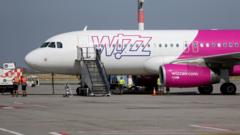
A Wizz Air passenger flight departing from London Luton Airport made an emergency landing in Budapest following a mid-air bomb threat, according to a report from BBC World. The commercial airliner was flying toward Central Europe when the alert was issued, prompting regional air traffic controllers and defense authorities to activate emergency protocols. A Hungarian fighter jet was scrambled to intercept the aircraft, subsequently escorting it safely to a landing in the Hungarian capital.
The security alert occurred while the aircraft was en route, necessitating swift operational coordination between civilian navigation services and military command centers. Hungarian defense forces deployed the fighter jet to establish immediate visual contact and monitor the airliner as it entered the country's national airspace. The escort remained with the passenger aircraft until it touched down without reported incident on the tarmac in Budapest.
Mid-flight security emergencies of this nature trigger established international aviation defense and safety frameworks across Europe. When a potential threat to an airliner is reported to authorities, quick-reaction military aircraft are routinely mobilized to provide tactical support and continuous surveillance. These established measures are intended to maintain clear flight paths, safeguard civilian airspace, and assist the flight crew during high-stress operational circumstances.
Standard civil aviation security procedures dictate that intercepted aircraft receive priority handling and direct routing from regional air traffic control agencies. The escorting military jet serves as a direct operational liaison, maintaining visual tracking and assisting ground controllers in managing the airspace corridor leading to the airport. This coordinated approach ensures that other commercial traffic is kept at a safe perimeter while the affected flight prepares for an expedited approach.
Budapest is the primary corporate and operational hub for Wizz Air, providing established maintenance, security, and administrative resources to handle complex fleet contingencies. Although specific details regarding whether Budapest was the flight's scheduled destination or an emergency diversion point were not immediately elaborated in initial reports, the carrier's primary facilities allow for comprehensive on-the-ground management. Airport emergency response teams were placed on standby to receive the arriving airliner.
Following the landing of an aircraft subjected to a bomb alert, standard aerodrome safety directives require the plane to taxi to a designated remote parking bay away from active passenger terminals. Ground personnel, local law enforcement, and specialized explosive ordnance disposal units typically cordon off the perimeter immediately upon arrival. Evacuation or controlled deplaning procedures are standard, followed by thorough security screenings of all travelers and their personal belongings.
Security teams are also mandated to carry out meticulous physical and technological sweeps of the aircraft's passenger cabin, luggage holds, and mechanical compartments. Every piece of checked baggage and freight must be re-screened to verify that no hazardous materials or suspicious devices are present on board. While such exhaustive inspections inevitably generate significant logistical delays, aviation regulators emphasize that precautionary procedures remain paramount in mitigating potential security risks.
Aviation industry experts note that while hoaxes and unsubstantiated threats occasionally target commercial air travel, authorities treat every incident with absolute operational seriousness until thoroughly investigated. The deployment of frontline military aircraft underscores the zero-tolerance stance adopted by European defense commands when addressing potential civil aviation security risks. Such emergency measures reflect strict adherence to multilateral air defense protocols established across the continent.
Official information regarding the origin of the threat, the flight number, and the exact count of passengers and crew members on board has not yet been publicly disclosed by authorities. Hungarian aviation and police officials are conducting their assessment to determine the credibility and source of the alert before releasing further findings. The aircraft is expected to remain under formal security evaluation until cleared by investigators to resume commercial service.
Primary source: BBC World. Newzly rewrites and structures source reporting for clarity; verify critical details at the original.