Behind the Tumultuous Real-Life Battle to Resurrect the Spix’s Macaw
Decades after vanishing from the wild, Brazil's iconic Spix’s macaw was slated for a historic comeback, but an ambitious international reintroduction effort has fractured amid fierce controversy, opaque management, and diplomatic disputes.
In this piece
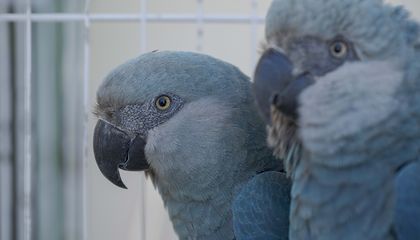
The Spix’s macaw, the rare blue bird that inspired the animated movie 'Rio,' vanished from the wild more than three decades ago. While captive breeding…
An ambitious international mission to reintroduce the Spix’s macaw to its native Brazilian habitat has run aground amid deep controversy and institutional fracturing. More than three decades after the striking blue parrot vanished from the wild, efforts to revive the species have become ensnared in disputes between wildlife authorities, independent researchers, and the private custodians managing the surviving captive population. The breakdown has transformed what was once hailed as a triumph of modern conservation into an acrimonious battle over the bird's future.
Known scientifically as Cyanopsitta spixii, the Spix’s macaw was once endemic to the arid Caatinga shrublands of northeastern Brazil. Decades of habitat destruction, dam construction, and rampant poaching for the illicit pet trade decimated the species throughout the late twentieth century. By the year 2000, the last confirmed wild individual disappeared, leaving the entire global population confined to a small, fragmented network of private collections and breeding aviaries.
The bird’s desperate plight reached global audiences in 2011 with the release of the animated blockbuster "Rio," which followed a captive-bred macaw named Blu traveling to Brazil to save his kind. The cinematic storyline mirrored real-world hopes that coordinated breeding science could orchestrate a miraculous ecological comeback. However, unlike the tidy resolution of the film, the actual rescue effort quickly found itself entangled in complex international wildlife politics and competing interests.
Much of the surviving captive population became concentrated in the hands of the Association for the Conservation of Threatened Parrots, a German non-governmental organization founded by private collector Martin Guth. Holding the vast majority of the world's remaining Spix’s macaws, the organization became an indispensable yet controversial partner for the Brazilian government. While the facility achieved notable breeding success that increased the species’ total head count, critics raised persistent questions regarding governance, oversight, and operational transparency.
In early 2020, years of delicate negotiations culminated in the repatriation of dozens of macaws to a purpose-built release facility in Curaçá, within Brazil’s Bahia state. Two years later, conservationists celebrated when a small cohort of birds was formally released into the wild, marking the first time in over twenty years that the species took flight in its ancestral home. For a brief moment, the collaborative endeavor appeared to vindicate the high-stakes strategy of relying on private stewardship.
That fragile consensus quickly deteriorated as tensions flared between German facility leadership and Brazilian environmental authorities under the Chico Mendes Institute for Biodiversity Conservation. The strain deepened following the controversial transfer of captive macaws to outside entities, including an animal rescue center in India, without the explicit consensus of Brazilian regulators. Scientific partners voiced alarm over the fragmentation of genetic management and what they characterized as unilateral decision-making by private holders.
The collapse of the partnership underscores fundamental dilemmas in contemporary biodiversity management, where extreme endangerment forces state agencies to collaborate with wealthy private collectors. When a species goes extinct in the wild, legal sovereignty and stewardship often clash with private property rights over surviving captive specimens. Biologists emphasize that conserving critically endangered fauna requires public accountability, genetic diversity preservation, and open ecological data, standards that proved difficult to maintain under a closed custodial model.
In response to escalating friction and governance breakdowns, the Brazilian government formally moved to sever its cooperation agreements with the German organization. Brazilian authorities have sought to assert sovereign control over the wild release site and establish alternative breeding networks with zoological institutions. Nevertheless, because dozens of birds remain housed abroad under separate jurisdictions, efforts to consolidate the global flock under a unified conservation plan remain severely hindered.
Moving forward, the fate of the Spix’s macaw hinges on whether fractured international parties can reestablish functional diplomatic and scientific protocols. Environmental monitors and ornithologists warn that without coordinated captive breeding and transparent genetic sharing, the wild population in Bahia cannot achieve long-term demographic viability. While the dream of repopulating the Caatinga skies endures, the crisis serves as a sobering reminder of the political and systemic fragility that plagues modern endangered species restoration.
Primary source: Smithsonian Magazine. Newzly rewrites and structures source reporting for clarity; verify critical details at the original.