Canada and EU Launch 'Alliance for the Future' at Montreal Summit
Canadian Prime Minister Mark Carney and EU leaders have unveiled the Alliance for the Future in Montreal, establishing a strategic bloc to protect member nations against rising global geopolitical instability.
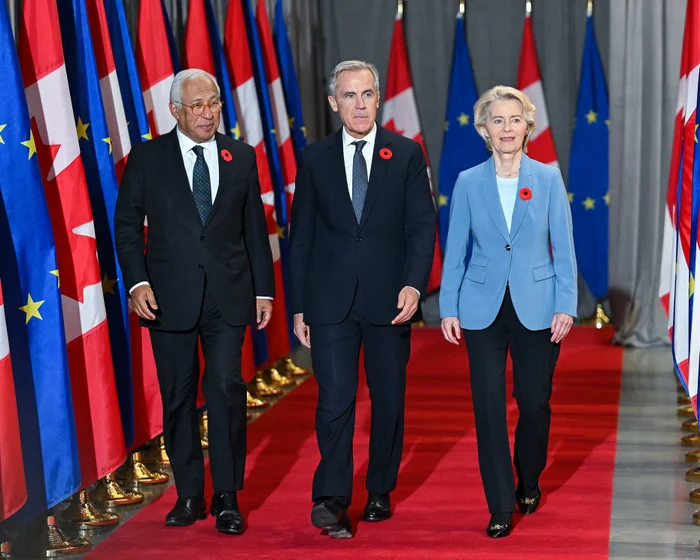
Canada and the European Union have announced the creation of the Alliance for the Future, a wide-ranging strategic pact designed to deepen transatlantic cooperation among democratic nations. The initiative was formally unveiled on Friday during a high-level bilateral summit held in Montreal. Leaders from both sides framed the agreement as a necessary foundation for enduring economic security and institutional resilience in an increasingly fragmented international landscape.
Speaking to reporters following the conclusion of bilateral talks, Canadian Prime Minister Mark Carney and European Commission President Ursula von der Leyen presented the pact as a vital buffer against escalating geopolitical turbulence. Von der Leyen characterized the alliance as a protective canopy under which citizens can thrive, emphasizing that the framework was deliberately conceived for a world shaken by new storms. Carney echoed the sentiment, noting that democratic allies must construct durable, forward-looking mechanisms to safeguard shared prosperity.
The two leaders underscored that the arrangement represents the deepest possible collaboration between Canada and the 27-member European bloc short of formal accession. Carney stated that the comprehensive alignment holds the potential to deliver unprecedented stability and market opportunity across diverse industrial sectors. By establishing joint committees and regular ministerial consultations, both governments aim to fortify diplomatic and regulatory coordination on key global challenges.
While anchored by Ottawa and Brussels, the Alliance for the Future is structured from the outset as an inclusive platform open to like-minded partners around the globe. Officials emphasized that third countries that uphold the rule of law, democratic governance, and fair market principles are encouraged to join specific cooperation tracks. This multilateral orientation is intended to prevent the alliance from functioning as an exclusive club, instead fostering a wider network of resilient states.
The formal unveiling in Montreal reflects growing urgency across transatlantic capitals regarding shifting trade dynamics and broader geopolitical fragmentation. In recent years, unpredictable foreign policy shifts and sudden disruptions to global commerce have exposed vulnerabilities in conventional bilateral frameworks. Policymakers in both Canada and Europe have increasingly sought dependable alternatives that shield domestic economies from external political pressures and unilateral trade actions.
Supply chain security and economic integration feature prominently among the initial priorities established by the new framework. Bilateral discussions centered on ensuring reliable access to critical raw materials, advancing clean energy transitions, and establishing shared standards for digital trade and emerging technologies. Leaders highlighted that pooling expertise in research, advanced manufacturing, and artificial intelligence will help both jurisdictions maintain a competitive edge.
The agreement also seeks to leverage institutional financing and collaborative research programs to translate diplomatic ambitions into tangible commercial ventures. European and Canadian officials signaled plans to connect public and private investment vehicles, accelerating strategic projects in clean industrial growth and sustainable infrastructure. By aligning procurement standards and technological benchmarks, the alliance aims to reduce systemic dependencies on non-allied supply corridors.
For Canada, the partnership represents a major strategic move to broaden its economic and diplomatic horizons beyond traditional North American reliance. For the European Union, solidifying institutional ties with a technologically advanced, resource-rich partner directly supports its push toward open strategic autonomy. The joint initiative demonstrates a shared conviction that democratic middle powers and multilateral blocs must collaborate closely to preserve rules-based international governance.
Looking ahead, bilateral teams and technical working groups are scheduled to meet over the coming months to establish concrete implementation milestones and operational structures. Officials indicated that further details regarding third-country participation criteria and specific joint ventures will be formalized in follow-up sessions early next year. Both Carney and von der Leyen reaffirmed their commitment to turning the Montreal declaration into a lasting pillar of transatlantic stability.
Primary source: The Guardian World. Newzly rewrites and structures source reporting for clarity; verify critical details at the original.