Chandra Uncovers Cause of Repeated Outbursts From Massive Star
NASA’s Chandra X-ray Observatory has solved a long-standing cosmic puzzle, revealing that a hidden compact companion triggers periodic, violent outbursts from a massive star in galaxy NGC 4559.
In this piece
Astronomers using NASA’s Chandra X-ray Observatory have discovered the cause of recurring eruptions from the volatile star AT 2016blu in galaxy NGC 4559. Data…
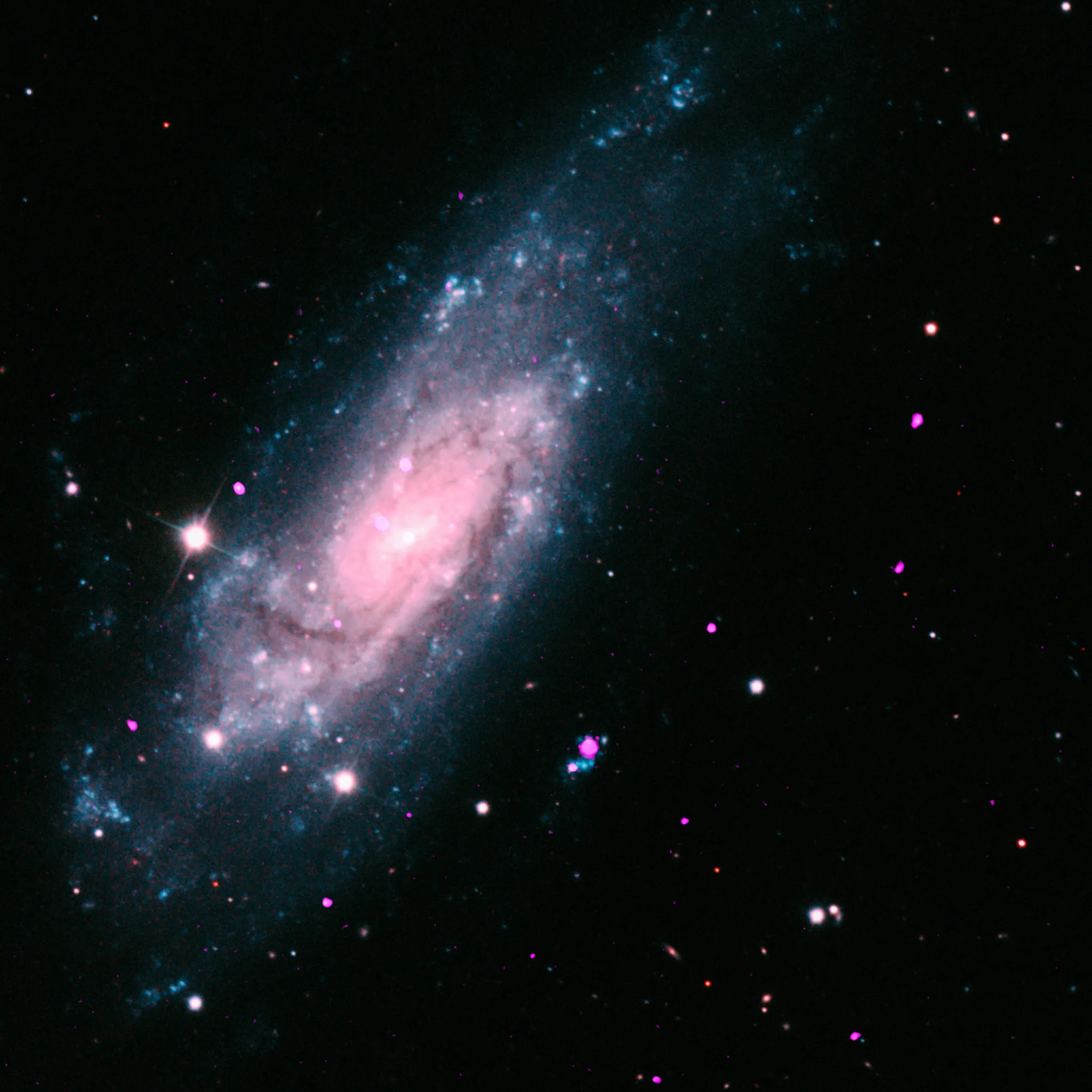
Astronomers utilizing NASA’s Chandra X-ray Observatory have resolved a long-standing cosmic puzzle by identifying the trigger behind recurring eruptive outbursts from an unstable giant star. Located in the spiral galaxy NGC 4559, approximately 30 million light-years from Earth, the volatile star known as AT 2016blu has puzzled observers for years with repetitive, violent blasts. High-energy X-ray observations now confirm that these periodic flares are driven by an unseen compact companion orbiting nearby.
The star is classified as a luminous blue variable, a rare and extremely massive stellar object estimated to hold roughly 33 times the mass of the Sun. Between 2012 and 2026, optical surveys detected at least 27 major outbursts originating from the object, each flaring with immense brightness. Because the eruptions resembled explosive stellar deaths without destroying the primary body, astronomers previously categorized AT 2016blu as a supernova impostor.
Long-term photometric monitoring revealed that the massive star was detonating on an unusually precise schedule, brightening dramatically roughly every 113 days. Such clockwork behavior strongly hinted at gravitational interactions within a binary system rather than purely internal stellar instability. However, optical telescopes alone could not confirm the presence of a companion hidden within the dense circumstellar glare.
To test the binary hypothesis, researchers pointed Chandra toward NGC 4559 during key orbital phases of the 113-day cycle. The sensitive space telescope detected a sharp spike in high-energy X-ray radiation at the exact moment the system reached peak brightness. The data demonstrated that the companion is an ultra-dense stellar corpse, either a neutron star or a stellar-mass black hole.
Astrophysicists explain that the compact companion travels along an elliptical orbit that regularly carries it dangerously close to the outer atmosphere of the luminous blue variable. During this close periastron passage, the immense gravity of the dense object strips away massive quantities of gas from the primary star. As this siphoned gas plunges toward the companion, friction and gravitational acceleration heat it to millions of degrees, triggering powerful X-ray flares and optical bursts.
The findings represent a significant scientific milestone, marking the first time X-ray observations have directly linked a repeating supernova impostor to a compact binary companion. While theorists have long suggested that unseen compact remnants could drive periodic eruptions in unstable massive stars, empirical evidence had remained elusive. Chandra's detection provides the clearest confirmation yet of this interaction mechanism in an extragalactic environment.
Understanding luminous blue variables is critical to unraveling the life cycles of the universe's most massive stars and the origins of heavy elements. These behemoths shed large fractions of their mass through energetic winds and violent eruptions before eventually collapsing into black holes or neutron stars. Binary interactions can dramatically accelerate this shedding process, altering the ultimate fate and remnant structure of both stellar bodies.
Scientists plan to continue monitoring AT 2016blu across multiple wavelengths to refine measurements of the companion's mass and orbital parameters. Follow-up observations combining space-based X-ray data with high-resolution ground-based spectroscopy could definitively determine whether the secondary object is a neutron star or a black hole.
The discovery in NGC 4559 also provides a valuable observational roadmap for identifying similar hidden binary systems lurking in distant galaxies. By hunting for synchronized optical and X-ray variability, astronomers hope to uncover more volatile massive stars being shaped by nearby remnants. Such studies will offer deeper insights into the extreme physics governing massive binary systems on the brink of collapse.
Primary source: NASA Breaking News. Newzly rewrites and structures source reporting for clarity; verify critical details at the original.