Enduring Life’s Endless Troubles: The Saint and the Garden Parable
A classic parable featuring an industrious youth and an ascetic hermit highlights the futility of escaping life's persistent troubles, offering enduring lessons on cultivating emotional resilience through sequential patience.
In this piece
An allegorical narrative highlighted by Divya Bhaskar's Dharm Darshan illustrates how a hardworking youth learned to navigate relentless difficulties through an…
A popular moral parable shared across Gujarati spiritual discourse underscores the human struggle with relentless challenges, illustrating through an ancient encounter between an industrious young seeker and an ascetic saint how persistent difficulties ought to be managed. Published by regional news platform Divya Bhaskar under its Dharm Darshan chronicle, the teaching addresses a universal dilemma: why life rarely permits a total, simultaneous reprieve from obligations and emotional adversity.
According to the narrative, a hardworking and capable young villager found himself chronically overwhelmed by recurring troubles. Despite his diligence and sincerity, consecutive hardships—ranging from domestic responsibilities to economic strains and vocational challenges—left him increasingly anxious, disheartened, and emotionally exhausted.
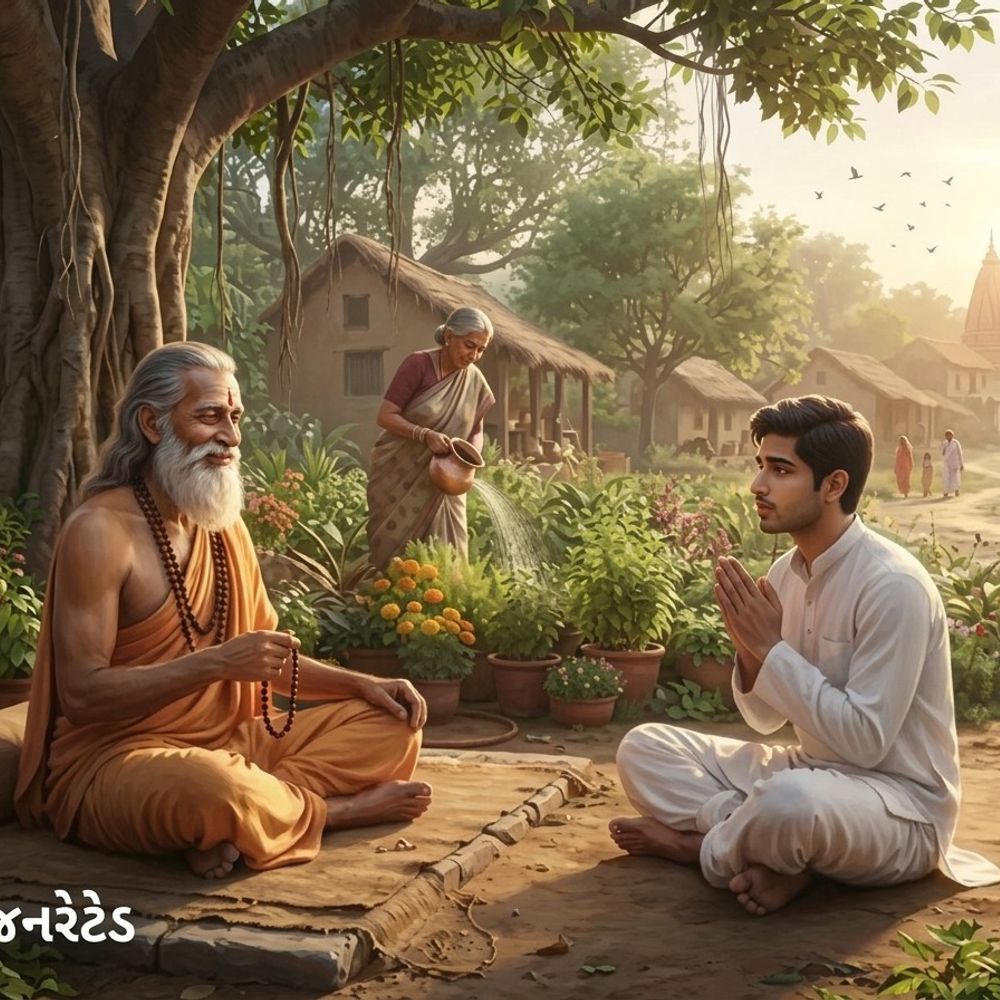
Distressed by the cyclical nature of his worries, the young man sought counsel from a revered elderly saint residing in an ashram on the outskirts of the settlement. Bowing before the ascetic, he pleaded for an ultimate remedy or spiritual formula that could eliminate all tribulations permanently at once, thereby guaranteeing enduring happiness and uninterrupted peace of mind.
The sage listened attentively to the youth's desperate plea with a calm smile, choosing experiential wisdom over theoretical lecturing. Rather than dismissing the impossible request outright, the hermit agreed to provide guidance on the condition that the visitor first perform a morning chore within the hermitage's sprawling botanical grounds.
The following morning, the saint handed the young man a watering vessel and assigned him a deceptively straightforward responsibility. He instructed the youth to irrigate the entire grounds so that no single plant suffered dryness, stipulating that every flowerbed and shrub across the expanse had to remain consistently moist throughout the day.
Determined to prove his commitment, the young man hurried from one quadrant of the garden to another, hauling water and drenching the roots of every plant. However, as the afternoon sun intensified, he discovered that by the time he completed irrigating the far corner of the expansive grounds, the soil in the earlier plots had already parched under the heat.
By twilight, physically drained, bathed in sweat, and thoroughly disillusioned, the youth returned to the hermitage porch. Admitting complete defeat to the spiritual master, he confessed that maintaining uniform moisture across all plants simultaneously was an impossible expectation, noting that tending to one quadrant invariably left another exposed to drying.
The saint warmly smiled and delivered the central philosophical revelation, noting that the futile effort in the garden directly reflected the nature of human existence. Just as a single caretaker cannot force every patch of earth to remain uniformly wet at the same instant, individuals cannot realistically demand an absolute cessation of every problem simultaneously.
The parable teaches that obstacles, duties, and sorrow circulate through life much like shifting weather patterns and the natural transition of seasons. Rather than striving for an artificial state where no conflicts exist, emotional resilience relies on confronting difficulties sequentially, applying focused attention and unagitated judgment to whatever immediate circumstance demands resolution.
In a contemporary culture often preoccupied with instant comfort and zero-stress outcomes, commentators framing such timeless tales note that internal serenity stems from accepting inevitable friction rather than fighting reality. Moving forward, the narrative's enduring appeal serves as a reminder to prioritize present-moment steadiness over chronic anxiety regarding future burdens.
Primary source: Divya Bhaskar Dharm Darshan. Newzly rewrites and structures source reporting for clarity; verify critical details at the original.