NASA’s Curiosity Rover Captures Drifting Twilight Clouds Over Mars
NASA’s Curiosity rover has photographed rare twilight clouds drifting above Gale Crater on its 5,061st Martian day, offering scientists valuable insights into the Red Planet's brief autumn atmospheric displays.
In this piece
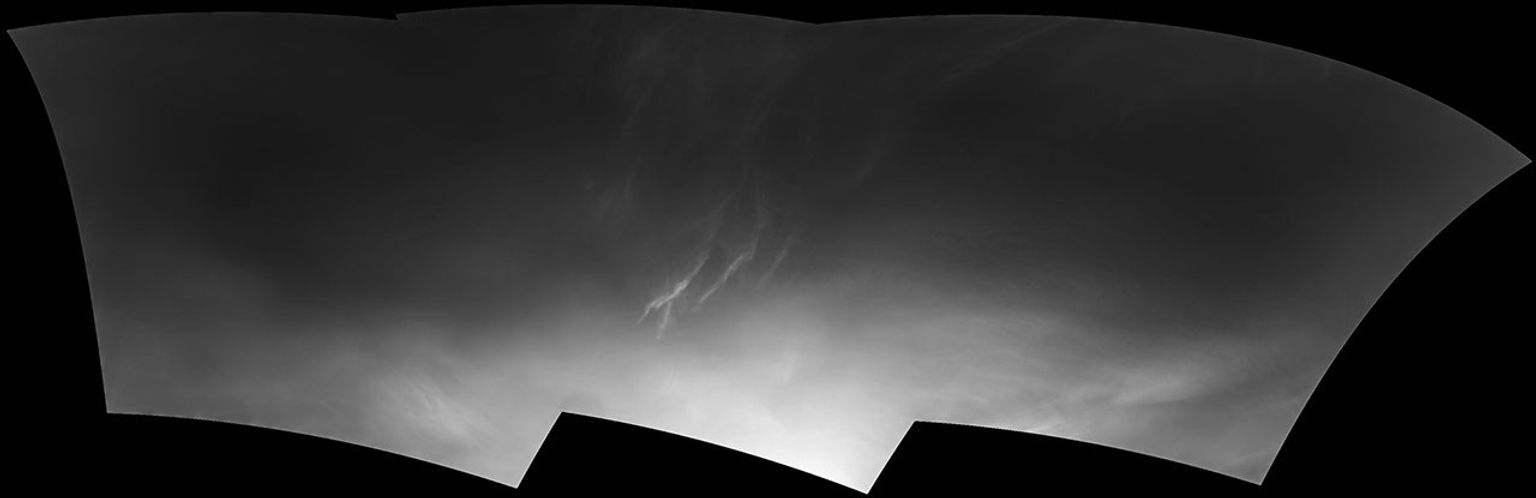
NASA’s Curiosity Mars rover captured drifting twilight clouds over Gale Crater on October 31, 2026, marking sol 5,061 of its mission. The navigation camera…
NASA’s Curiosity Mars rover has captured striking views of drifting twilight clouds floating high in the Martian atmosphere above Gale Crater. The newly released imagery was recorded on October 31, 2026, marking the 5,061st Martian day, or sol, of the rover's ongoing mission. These faint atmospheric features drift across the evening sky during a brief seasonal window on the Red Planet.
The rover relied on its onboard navigation cameras to detect the subtle formations shortly after sunset. Often called twilight clouds or noctilucent clouds, they become visible when sunlight from below the horizon reaches high-altitude particles after the surface has fallen into twilight. The resulting images reveal thin, shimmering structures that would otherwise remain hidden against the brighter daytime sky.
According to mission records, these drifting clouds appear for only a short time each Martian autumn in the skies above Gale Crater. The fleeting nature of the phenomenon makes seasonal imaging campaigns critical for planetary scientists studying the Red Planet. Each occurrence provides researchers with a rare snapshot of active cloud formation in an otherwise arid and dusty environment.
Curiosity has spent more than a decade exploring Gale Crater, having touched down inside the massive basin in August 2012. Although the rover's primary scientific goals center on analyzing rocks and soil for evidence of past habitable environments, atmospheric observations have remained an essential component of its work. Routine sky surveys help scientists track how modern environmental conditions shift from sol to sol.
The Martian atmosphere is notoriously thin, cold, and composed primarily of carbon dioxide, presenting conditions vastly different from Earth's weather systems. Despite the dry atmosphere, high-altitude clouds can form when minuscule amounts of water ice or dry ice condense into crystalline veils. Determining the altitude and composition of these clouds offers crucial clues about temperature variations in the upper atmosphere.
Imaging these delicate structures demands specialized timing and exposure sequences. Navigation cameras take repeated frames to monitor how cloud banks drift and disperse in high-altitude winds. By measuring the speed and direction of the shifting patterns, researchers can deduce upper-level wind speeds in regions where ground-based weather stations cannot directly measure them.
The study of Martian twilight clouds provides wider benefits for understanding the planet's dynamic climate and seasonal water cycles. Tracking when these clouds form, how long they persist, and when they disappear helps planetary scientists refine global atmospheric models. These models are essential not only for understanding Mars' planetary history, but also for forecasting environmental conditions for future robotic and crewed missions.
Reaching sol 5,061 represents an extraordinary endurance record for Curiosity, which was originally planned for an operational lifetime of approximately two Earth years. The rover continues to climb the foothills of Mount Sharp, the five-kilometer-high mountain rising from the center of Gale Crater. Even as its mechanical hardware ages, its scientific instruments continue to supply new perspectives on the Martian landscape and atmosphere.
Planetary meteorology on Mars also offers key comparative data for atmospheric science across the solar system. Observing cloud behavior and dust transport in such a low-pressure environment allows scientists to test fundamental principles of physics and atmospheric circulation. The distinct bowl-like topography of Gale Crater creates unique local conditions that make sustained observations especially valuable.
With the autumn cloud-watching window active, Curiosity is expected to conduct further twilight observations alongside its regular geological sampling tasks. Science teams on Earth will continue cataloging incoming navigation camera data to map the lifecycle of this season's twilight displays. As the mission pushes forward, each new sol brings additional clarity to the evolving weather of Mars.
Primary source: NASA Breaking News. Newzly rewrites and structures source reporting for clarity; verify critical details at the original.