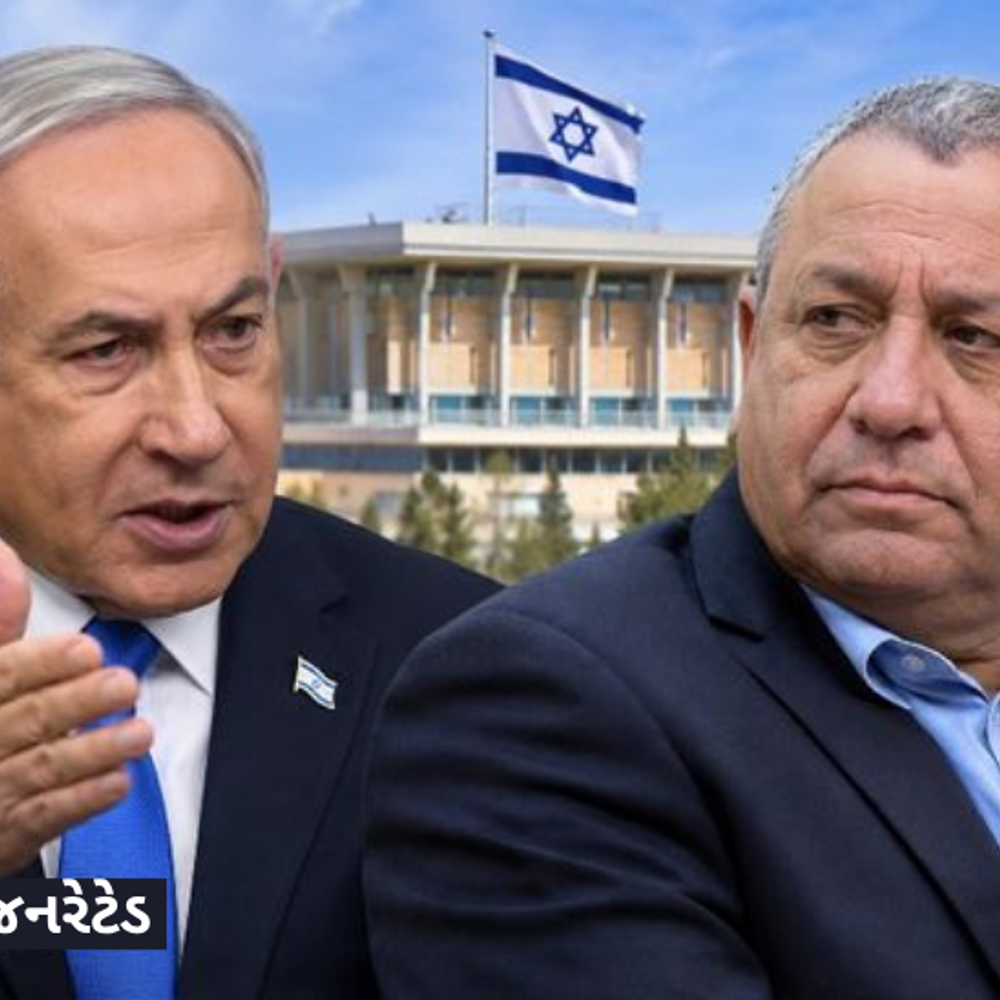
Netanyahu and Eisenkot discuss government talks and sharing the premiership
Divya Bhaskar reports that Benjamin Netanyahu and Gadi Eisenkot have discussed forming a government, including a proposal to share the prime minister’s post, with Eisenkot seeking proof of seriousness within 24 hours.
In this piece
A Divya Bhaskar report says Benjamin Netanyahu and Gadi Eisenkot have talked about forming a government and sharing the prime minister’s post. Eisenkot is…
Benjamin Netanyahu and Gadi Eisenkot have discussed forming a government in Israel, according to a report by Divya Bhaskar, which says a proposal to share the prime minister’s post is part of the talks. The same account says Eisenkot has called on Netanyahu to demonstrate seriousness within 24 hours.
The report appears on the outlet’s international desk and is framed as news of political contact over a governing arrangement. The headline presents the sharing of the premiership as a proposal under discussion. The material available with the report does not describe a signed agreement, a meeting place, or other participants.
Eisenkot is the former chief of staff of the Israel Defense Forces who later moved into politics, and he is the figure the report places opposite Netanyahu. Netanyahu, the longtime Likud leader, is named as the person Eisenkot wants to see answer that call on a one-day timetable. The report summarizes Eisenkot’s position in those terms and does not reproduce a longer statement or a list of conditions.
Sharing the prime minister’s office would be a high-stakes formula in a system built on coalition bargaining. Israel’s governments depend on Knesset majorities assembled from multiple parties, and the premiership is often the prize that decides whether rivals can sit together. A rotation deal between Netanyahu and Benny Gantz in 2020 is a recent precedent for splitting the post over time; that arrangement later came apart. Divya Bhaskar’s account says sharing has been proposed in the current talks and does not claim the proposal copies the 2020 terms.
The report leaves open how any split would work in practice. It does not set out how long each figure would hold the office, which parties would join a coalition, or which policy disputes the talks are meant to settle. Those gaps matter because a rotation can ease a partnership only when both sides accept a timetable and a common platform.
Eisenkot’s reported 24-hour appeal, as Divya Bhaskar presents it, asks Netanyahu to show that the discussions are in earnest. A deadline that short would push the exchange from quiet soundings toward a public political signal. Whether Netanyahu treats the window as binding is not answered in the report.
The pressure described in the headline also shows why the story is still provisional. Coalition contacts in Israel often move through staff talks, party forums, and public statements before any candidate is asked to form a government. A single call for seriousness within a day can accelerate that process or expose that the sides remain far apart. The report itself stops at the talks, the proposal, and Eisenkot’s appeal.
Readers have a narrow set of attributed facts: discussions between Netanyahu and Eisenkot on forming a government, a proposal to share the prime minister’s post, and a request that Netanyahu prove seriousness within 24 hours. Seat counts, a date for any Knesset vote, and comments from other faction leaders are outside what this account supplies.
What comes next hinges on whether Netanyahu responds inside the period Eisenkot is reported to have set, and on whether a sharing idea moves from proposal to negotiated terms. Divya Bhaskar does not describe a completed government or any timetable beyond that appeal. Until the people named in the report, or their parties, put a fuller account on the record, the effort remains a discussion under a short public test.
Primary source: Divya Bhaskar International. Newzly rewrites and structures source reporting for clarity; verify critical details at the original.