Netanyahu and Eisenkot hold talks on a unity government to break Israel’s deadlock
Israel’s prime minister and Gadi Eisenkot met as reports said Netanyahu offered his rival the first turn in a rotating premiership, part of a push for a national unity government.
In this piece
Benjamin Netanyahu and Gadi Eisenkot held talks on forming a national unity government to break Israel’s political deadlock, according to multiple news reports.…
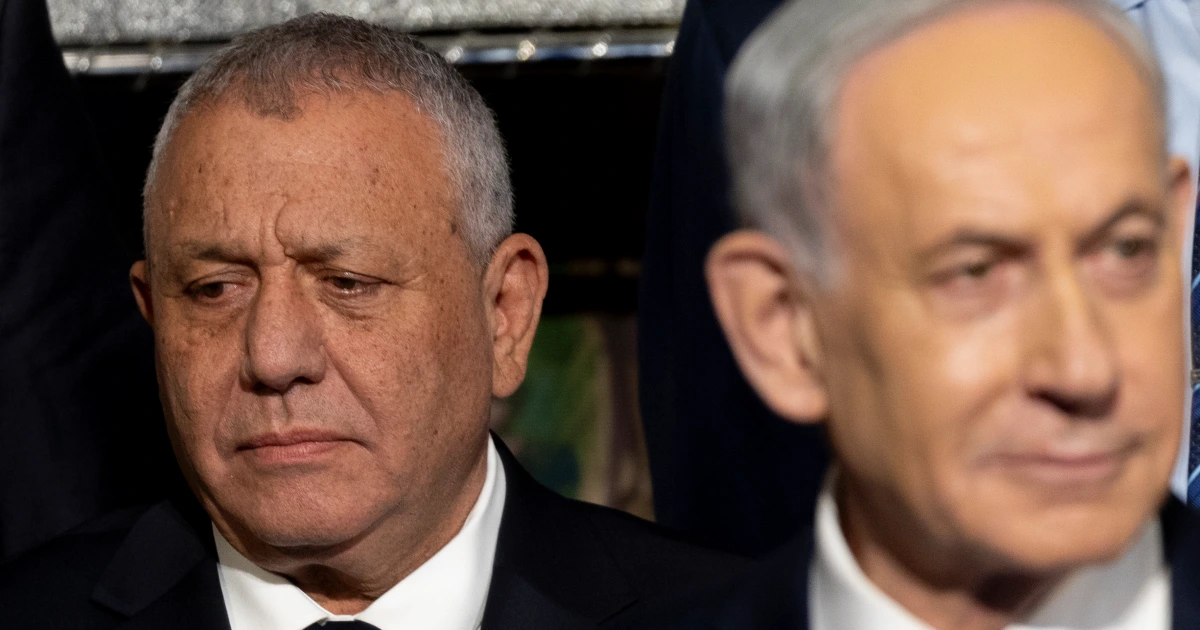
Israeli Prime Minister Benjamin Netanyahu and Gadi Eisenkot have held talks aimed at forming a national unity government, according to reports from NBC News, Politico, The New York Times, The Washington Post, and Al Jazeera. The discussions are framed as an effort to break a governing deadlock.
The New York Times reported that Netanyahu, under pressure, offered a rival the lead in a unity government. The Washington Post said Netanyahu offered to let Eisenkot lead first in a power-sharing government. Al Jazeera reported that the two met after a rotating premiership proposal.
Taken together, the accounts describe a possible arrangement in which leadership would rotate rather than rest with a single premier for a full term. Reports indicate Eisenkot would take the first turn if such a deal were reached. Outlets have not published, in the material reviewed here, a full text of any agreement or a timetable for a rotation.
Politico described the meeting as a discussion of forming a “national unity government.” NBC News characterized the talks as a push to break the deadlock. Those formulations point to coalition arithmetic that has not yet produced a stable governing majority, though the reports available here do not spell out seat counts or party-by-party commitments.
Netanyahu is Israel’s long-serving prime minister and the central figure in repeated efforts to assemble a governing coalition. Eisenkot, a former military chief who later entered politics, has been treated in this round of coverage as the counterpart in the unity talks. The reports do not include on-the-record quotations from either man setting out terms.
A rotating premiership would be a significant concession from a leader who has typically sought to hold the top post himself. Coverage that describes Netanyahu as under pressure suggests the offer is tied to the difficulty of forming a government on existing lines. What that pressure consists of—electoral math, coalition partners, or public standing—is not detailed in the headlines and summaries used for this account.
Unity or power-sharing governments are a familiar tool in parliamentary systems when no bloc can govern alone. In Israel they have been discussed, and at times used, when security crises or electoral stalemates made exclusive coalitions hard to sustain. Whether the current talks fit that pattern, or amount only to an opening bid, is not established by the reporting summarized here.
Any deal would still need political backing beyond a meeting between the two men. A national unity government implies bringing additional parties into an arrangement broad enough to command a majority. The available reports do not name other participants in the talks or say whether coalition partners have accepted a rotation.
The gap between an offer and a government remains wide. Meetings can signal seriousness without producing a signed framework, and a proposal that one leader goes first can still collapse over the length of each turn, control of ministries, or legislation each side treats as essential. None of those details are confirmed in the accounts cited above.
What happens next depends on whether the rotating-premiership idea survives further negotiation. If the sides narrow terms, Israel’s president and the Knesset would still have to move through the formal steps of designating and confirming a government. If talks stall, the deadlock the reports describe would remain unresolved.
For now, the public record is the fact of the meeting and the reported offer that Eisenkot lead first. Further clarity would require statements from the participants or a published outline of the arrangement, neither of which appears in the wire summaries underlying this article.
Primary source: Google News U.S.. Newzly rewrites and structures source reporting for clarity; verify critical details at the original.