Rahul Gandhi says delimitation would be the death of democracy as government readies bills
The Hindu reported that talks between Rahul Gandhi and M.K. Stalin failed as the government prepares constitutional, delimitation, and Union Territory bills and claims a two-thirds majority.
In this piece
Rahul Gandhi warned that delimitation would be the death of democracy in India after talks with M.K. Stalin failed, The Hindu reported. The government plans to…
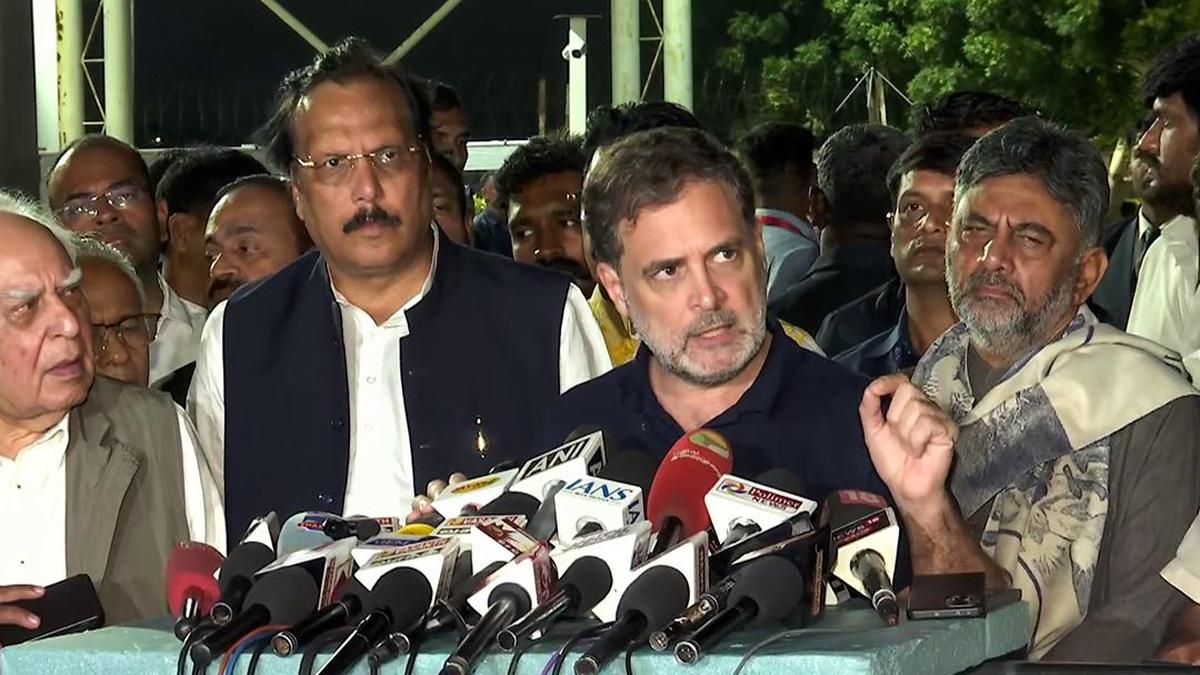
Rahul Gandhi has said delimitation will be the death of democracy in India, The Hindu reported, after talks with M.K. Stalin failed. The warning lands as the Union government prepares to place delimitation legislation before a special sitting of the Lok Sabha. How India redraws constituencies, and how many seats the House will have, is now an open national fight.
News On AIR reported that the government will introduce a Constitution amendment bill, a delimitation bill, and Union Territories laws bills at that special sitting. The same report said the government claims support of more than a two-thirds majority in Parliament. A two-thirds majority is the threshold generally associated with amending the Constitution.
Al Jazeera has framed the proposal as a plan to increase Lok Sabha seats by 50 percent and has looked at the implications. The headlines available here do not give a final seat total, a formula for sharing new seats, or a state-by-state tally of winners and losers. Those points will matter more than the headline percentage once the bill text is public.
NDTV described Prime Minister Narendra Modi's delimitation move as historic and examined how it could clear the two-thirds bar, summarizing the arithmetic as "two-thirds plus some." The coverage treats passage as a question of numbers on the floor as well as of principle. It also indicates that the government believes it can draw support beyond its own benches.
Telegraph India reported that CJP called the delimitation bill the biggest threat and said Indian democracy will be finished. That wording tracks Gandhi's line that delimitation would be the death of democracy. The reporting presents party criticism and the CJP comment side by side; it does not describe them as one joint campaign.
Delimitation is the redrawing of constituency boundaries and, in some exercises, the allocation of seats among states and territories. In a federal legislature, those choices decide how population becomes representation in the Lok Sabha. Because India's states have not grown at the same pace, any fresh exercise is widely understood to carry consequences for regional balance, even before a new map is published.
The reported failure of talks between Gandhi and Stalin is a political fact on its own. The Hindu's account indicates that the two leaders did not reach an understanding as the government prepared its bills. The headlines do not say what was on the table, who else took part, or why the conversation ended without agreement.
The stakes are the weight of each state in lawmaking and in forming the national government. If the 50 percent increase described by Al Jazeera is the scale Parliament is asked to approve, the directly elected House would be substantially larger and parties would face a wider map of constituencies. Critics already quoted in the coverage argue that the method of expansion could undermine democratic representation. Government-facing accounts, including News On AIR and NDTV, present the move as historic and numerically secure.
The legislative package itself is still only outlined. The headlines identify a constitutional amendment, a delimitation measure, and Union Territories laws, without setting out their clauses. Until the texts are tabled, this reporting does not establish how new seats would be distributed or how existing constituencies would be redrawn. Those answers have to come from the bills.
The next step described by News On AIR is the special Lok Sabha sitting at which the government plans to introduce the measures. If the claimed majority is present and holds, a constitutional amendment could meet the two-thirds test in Parliament. Opposition figures have already cast the exercise as a threat to democracy, while the government has cast it as a historic reform with the votes to pass. The gap between those accounts will be tested when members see the text and vote.
Primary source: Google News India. Newzly rewrites and structures source reporting for clarity; verify critical details at the original.