Spain's King and Queen Attend Memorial Service for Toledo Rail Crash Victims
Spain's King Felipe VI and Queen Letizia joined grieving families at Toledo Cathedral for a solemn memorial service honoring the 69 victims of a high-speed rail disaster near Urda.
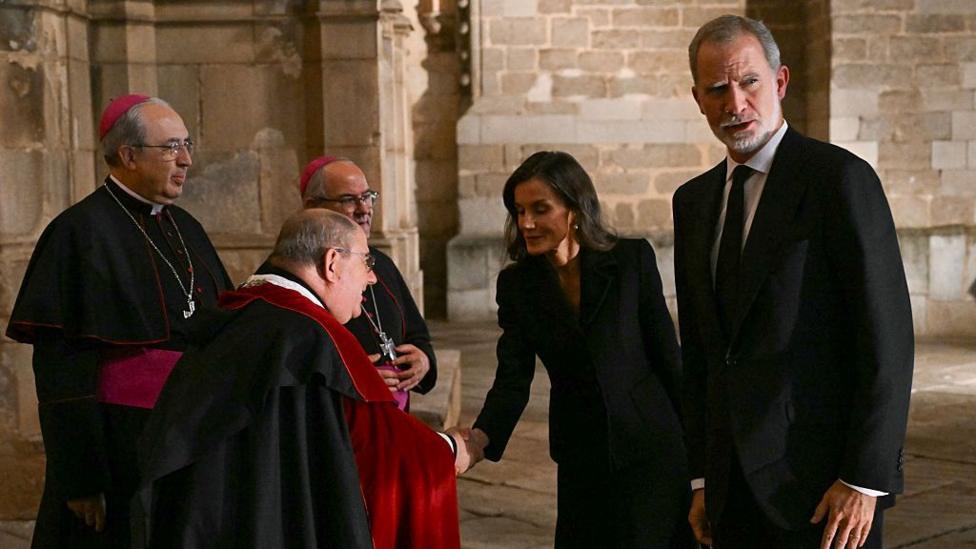
King Felipe VI and Queen Letizia of Spain joined hundreds of mourners at Toledo Cathedral for a solemn memorial service honoring the victims of a catastrophic high-speed rail collision. The disaster, which occurred two weeks ago near the town of Urda in the province of Toledo, claimed the lives of 69 people and left dozens of passengers injured.
The service took place inside the historic 13th-century cathedral and was presided over by the Archbishop of Toledo, Francisco Cerro Chaves. Surrounding the altar, 69 candles were lit in quiet tribute, with each flame representing one of the passengers who lost their lives in the collision.
In a deeply symbolic gesture of communal solidarity, a revered 16th-century sculpture of Christ, the Santísimo Cristo de la Vera-Cruz, was relocated from Urda to the cathedral specifically for the service. Residents from Urda, many of whom were among the first civilians to reach the scene to pull survivors from the wreckage, attended alongside the bereaved families.
Dressed in mourning attire, King Felipe and Queen Letizia sat alongside roughly 100 relatives of the victims during the religious mass. Following the conclusion of the ceremony, the monarchs spent time speaking privately with grieving families, offering personal condolences and embracing relatives coping with sudden loss.
While two weeks have elapsed since the tragedy, the human toll continues to strain regional medical facilities. Health authorities confirmed that 28 people remain hospitalized in specialized facilities, including Toledo University Hospital, where doctors continue treating severe physical trauma and monitoring critical cases.
The royal couple had previously traveled to Toledo University Hospital in the immediate aftermath of the disaster to comfort survivors and express gratitude to medical personnel and first responders. Their presence at the formal memorial service reaffirmed national support as the country endures one of its deadliest transportation accidents in modern history.
The fatal collision unfolded along the Madrid–Seville line when an oncoming passenger train struck a stationary train near Urda. The force of the impact inflicted severe structural damage across multiple carriages, necessitating a complex multi-agency rescue operation by emergency teams and civil defense units.
Senior national and regional officials attended the ceremony alongside local civic leaders and emergency coordinators to pay homage to the deceased. The tragedy has prompted widespread national reflection and intensified calls for comprehensive scrutiny of rail traffic safety protocols along major transit routes.
Judicial authorities and specialized rail accident investigators are actively reviewing operational logs and signaling systems to understand why the stationary train was struck. As communities throughout Spain mourn the 69 lives lost, medical personnel remain focused on the rehabilitation of the injured survivors still under clinical care.
Primary source: BBC World. Newzly rewrites and structures source reporting for clarity; verify critical details at the original.