Why Karnataka's ASHA Workers Are Demanding an End to Volunteer Status
Thousands of Accredited Social Health Activists in Karnataka are demanding an end to their official volunteer classification, calling for a fixed monthly honorarium and formal employment protections after years of sustaining doorstep healthcare.
In this piece
Accredited Social Health Activists across Karnataka are challenging their designation as honorary volunteers while shouldering critical rural healthcare duties.…
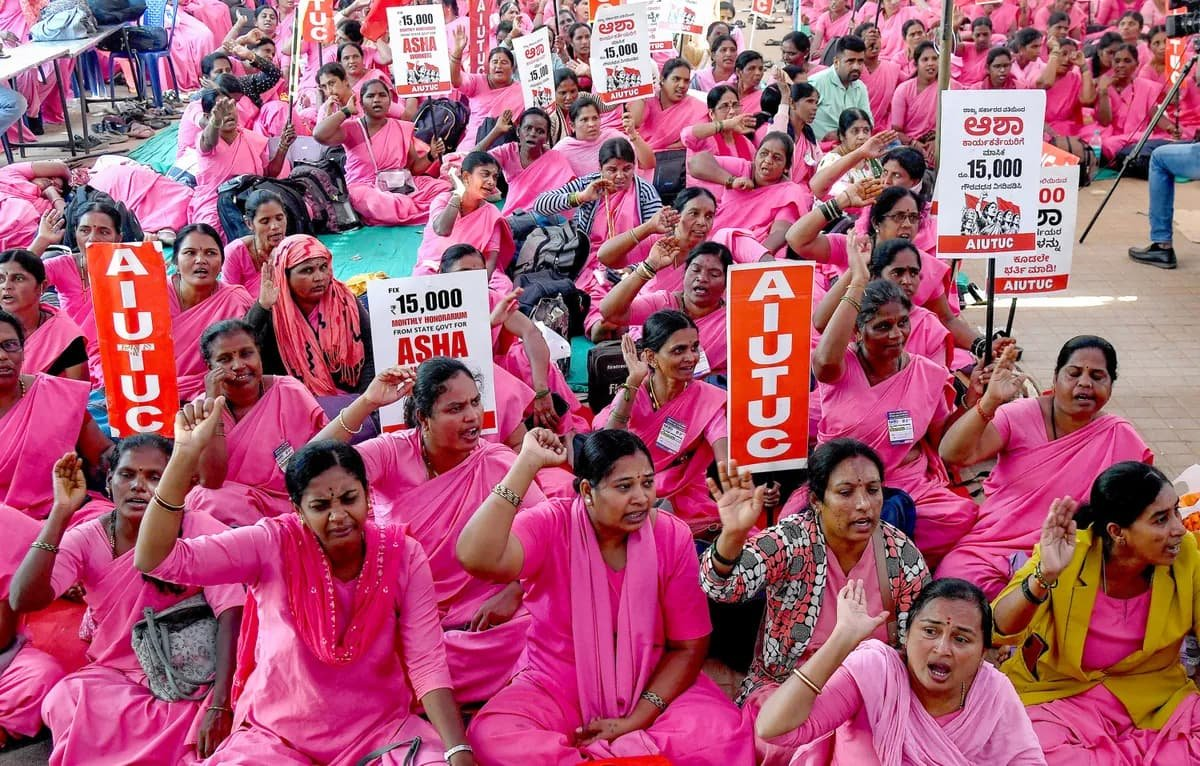
Accredited Social Health Activists, known as ASHAs, across Karnataka have intensified their calls for the state government to recognize them as formal healthcare workers rather than honorary volunteers. Staging demonstrations and indefinite protests in Bengaluru, thousands of female frontline workers are demanding a guaranteed monthly honorarium, the timely clearance of pending performance incentives, and comprehensive retirement benefits. The ongoing mobilization reflects years of mounting frustration over wages that union leaders describe as unlivable given their expanding responsibilities.
Under the current administrative framework, ASHA workers in Karnataka receive a base state honorarium of 5,000 rupees each month, augmented by variable central and state performance incentives. Demonstrators are urging the government to replace this piecemeal remuneration with an assured monthly payment of 15,000 rupees. They point out that existing earnings fall dramatically short of Karnataka's statutory minimum wages for skilled and semi-skilled labor, leaving many households struggling to cope with rising living costs.
Instituted under India's National Health Mission, the ASHA program was conceived to bridge the gap between rural communities and the formal healthcare system. While initially designed as a community volunteer role carrying modest stipends, the day-to-day duties of an ASHA worker have grown into an intensive, full-time commitment. In villages and semi-urban wards, these women serve as the primary point of contact for maternal and child health, routine immunizations, and communicable disease surveillance.
Over time, government departments have increasingly relied on the ASHA network to execute new health initiatives, administer field surveys, and monitor vulnerable populations. During public health emergencies, including the COVID-19 pandemic, these workers were deployed to conduct doorstep screenings, monitor quarantines, and deliver medications under high-risk conditions. Yet despite functioning as the operational spine of preventive public health delivery, their institutional status has remained unchanged for nearly two decades.
Labor advocates and public health specialists argue that maintaining the "honorary volunteer" label allows state authorities to bypass statutory labor protections. Because ASHAs are not classified as formal government employees or civil servants, they lack access to pensions, provident funds, maternity leave, and gratuity. This classification creates a persistent contradiction where workers execute mandatory administrative duties while being denied the basic legal safeguards granted to the organized workforce.
The financial strain on Karnataka's frontline health workforce is further highlighted by comparisons with neighboring states. Several other Indian states have progressively enhanced their state contributions to provide higher fixed remuneration packages, with honorariums in states such as Kerala and West Bengal notably exceeding Karnataka's current base payout. Union representatives emphasize that Karnataka, despite having one of India's largest state economies, has lagged in securing adequate safety nets for its female public health cadre.
The ongoing agitation is also driven by a deepening trust deficit between worker unions and government leadership. Previous strikes and protest campaigns were paused after administrative officials offered verbal assurances and promised fiscal reviews. However, union representatives report that promised wage revisions either faced bureaucratic delays or failed to materialize, leading demonstrators at Freedom Park to insist on written, executive orders before concluding their protests.
The impasse carries significant consequences for grassroots healthcare delivery across Karnataka's rural and semi-urban communities. With thousands of ASHAs stepping away from their beats to participate in rallies, routine outreach programs, maternal checkup tracking, and immunization schedules face administrative disruption. Health experts note that prolonged dissatisfaction among frontline workers risks weakening immunization coverage and community-level disease monitoring over time.
State officials have acknowledged the memorandums submitted by union leadership, though formal decisions regarding a budget expansion remain under discussion among finance and health departments. For the protesting workers, resolving the status of the last-mile health cadre is no longer merely a financial negotiation, but a question of basic dignity and worker rights. Until the state addresses the disparity between expectations and compensation, Karnataka's frontline caregivers signal they will maintain pressure on policymakers.
Primary source: Google News Karnataka. Newzly rewrites and structures source reporting for clarity; verify critical details at the original.