Hera Spacecraft Reveals Cratered Face of Asteroid Didymos After Historic NASA Collision
The European Space Agency's Hera probe has revealed a crater-covered side of asteroid Didymos as it prepares to examine the aftermath of NASA's historic 2022 asteroid collision.
In this piece
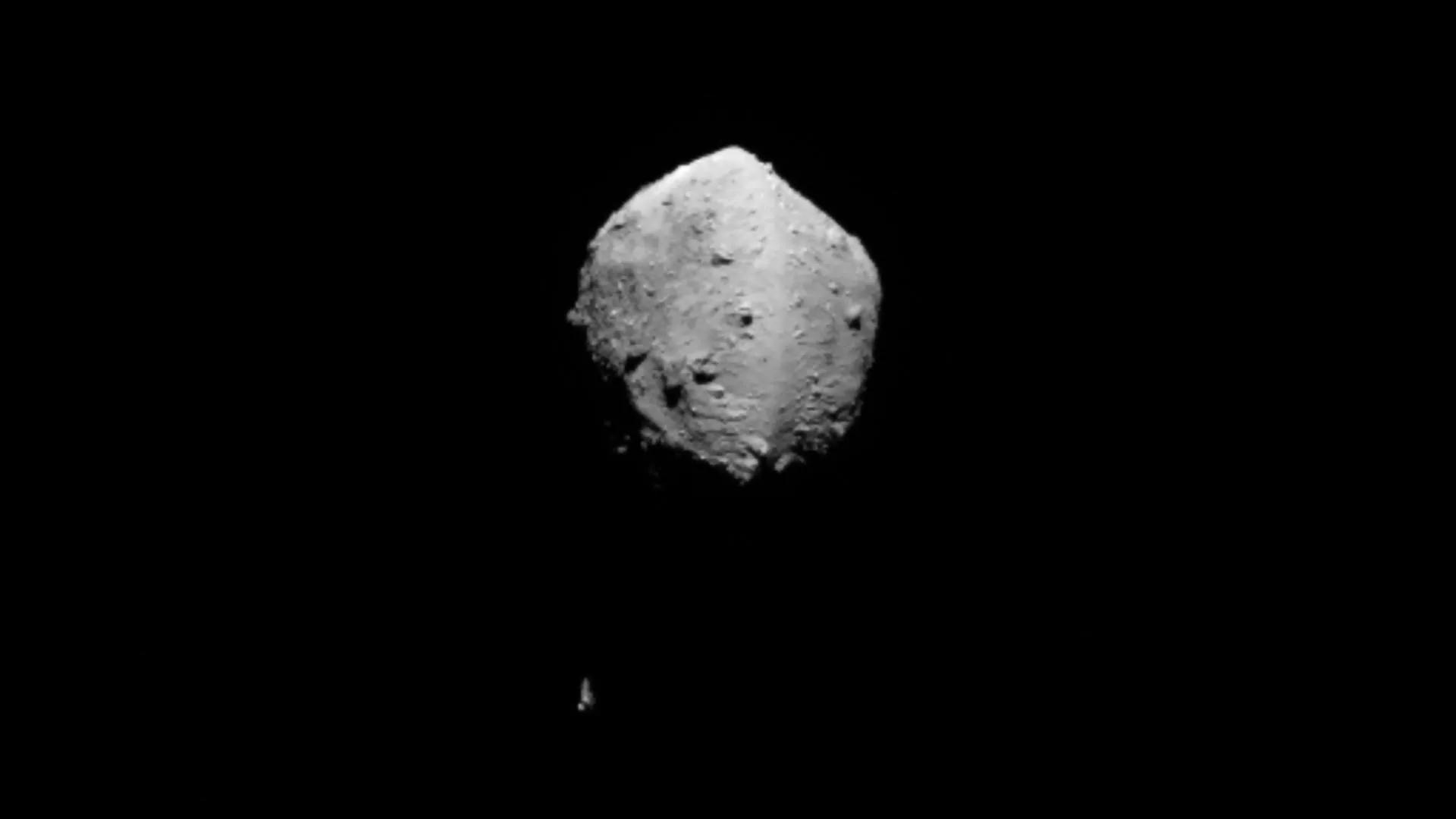
A European spacecraft has captured detailed images of the cratered surface of asteroid Didymos ahead of its investigation into NASA’s 2022 collision. The…
A European spacecraft has beamed back new observations of the asteroid Didymos, uncovering a rugged, crater-covered terrain as it approaches the binary asteroid system. The findings mark a critical milestone in international efforts to study the aftermath of NASA’s historic 2022 asteroid deflection test.
The European Space Agency’s Hera mission is preparing to conduct a comprehensive forensic survey of the system, which was fundamentally altered when a NASA probe intentionally struck the smaller companion asteroid, Dimorphos. Scientists anticipate that these preliminary views of Didymos will provide vital baseline measurements of the primary body’s topography, surface texture, and physical characteristics.
NASA’s Double Asteroid Redirection Test, or DART, demonstrated for the first time in late 2022 that a targeted kinetic impact could successfully alter an asteroid’s orbital period. While terrestrial observatories and space telescopes recorded a noticeable shift in the moonlet’s path around Didymos, ground instruments lacked the resolving power to examine the direct surface aftermath.
Hera was developed specifically to close those observational gaps by traveling directly to the collision site. Carrying sophisticated imaging payloads, laser altimeters, and two dedicated CubeSats, the probe is engineered to document the precise structural consequences of the high-speed collision from close range.
The newly revealed, heavily cratered appearance of Didymos presents a complex geological landscape that scientists describe as a strange and dynamic world. Understanding the composition, boulder distribution, and surface features of Didymos will help researchers establish how shockwaves and ejected material behaved throughout the binary system during the collision.
Planetary defense researchers consider this detailed follow-up indispensable for transforming kinetic deflection into an operational planetary safeguarding tool. By measuring the exact mass, internal density, and structural porosity of the asteroid pair, scientists can validate mathematical simulations that currently govern deflection calculations.
In the event that a hazardous asteroid ever threatens Earth, mission planners will require precise predictive models to know how much kinetic momentum must be transferred to redirect it safely. Hera’s close-up data will clarify whether the 2022 kinetic strike created a discrete crater or caused a broader reshaping of the asteroid’s aggregate structure.
The mission also underscores growing multilateral collaboration between major space agencies tackling shared celestial challenges. By pairing an American kinetic impactor with a European reconnaissance spacecraft, the tandem effort establishes a pioneering framework for future planetary protection initiatives.
As Hera steadily draws nearer to the Didymos system, flight controllers will maneuver the spacecraft into lower orbits to begin high-resolution mapping campaigns. Scientists expect the upcoming observational phases to answer lingering questions about asteroid geophysics, impact physics, and the long-term stability of rubble-pile asteroids in deep space.
The ultimate goal of the investigation extends far beyond planetary science, directly informing planetary defense blueprints for future generations. Data gathered during Hera’s operational lifespan will help determine how effectively Earth can protect itself should a dangerous space rock ever be discovered on an impact trajectory.
Primary source: ScienceDaily. Newzly rewrites and structures source reporting for clarity; verify critical details at the original.