NASA Collage Highlights 49 Drill Holes Made by Curiosity on Mars
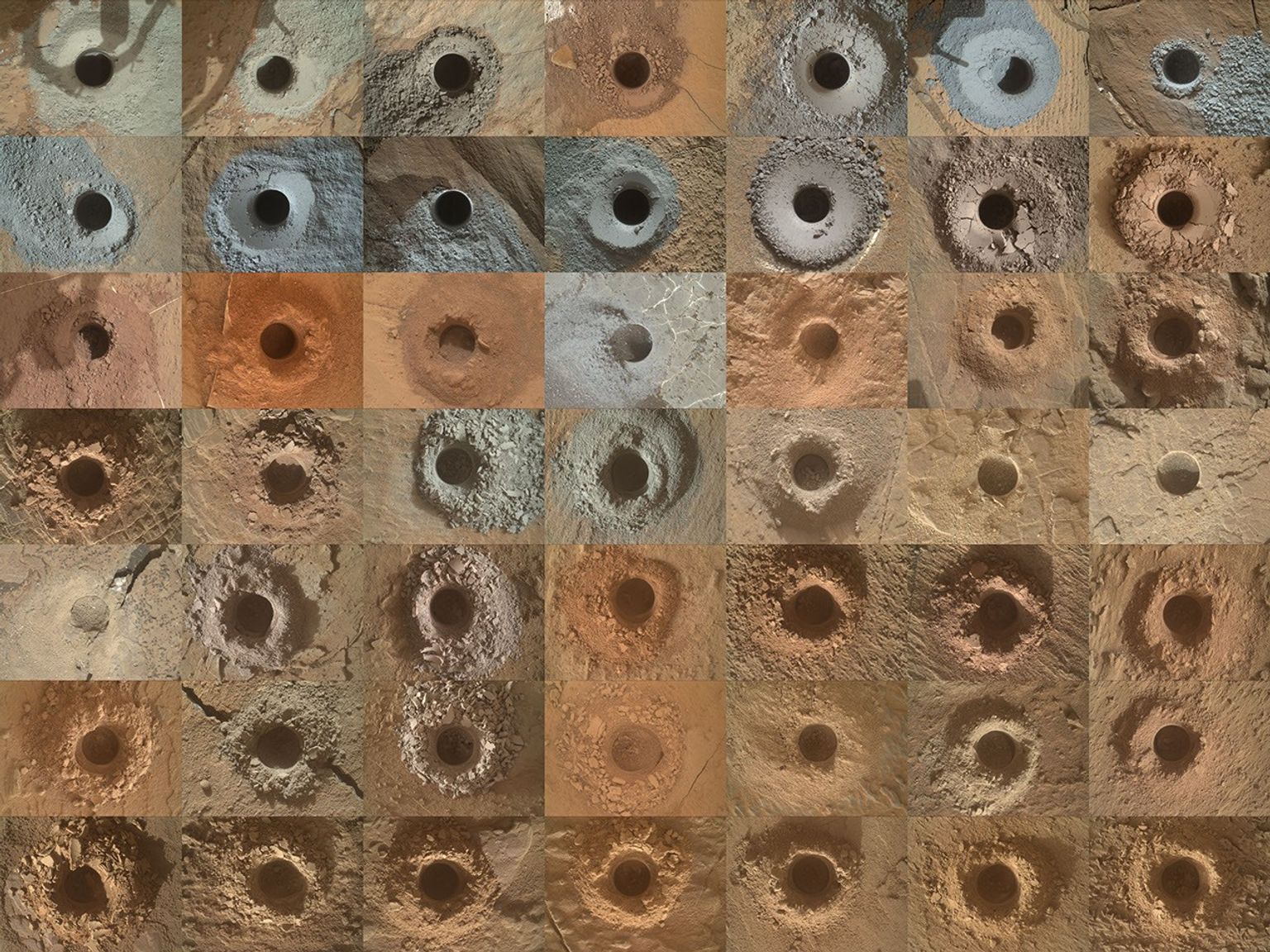
A newly released NASA collage brings together 49 drill holes carved by the Curiosity rover on Mars, showcasing more than a decade of rock sampling that has illuminated the Red Planet's ancient, watery past.
In this piece
NASA has unveiled a visual record showing 49 drill holes bored into the Martian surface by the Curiosity rover as of November 2026. Each borehole represents a…
NASA has released an expansive composite collage displaying 49 distinct drill holes created by the Curiosity rover across the Martian landscape as of November 2026. The visual retrospective documents the mechanical milestones of a mission that has systematically sampled Martian bedrock for well over a decade. Captured primarily by the rover's robotic arm camera, each borehole serves as an individual portal into the planet's geological evolution.
The process behind each hole involves Curiosity's percussive drill, mounted at the turret of its two-meter robotic arm. The drill penetrates roughly two to three inches into solid rock, grinding the target into a fine, unweathered powder. That pulverized material is then transferred through a sieve mechanism directly into the rover's internal analytical laboratories located inside its chassis.
Once inside the rover's belly, the rock powder is delivered into instruments known as Chemistry and Mineralogy, or CheMin, and Sample Analysis at Mars, or SAM. CheMin uses X-ray diffraction to identify the specific crystalline minerals present within the powdered rock. Meanwhile, SAM uses a miniature chemical laboratory, including ovens and a mass spectrometer, to search for organic compounds, gases, and isotopic signatures essential to understanding habitability.
Curiosity touched down inside Gale Crater in August 2012, targeting an impact basin that scientists suspected had once hosted standing water. At the center of the crater rises Mount Sharp, a massive mountain of layered sedimentary deposits standing about five kilometers tall. By drilling into progressively younger rock layers as it ascends, the rover is reading the environmental history of Mars much like pages in an ancient book.
The 49 holes highlighted in the collage reveal a striking palette of Martian geology, ranging from pale gray powders to deep ochre dust. While the surface of Mars is notoriously rusted and reddish-brown due to atmospheric oxidation, drilling allows scientists to inspect pristine rock shielded from cosmic radiation. The varied shades and textures reflect diverse depositional environments, including ancient riverbeds, lake sediments, and dry windblown sandstones.
Samples taken from these drill sites have fundamentally reshaped modern planetary science. Early drilling campaigns confirmed that Gale Crater once held persistent freshwater lakes containing essential chemical ingredients for microbial life, such as carbon, hydrogen, oxygen, nitrogen, phosphorus, and sulfur. Subsequent samples collected higher up the mountain documented a profound planetary shift, transitioning from water-rich mudstones to drier, sulfate-laden layers.
Reaching 49 drill holes represents a significant feat of engineering longevity for a machine originally built for a two-year primary mission. Over the years, engineers at NASA's Jet Propulsion Laboratory had to reinvent the drilling method when a mechanical brake on the drill feed mechanism jammed in late 2016. Ground teams successfully developed an alternative technique dubbed feed-extended drilling, allowing the rover to continue gathering core science years after the hardware anomaly.
The visual collection offers more than an aesthetic survey of Martian soil; it serves as a tangible index of robotic exploration. Planetary researchers rely on this catalog of drilled samples to construct a timeline of how a warm, wet world gradually transformed into the hyper-arid, frozen desert observed today. These findings also provide crucial comparative baselines for other missions, including the Perseverance rover exploring Jezero Crater.
Curiosity remains fully operational and continues its deliberate ascent up the foothills of Mount Sharp. Science teams are currently identifying future drilling targets within layered sulfate units that could reveal how ancient water finally vanished from the region. As Curiosity presses forward, additional drill holes will continue to expand NASA's subterranean inventory of the Red Planet.
Primary source: NASA Breaking News. Newzly rewrites and structures source reporting for clarity; verify critical details at the original.