NASA Completes 500-Second RS-25 Rocket Engine Test at Stennis
Engineers at Stennis Space Center fired developmental RS-25 engine No. 10001 for 500 seconds at 111% power, validating critical thermal upgrades for future Artemis lunar missions.
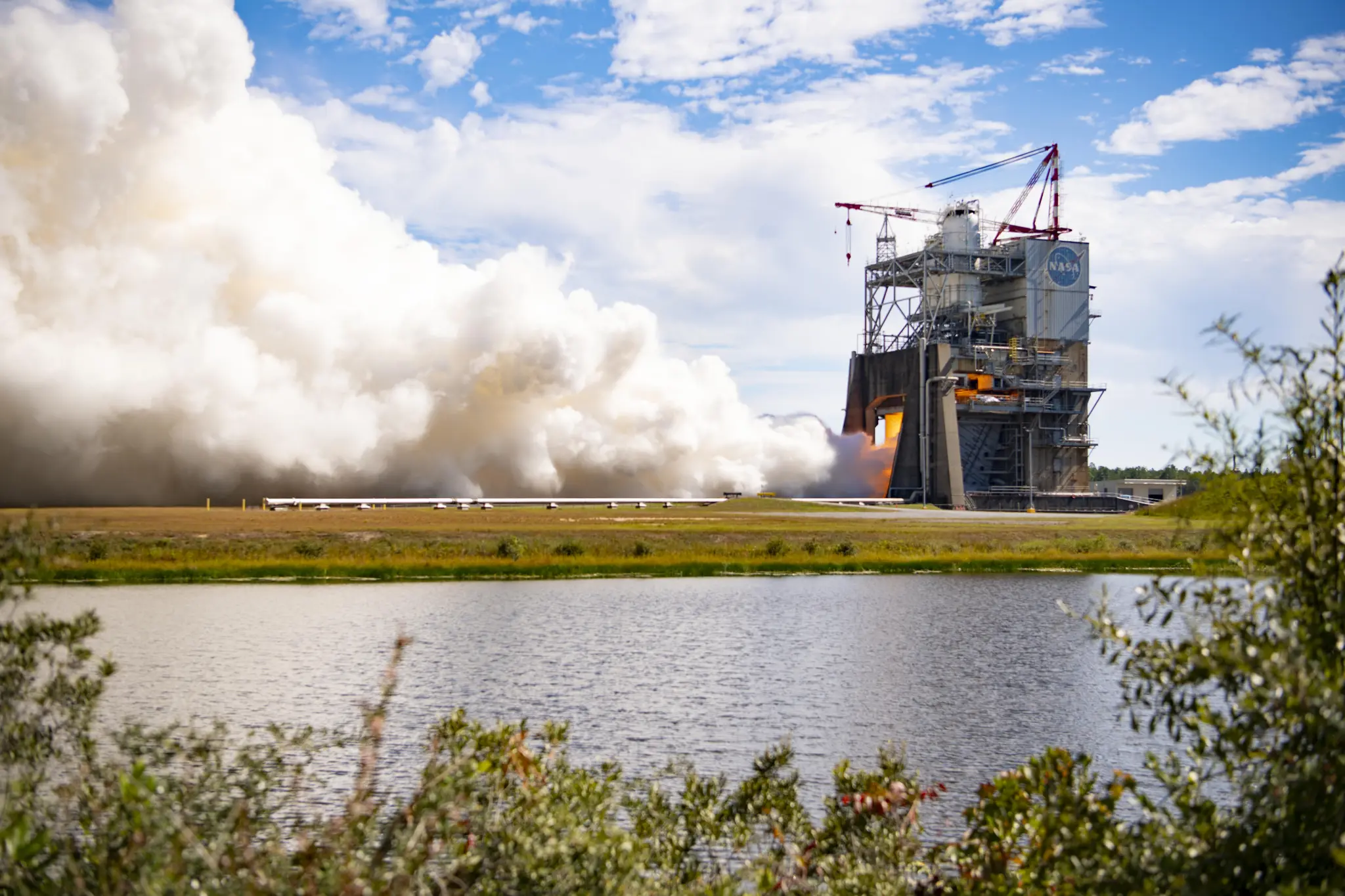
Teams at NASA’s Stennis Space Center near Bay St. Louis, Mississippi, successfully completed a full-duration hot fire test of developmental RS-25 engine No. 10001 on Oct. 21, 2026. The static firing ran for nearly eight-and-a-half minutes on the Fred Haise Test Stand, delivering essential performance data for the agency's Artemis lunar exploration campaign.
During the run, operators throttled the engine up to a 111% power level, matching the elevated thrust profile required during an operational launch of NASA’s Space Launch System rocket. The 500-second duration corresponds precisely to the time that four RS-25 engines must burn continuously during liftoff to help loft the vehicle into low Earth orbit.
Engineers utilized the firing to validate several newly fabricated components, including an upgraded thermal protection system engineered to shield the engine nozzle from extreme launch conditions. By gathering detailed temperature and pressure metrics, the engineering team can confirm whether the updated insulation materials adequately resist intense convective and radiative heating.
Engine No. 10001 serves as a dedicated developmental testbed rather than a flight unit, enabling researchers to stress experimental configurations safely. This allows NASA and prime contractor Aerojet Rocketdyne to assess redesigned parts, modern manufacturing techniques, and updated supply chain elements without putting flight-bound hardware at risk.
The RS-25 engine family carries a storied legacy, having powered 135 missions throughout NASA’s Space Shuttle Program. For the Space Launch System, the propulsion system was adapted to withstand harsher aerodynamic and thermal conditions, higher operating pressures, and a longer sustained burn sequence alongside twin solid rocket boosters.
To support ongoing Artemis flights beyond the initial shuttle-era inventory, NASA has contracted for newly manufactured RS-25 units that incorporate cost-saving fabrication methods. Engineers have integrated modern digital engine controllers, streamlined fluid lines, and additive manufacturing techniques like 3D printing to lower production expenses and build times.
Operating at 111% rated power represents a critical operating threshold for the evolved lunar rocket design. While shuttle flights typically flew engines throttled up to 104.5% or 109% of original rated thrust, the SLS architecture demands the higher 111% setting to push the massive core stage and its Orion spacecraft payload toward the Moon.
Located along the Mississippi Gulf Coast, Stennis Space Center has served for decades as the cornerstone of American rocket engine qualification, from the Saturn V Apollo era to the present day. The successful 500-second trial reaffirms the operational readiness of the Fred Haise Test Stand and its high-pressure fluid delivery infrastructure.
Technicians and propulsion specialists will spend the coming weeks reviewing sensor telemetry, acoustic profiles, and post-fire inspections from the Oct. 21 run. NASA plans to apply the resulting findings toward certifying the next production batch of RS-25 engines that will power future crewed missions deeper into the solar system.
Primary source: NASA Breaking News. Newzly rewrites and structures source reporting for clarity; verify critical details at the original.