NASA Completes Full-Duration RS-25 Engine Test at Stennis Space Center
Engineers at NASA’s Stennis Space Center fired RS-25 engine No. 10001 for 500 seconds at 111 percent power, qualifying hardware for Artemis Moon missions.
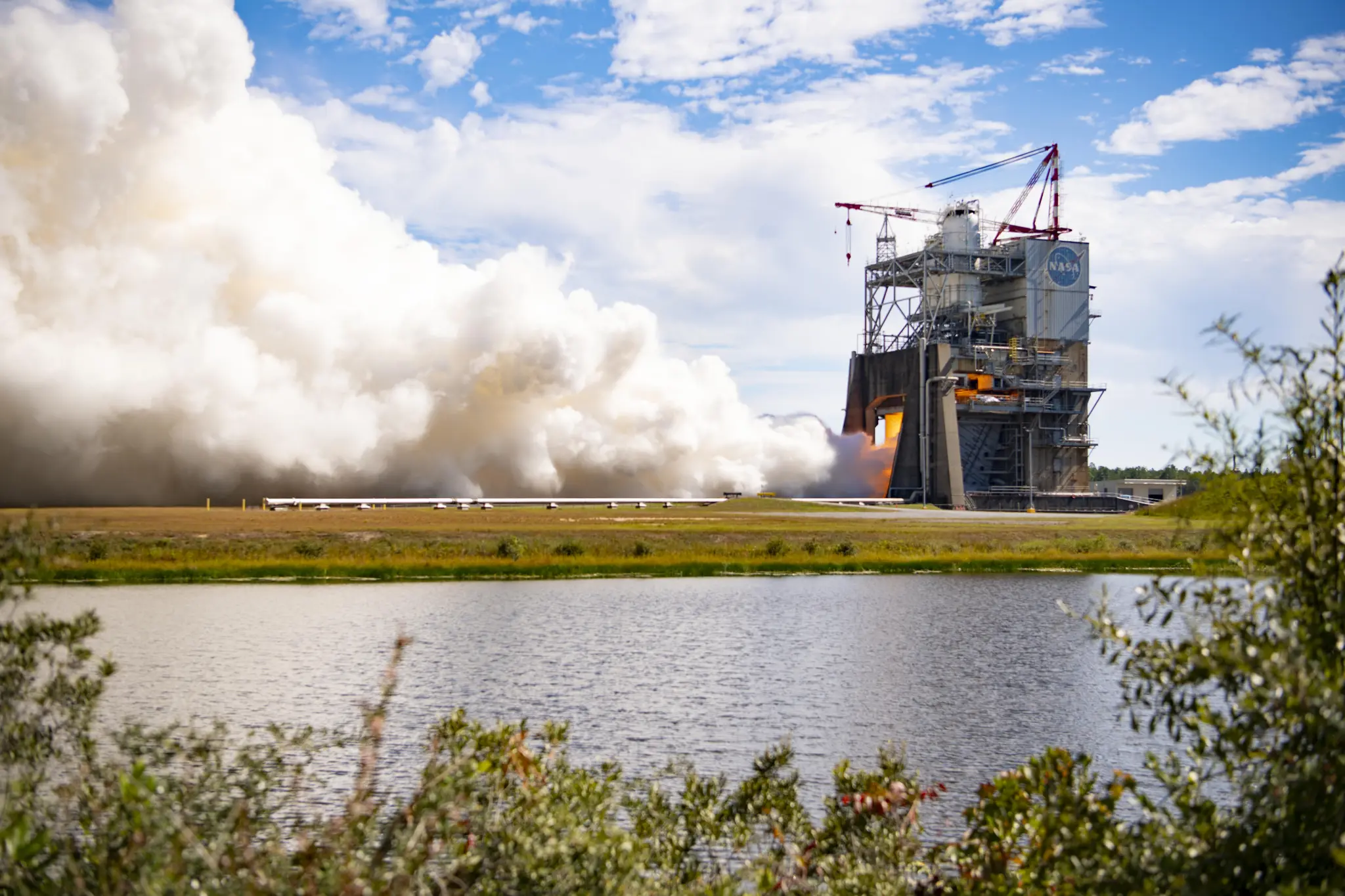
Teams at NASA’s Stennis Space Center near Bay St. Louis, Mississippi, successfully carried out a major hot fire test of developmental RS-25 engine No. 10001 on Oct. 21. The ground test represents an important step forward in certifying upgraded propulsion hardware for the Space Launch System rocket. Operators monitored the ignition from the site's control center as the engine roared to life over the test stand.
The static fire lasted for 500 seconds, or nearly eight and a half minutes, directly mirroring the operational burn duration required during an actual launch. Throughout the run, engineers throttled the engine up to 111 percent of its baseline power level. Operating at this elevated thrust setting provides necessary margins to ensure the machinery can handle rigorous ascent profiles.
Conducted on the historic Fred Haise Test Stand, the trial utilized engine No. 10001 as a dedicated platform to examine newly produced hardware components. The testing series allows NASA to evaluate modernized manufacturing techniques alongside advanced material assemblies before parts are integrated into operational flight vehicles. These procedures help ensure that updated components meet stringent human-rating safety standards.
A focal point of the run was verifying the performance of a redesigned thermal protection system fitted around the engine nozzle. The protective material is engineered to shield sensitive structural hardware from the extreme aerodynamic and convective heating generated during flight. Validating how the coating behaves under sustained full-temperature firing is vital for certifying the nozzle assembly.
The RS-25 propulsion system forms the core liquid propulsion element of NASA's heavy-lift Space Launch System vehicle. Four of these engines are installed at the base of the towering core stage, firing in unison alongside two side-mounted solid rocket boosters. Working together, the system provides more than eight million pounds of total thrust during liftoff.
The RS-25 brings decades of operational pedigree to the SLS architecture, having originally powered the Space Shuttle fleet across more than one hundred orbital missions. NASA and its commercial partners have redesigned key elements of the engine, introducing modern digital controllers and streamlined components to reduce production costs. These updates maintain the engine's proven reliability while supporting the heightened performance demands of deep-space exploration.
The ongoing test schedule at Stennis forms a crucial backbone for the broader Artemis exploration campaign, which seeks to land astronauts on the lunar surface. High-thrust, long-duration ground trials confirm that new fabrication lines can consistently produce hardware capable of sending the Orion spacecraft toward deep space. Every successful burn reduces operational risk for upcoming crewed flights.
Pushing the engine to 111 percent thrust yields critical operational insight into structural and mechanical margins under stress. During the 500-second test, hundreds of specialized instrumentation channels gathered continuous data regarding chamber pressure, temperature shifts, and fluid dynamics. Propulsion specialists will compare these real-world measurements against predictive computational models to verify that structural behavior aligns with safety expectations.
With the hot fire completed, technical teams will spend the coming weeks analyzing acoustic, structural, and propellant flow data recorded during the run. The findings will inform ongoing certification work for future production engines as manufacturing continues for upcoming Artemis flights. Stennis is expected to conduct subsequent tests as NASA prepares the propulsion hardware needed for deep-space exploration missions later this decade.
Primary source: NASA Breaking News. Newzly rewrites and structures source reporting for clarity; verify critical details at the original.