Pair of Massive Stars May Secretly Feed Milky Way's Central Black Hole
Astronomers have traced mysterious gas clumps near the Milky Way's central supermassive black hole to colliding stellar winds, revealing how a pair of massive stars may be funneling material inward.
In this piece
Astronomers have traced mysterious gas clouds near the Milky Way's central black hole to a massive pair of stars whose colliding winds create dense clumps of…
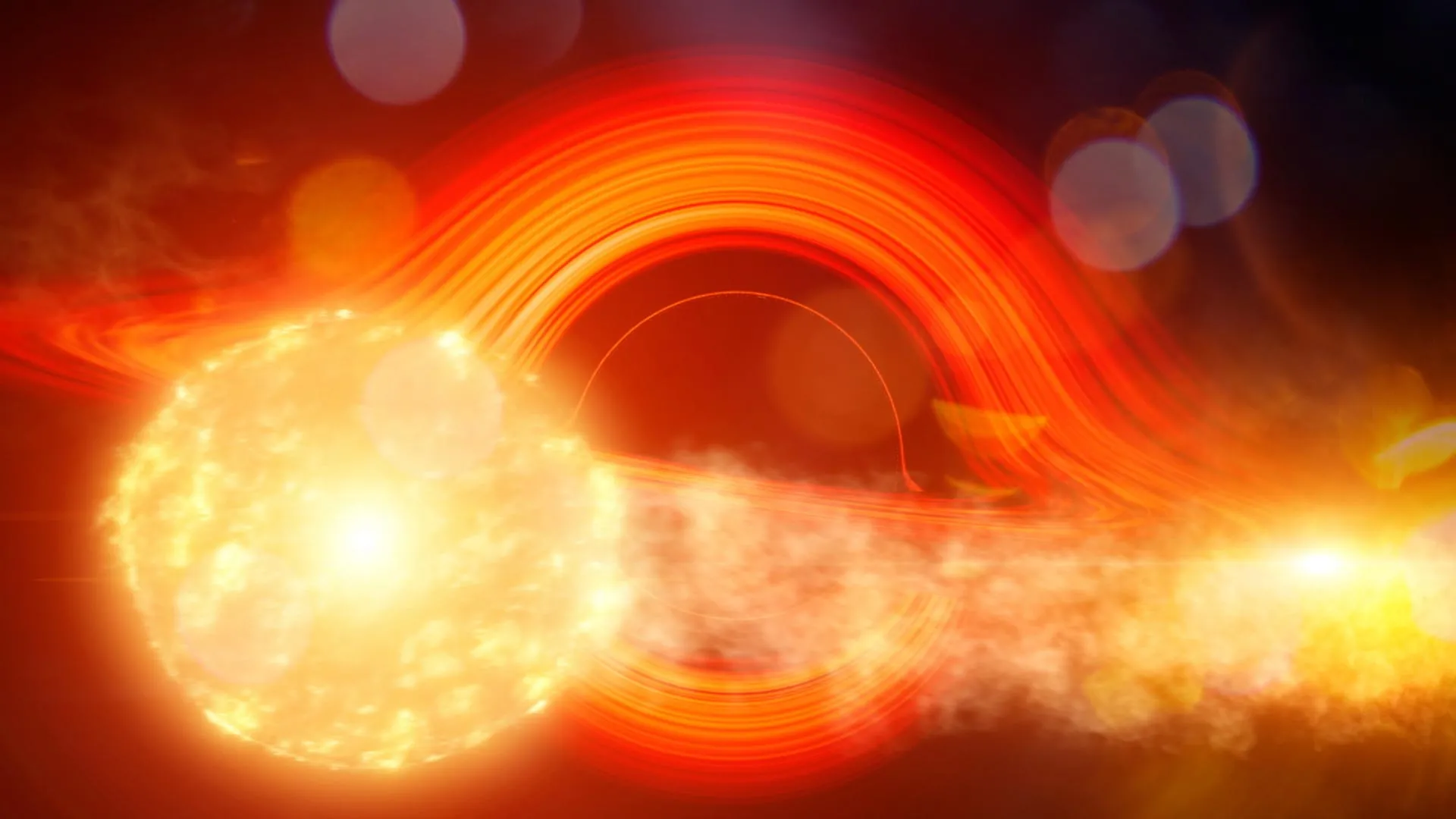
Astronomers studying the galactic center have identified a massive stellar binary whose colliding winds appear to be actively generating dense clumps of gas near the Milky Way's supermassive black hole. The discovery suggests that these concentrated clouds may eventually drift inward to feed the cosmic giant, establishing an unexpected direct bridge between local stellar activity and central black hole accretion. The finding provides fresh insight into how the galaxy's dormant central core acquires matter over cosmic time.
According to research on the galactic core, the phenomenon originates from two massive stars locked in close orbit within the central environment. As intense stellar winds expelled by both stars collide at extreme speeds, the violent hydrodynamic shock compresses the ambient gas into compact, coherent clumps rather than letting it disperse smoothly across the surrounding interstellar medium. These dense packets of matter remain structurally intact as they move through the challenging environment.
For years, astrophysicists observing the heart of the galaxy have tracked mysterious, fast-moving gas formations navigating the extreme gravitational landscape near the central black hole. The origin of these peculiar structures had remained a long-standing puzzle, prompting competing hypotheses ranging from evaporated protoplanetary disks to the shredded remnants of destabilized stellar atmospheres. Identifying a definitive source has been a central goal for understanding local galactic physics.
The new observations provide a coherent physical explanation by tracing the characteristics of the gas formations directly to the collision zone between the two massive stars. By analyzing the trajectory, velocity, and density of the clumps, researchers were able to link their creation to the recurring shock waves produced by the stellar pairing. This mechanism demonstrates that stellar wind interactions can continuously replenish cold, dense gas reservoirs deep within the galactic core.
The Milky Way's central black hole, Sagittarius A*, has long been recognized as unusually quiet compared to the violent active galactic nuclei observed across the distant universe. Rather than gorging on a massive, permanent accretion disk, the Milky Way's central giant appears to subsist on an irregular diet of small, episodic gas streams. Detecting clump formation near the core helps explain how such sporadic accretion events can be sustained without a large, continuous reservoir of falling gas.
Understanding how material migrates toward the supermassive black hole is essential for mapping the broader lifecycle and energetic behavior of the galaxy. When dense gas clumps plunge toward the event horizon, gravitational compression and friction heat the matter to extreme temperatures, often producing telltale electromagnetic flares across X-ray and infrared bands. Clarifying the origin of these feeding events helps astronomers interpret the occasional flares detected from the galactic center.
The discovery also underscores an intricate evolutionary connection between massive stellar populations and supermassive black holes. Massive stars are known to lead brief, violent lives characterized by relentless mass loss through powerful stellar winds before ending in supernova explosions. The finding shows that before their final demise, such stars can play a direct role in funneling material into the central gravitational well, shaping the growth of cosmic giants.
Astronomers emphasize that continued high-resolution observation of the galactic center will be critical to verify how these newly formed clumps interact with the black hole's tidal field over the coming years. Future monitoring campaigns across radio, infrared, and space-based X-ray telescopes are expected to track the path of the gas and observe whether it falls inward or is torn apart. The research opens a promising path for modeling stellar wind collisions in dense galactic nuclei across the universe.
Primary source: ScienceDaily. Newzly rewrites and structures source reporting for clarity; verify critical details at the original.