Trump Floats Ban on U.S. Companies Building AI Data Centres Abroad
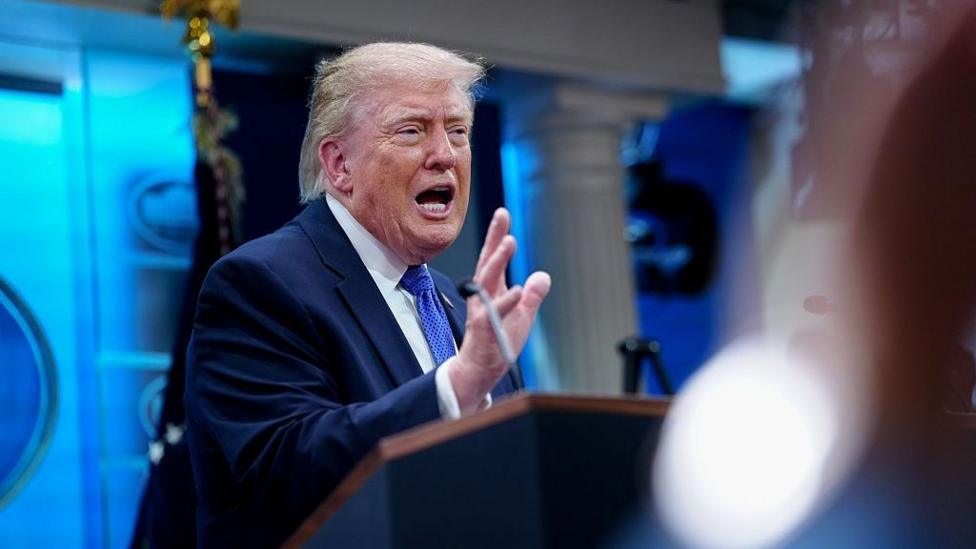
President Donald Trump has suggested banning U.S. companies from building artificial intelligence data centres overseas, offering few operational details while acknowledging his own team was hearing the proposal for the first time.
In this piece
President Donald Trump has floated a potential ban on American firms constructing artificial intelligence data centres abroad. With few specifics provided, the…
U.S. President Donald Trump has raised the prospect of barring American companies from constructing artificial intelligence data centres overseas, signaling a potential shift in federal tech policy. The remarks, reported by BBC News, outline an unexpected stance intended to keep high-value digital infrastructure on domestic soil. The announcement marks an aggressive turn in discussions surrounding national technological sovereignty.
The president offered very little detail regarding how such an overseas ban would be structured, legally anchored, or enforced across the private sector. Furthermore, Trump noted during his remarks that members of his own administrative team were hearing about the concept for the first time. The admission suggests the initiative has not yet undergone formal interagency development or policy review.
Artificial intelligence infrastructure has quickly emerged as an essential foundation for economic competitiveness and national defense. Modern AI architectures depend on vast computational power, requiring developers to construct massive facilities equipped with specialized processors, extensive cooling equipment, and dedicated power connections. As a result, capital expenditure on data centre construction has expanded at an unprecedented rate worldwide.
To meet soaring international demand and maintain low-latency connections for foreign clients, American technology developers have routinely pursued facility construction across Europe, Asia, and other regions. These foreign sites also allow companies to comply with local data sovereignty laws and tap into regional power resources. An outright prohibition on foreign projects would significantly disrupt established global operational models.
Advocates for keeping data infrastructure within the United States contend that domestic facilities protect proprietary innovations and generate high-paying domestic tech jobs. However, concentrating all future capacity within American borders could intensify pressure on domestic electrical utilities, water supplies, and regional transmission networks. Many municipal utilities already face growing challenges meeting the steep electrical demands of new computing clusters.
The unexpected nature of the statement has prompted uncertainty across the commercial technology sector and financial markets. Industry analysts emphasize that pronouncements made without prior departmental coordination often face significant operational and legal revisions before taking effect. Corporate leaders must now determine whether the remarks reflect an imminent executive initiative or an opening position in a broader policy debate.
Restricting American corporations from investing capital in foreign facilities would also present intricate legal and regulatory dilemmas. Federal authorities would need to define what qualifies as an AI data centre, address foreign joint ventures, and navigate existing international trade pacts. Regulating multinational corporate subsidiaries that operate under local foreign jurisdictions could spark friction with key allied trading partners.
The issue aligns with broader concerns in Washington over the export and deployment of critical emerging technologies. Federal lawmakers and security officials have frequently scrutinized foreign access to advanced computing infrastructure to prevent state adversaries from utilizing American innovations. Even so, trade groups generally favor cooperative international frameworks over mandatory domestic investment mandates.
Looking ahead, technology executives and market participants will be watching for official clarification from the White House and federal regulatory agencies. Observers note that turning the president's remarks into enforceable policy would require either a detailed executive order or direct authorization from Congress. Until formal documentation is presented, the tech industry remains in a holding pattern regarding its long-term global infrastructure planning.
Primary source: BBC US & Canada. Newzly rewrites and structures source reporting for clarity; verify critical details at the original.